Showing posts with label health care. Show all posts

Wednesday, May 05, 2010

McCotter's Slanted Newsletter On Health Care Costs

From Thad McCotter's latest newsletter comes this ominous news:
On April 22, 2010, The Centers for Medicare and Medicaid Services (CMS) released a new analysis of President Obama’s government health care plan, confirming our nation’s health care costs will increase rather than decrease and violating a pledge the President made to the nation on September 10, 2009.
McCotter then went on to list many of CMS's negative conclusions without noting the positives, and he also neglected to provide analysis explaining the difference between the CBO's earlier estimate and this one. Fortunately, Ezra Klein provided the facts:
The Congressional Budget Office's estimates look at the deficit. CMS is looking at total national health expenditures. This often confuses people into thinking that there's conflict between the two sets of numbers when there isn't: CBO says that federal spending is going to go up to pay for the coverage expansion, but that savings and revenue will go up by even more, leading to a net reduction in the federal deficit.

CMS is looking only at the spending side. And here's what it finds: In 2019, implementation of the Affordable Care Act will reduce the ranks of the uninsured by 34 million people and increase nation health expenditures by 1 percent.

One percent.

And that 1 percent is actually 1 percent and falling: When the legislation is fully implemented in 2016, the spending increase will be 2 percent. But cost controls kick in over those years and bring it down to 1 percent. Assuming the trend holds, the second decade will see national health expenditures fall below what spending would've been if the bill hadn't passed.
Or, to put it in dollars and cents (emphasis added):
Third Way, the centrist policy outfit, sent over its own analysis of the data. "The fact is that by 2019, national health spending per insured person will be $15,132 compared to $16,812 without the new law," they write. "That’s 10 percent less spending per insured person than it would have been, according to the actuary’s report."
That study suddenly doesn't look so bad. We'll be insuring 34 million people and spending less money than we would have been if nothing had been done. That sounds like a good deal to me.


(Cross-posted at Blogging for Michigan.)

Friday, April 23, 2010

A Recipe for Scrambled Eggs - Republican Style

When I read Eclectablog's post about ousted Congressman Walberg's town hall meetings focused on repealing the recently passed health care bill, I couldn't help but wonder if Walberg liked Sue Lowden's "chickens for checkups" idea too. After all, Walberg thinks it's perfectly acceptable for the uninsured to get their health care by walking into an emergency room. Yep, that's a cost effective way to provide health care to people - not. Even Mitch McConnell admits it's a bad idea:
It's not the most efficient way to provide it. As we know, the doctors in the hospitals are sworn to provide health care. We all agree it is not the most efficient way to provide health care to find somebody only in the emergency room and then pass those costs on to those who are paying for insurance.
Okay, so we all know Walberg's idea is lame, but what about this "chicken for checkups" idea? Could it work? Personally, I live in a condo and I doubt the association board would approve a chicken coop outside my door, but even assuming they agreed, would my doctor take a chicken in lieu of cash? Are there even enough chickens in the world to cover health care expenses? According to TPM, absolutely not. "There aren't enough chickens in the world -- let alone the United States -- to cover the costs of health care in this country alone."

They crunched the numbers so we wouldn't have to:
Total U.S. health care costs in 2008: $2.3 trillion
US population: About 300 million
Average cost of health care per person: $7,681
Average weight of a chicken: 5.9 lbs
Market price per pound: 85 cents
Average spot price per chicken: $5.02
Average number of chickens per resident needed to cover health care costs: 1,530 chickens
Total number of chickens needed to cover United States health care costs: 459 billion chickens
Estimated worldwide chicken population: 16 billion chickens
Current worldwide chicken shortage to cover U.S. health care: 443 billion cluckers
Cluck, cluck. It looks like Lowden and Walberg are both peddling a bunch of chicken poop when it comes to health care reform.

Wednesday, December 30, 2009

Hoekstra Is A Danger To Your Health And Well-Being

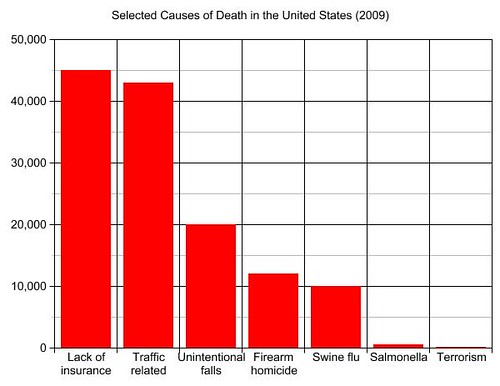
While Hoekstra runs around trying to profit from the attempted bombing over Detroit and score points with teabagger Republicans, it's important to put this incident into perspective. Via Blue Texan at FDL (see his chart below):

Terrorism Still Less Deadly in US Than Lack of Health Insurance, Salmonella
If you count the Ft. Hoot shooting as a terrorist attack, which even the likes of Pantload doesn’t, 16 people have died in the United States as a result of terrorism in 2009. The other three deaths include the Little Rock military recruiting office shooting (1), the Holocaust Museum shooting (1), and Dr. George Tiller’s assassination (1), the last two coming at the hands of right-wing extremists.

On the other hand, 45,000 Americans died because they didn’t have health insurance and 600 died from salmonella poisoning.
Clearly, lack of health insurance is more of a threat to Americans than a terrorist attack, yet Hoekstra voted NO on health care. He's clearly in no position to be shooting off his mouth and calling on the president to "lead in the fight to keep Americans safe" after that vote.

From FireDogLake, causing of death in US

Wednesday, December 23, 2009

Senate Health Bill Provides Enormous Help To Poor

Everyone seems to be trashing the Senate's health reform bill. That's fine, dissent is good, but I don't think we should let it blind us to the positives, such as the enormous good the bill will do for the poor and middle class. (Via Jonathan Cohn at TNR.)
This bill would mean Medicaid coverage for an additional 15 million people a year, all of them living below or just above the poverty line. For a sense of scale, that's more than double the entire population now covered by the state Children's Health Insurance Program.

This bill would also subsidize coverage in the exchanges for (roughly) another 15 million people a year, the majority of whom would also qualify as low-income by any reasonable standard.
"Do the math," he says, and we'll see that this bill is "arguably, the single most progressive initiative in a generation."

And if you don't believe Cohn, he asks you to consider what his colleague Harold Pollack at the Huffington Post had to say [emphasis mine]:
Fully implemented, the bill would provide about $200 billion per year down the income scale in subsidies to poor, near-poor, and working Americans.

$200 billion is a big number. It exceeds the combined total of federal spending on Food Stamps and all nutrition assistance programs, the Earned Income Tax Credit, Head Start, TANF cash payments to single mothers and their children, the Department of Housing and Urban Development, and the National Institutes of Health.
That money won't be allocated to wars or tax cuts for the rich, it's going to help the poor and middle class.

Trash the bill if you want, but don't let yourself lose sight of the good it will do.


(Cross-posted at Blogging for MI.)

Wednesday, December 16, 2009

Don't Give Up On Health Care Now

I am extremely disillusioned with the shape the healthcare bill has taken, but I'm not willing to say it shouldn't pass and/or we should start over. I'll let Kevin Drum speak for me. He makes a compelling argument for seeing this bill through.
With the public option now out of the healthcare bill, is it still worth passing? Regular readers will be unsurprised that I think the answer is pretty firmly yes—and that liberals who now want to pick up their toys and hand reform its sixth defeat in the past century need to wake up and smell the decaf. Politics sucks. It always has. But the bill in front of us—messy, incomplete, and replete with bribes to every interest group imaginable—is still well worth passing.
Six defeats. Think about that. More from Kevin:
When big legislative efforts go down in flames, they almost never spring back onto the calendar anytime soon — and that's especially true when big healthcare bills fail. It didn't happen in 1936, it didn't happen in 1949, it didn't happen in 1974, and it didn't happen in 1995. What makes anyone think it will happen in 2010?
Drum also makes the point that if healthcare reform dies this year, it dies for a good long time, and Republicans know it. And even though it's not the bill we wanted, it's a good start. Via Ezra Klein:
"This is a good bill," Sen. Sherrod Brown said on Countdown last night. "Not a great bill, but a good bill." That's about right. But the other piece to remember is that more than it's a good bill, it's a good start. With $900 billion in subsidies already in place, it's easier to add another hundred billion later, if we need it, than it would be to pass $1 trillion in subsidies in 2011. With the exchanges built and private insurers unable to hold down costs, it's easier to argue for adding a strong public option to the market than it was before we'd tried regulation and a new competitive structure. With 95 percent of the country covered, it's easier to go the final 5 percent. And with a health-care reform bill actually passed, it's easier to convince legislators that passing such bills is possible.
Here's some other things we'll be getting:
  • Insurers have to take all comers. They can't turn you down for a preexisting condition or cut you off after you get sick.

  • Community rating. Within a few broad classes, everyone gets charged the same amount for insurance.

  • Individual mandate. I know a lot of liberals hate this, but how is it different from a tax? And its purpose is sound: it keeps the insurance pool broad and insurance rates down.

  • A significant expansion of Medicaid.

  • Subsidies for low and middle income workers that keeps premium costs under 10% of income.

  • Limits on ER charges to low-income uninsured emergency patients.

  • Caps on out-of-pocket expenses.

  • A broad range of cost-containment measures.

  • A dedicated revenue stream to support all this.
  • Drum is right. This is still a huge achievement, one that will benefit tens of millions of people in very concrete ways and will do it without expanding our long-term deficit. And he also points out "this is more than Bill Clinton ever did, more than Teddy Kennedy did, more than LBJ did, more than Truman did, and more than FDR did."

    Don't throw in the towel now.

    Thursday, December 03, 2009

    All I Want For Xmas Is...

    (Via Fox News Detroit)

    A man in Riverview has an unusual Christmas display on his lawn and the neighbors aren't too happy about it. His signs support national health insurance, but the mom next door is upset because her kids are asking questions. "I just don't think Christmas is the time to make a political statement," she said.

    Fox asks what you think. I say that young man probably speaks for millions of people who would love to wake up to health insurance under their tree on December 25th.

    Tuesday, November 17, 2009

    Health Care Reform: Keep It Separate From Religion

    Thank you for respecting a woman's right to choose, Congressman Schauer, and for also having the courage to say what many women think - "The government doesn't belong in the room when these very personal, private decisions are being made." And neither does the religious right, Council of Catholic Bishops and Bart Stupak. They certainly don't speak for all people of faith.

    From the United Church of Christ:
    UCC Minister and Co-Team Leader for the Cleveland-based Team, the Rev. Loey Powell, reiterated the UCC's 40-year history of support for reproductive health care and said of the amendment, "We join [partner faith] groups in expressing our disappointment that the House bowed to pressure exerted at the last minute from anti-abortion lobbyists ... Once again women's health and well-being have been compromised in the halls of Congress."
    United Methodist Church:
    The United Methodist Church’s official positions on abortion and immigration stand in opposition, however, to restrictions placed in the bill that limit coverage for all of God’s children living in the United States. H.R. 3962 excludes immigrants and women whose circumstances indicate need for an abortion. These restrictions even include persons who now have such insurance.

    The bill establishes a two-tiered system of health delivery. It essentially penalizes women and immigrants with fewer economic resources.
    National Council of Jewish Women:
    "This Stupak-Pitts amendment is an egregious assault on the rights of women and an enormous step backward for those who believe in the separation of religion and state. It enshrines one religious view of abortion into law and enlists the federal government to enforce it.
    Religious Coalition for Reproductive Choice:
    We call on the Senate to ensure that health care reform is freed of religious ideology and restrictions that will prevent women from making their own reproductive health care choices.
    Ideally, I think our leaders should heed JFK's words:
    I believe in an America where the separation of church and state is absolute, where no Catholic prelate would tell the president (should he be Catholic) how to act, and no Protestant minister would tell his parishioners for whom to vote. . . . That is the kind of America in which I believe. . . . Whatever issue may come before me as president - on birth control, divorce, censorship, gambling or any other subject - I will make my decision in accordance with . . . what my conscience tells me to be the national interest, and without regard to outside religious pressures or dictates.
    Along with 40 other Democrats, Stupak is threatening there will be hell to pay if his amendment is removed, and the Council of Catholic Bishops is threatening to withdraw their support for reform too. Their religion may condone turning their backs on the uninsured, but mine believes health care is a matter of social justice.

    There are hundreds of religions in this world and we'll never find common ground acceptable to everyone. However, as this blogger so eloquently put it...
    Freedom of religion in our nation means, first and foremost, the right of individuals to live their lives in accord with their most cherished religious beliefs, and free of government interference. [...]

    At the same time, though, the reciprocal of that freedom is an equally fundamental responsibility. This is the responsibility not to use the authority of the government to compel individuals to live their lives in accord with our "religious dictates" that they do not share. Muslims have the right not to consume pork, but they should not use the power of the government to forbid others to eat pork. Jews have the right not to work on Saturday, but they should not use the power of the government to prohibit others from working on Saturday. And Catholics have the right not to marry people of the same sex, but they should not use the power of the government to forbid others from marrying the person they love.
    And religion should not use the power of government to block health care reform.


    (Cross-posted at Blogging for MI.)

    Wednesday, November 04, 2009

    Health Care and Gay Rights Helped by Yesterday's Election

    Regardless of Republican gloating, I'm not reading too much into yesterday's election. They picked up a couple of governorships in Virginia and New Jersey, but Democrats picked up two seats in Congress, and those two seats might just make the difference in getting health care reform passed.

    Via Brian Beutler at TPM:
    The NY-23 seat abdicated by Republican John McHugh (who resigned to become Secretary of the Army) went to Democrat Bill Owens--the first Democrat to hold the seat in over a century. And the CA-10 seat abdicated by Democrat Ellen Tauscher (who resigned to become Under Secretary of State for Arms Control and International Security Affairs) went to Democrat John Garamendi.

    That creates some simple arithmetic. Yesterday, Democrats had 256 voting members in the House. By week's end, they'll have 258. Last week, House Speaker Nancy Pelosi could afford to lose no more than 38 Democratic votes on a landmark health care reform bill. Next week, after Owens and Garamendi are sworn in, she can lose up to 40. For legislation this historic and far-reaching, she'll need every vote she can get--and both seem likely to support reform.
    I'll give up two governorships in return for getting health care reform passed.

    And this news will be music to the ears of gay rights activists: "As gay marriage was being voted down in Maine, several openly gay candidates in the South scored victories."

    In the south!! So go ahead and gloat, Republicans. It doesn't matter, because mainstream America is not red. (Are you paying attention, Dems?)

    Tuesday, November 03, 2009

    Health Care Bill is a Pro-Life Issue Too

    In this FDL Action Health Care Update, I read that Bart Stupak is threatening to block the House health care bill from passing over the issue of tax dollars for abortion. He wants to vote his conscience and strip abortion-related provisions out of the House bill, in spite of the fact the bill already contains restrictions to prevent federal funding of abortions.

    Okay, I can respect that, but isn't health care for the uninsured a moral issue too? And how does Stupak square his concern for fetuses with the lack of respect he shows this group of people?
    In his letter to Secretary of the Army John McHugh, Stupak expressed concern over reports that terrorist suspects would have priority over United States citizens waiting for the vaccine.
    Apparently "suspected" terrorists are less worthy.
    It might only be 229 more vaccines but I would rather see 229 vaccines go to pregnant women of young children to be protected from H1N1 not to a group of people who are beheld as suspected terrorist against our country.
    I'm not trying to beat up on Stupak. I think his heart is in the right place, and he votes with Democrats more than 90% of the time, but I'm tired of the way this argument always gets framed. We should respect all life, including the lives of terrorists and the uninsured, not just the lives of fetuses.

    The good news is that Stupak does support health care reform and still plans to support it.
    If everything I want [is] in the final bill, I like everything in the bill except you have public funding for abortion, and we had a chance to run our amendment and we lost. OK, I voted my conscience, stayed true to my principles, stayed true to the beliefs of this district, could I vote for healthcare? Yes I still could.
    I hope the other 39 House Democrats aligned with Stupak vote Yes. Health care for the uninsured deserves their respect and support too.

    Tuesday, October 27, 2009

    Opting In, Opting Out, Why The Next Election Is Vitally Important

    As Cordelia Lear pointed out at Blogging for MI yesterday, the opt-out choice that allows states to withdraw from the public option is no panacea. Read what she says about Mike Bishop and Andy Dillon to understand why opt-out is a bad idea, but it's basically because the public option choice will literally be in the hands of lawmakers who don't care about us.

    I originally figured I could live with the opt-out plan because it's loosely modeled on Medicaid, "which originally allowed states to “opt-out” of the program and today enjoys the participation of all 50 states." And, as TPM pointed out, there was good reason to believe that the public option would have been a lot scarier as a GOP straw man than it would as a real world option for people who can't get private coverage.
    And if the public option is available in North Carolina, just to pick a hypothetical, and not South Carolina, after a while, people in the South Carolina might start to wonder what the logic was of denying them a lower cost health insurance option. And if that's true, presumably, pressure will build in the opt-out states to opt-in. So even if a substantial number of people aren't covered at the start, there's good reason to believe that will change over time.
    There's just one tiny problem with the "presumably, pressure will build to opt-in" scenario. We're dealing with politicians who often put party ideology ahead of people. If pressuring our leaders worked, we would have had health care a long time ago.

    And, as Cordelia mentioned, it's not exactly clear who gets to do the opting-out. Will governors be able to unilaterally make that decision or will it take action by both houses of the state legislature? As Jon Walker at FDL pointed out, depending on how the opt-out is written, millions of people in states controlled by Republicans could find themselves disenfranchised.

    If a Republican becomes Michigan's next governor, or they manage to pick up any seats, we can kiss opting-in goodbye. Seriously. That makes the next election extremely important because there's just one thing standing between national health care and the 1.13 million uninsured adults in our state - Republicans (and DINO's like Dillon).

    (Cross-posted at Blogging for MI.)

    Monday, October 12, 2009

    Mike Rogers Defends Wasting $700 Billion Annually

    Rep. Mike Rogers (R-MI) receives a lot of money from the pharmaceutical, health and insurance industries, which probably explains why he's pushing false information about health care reform. While speaking at the Michigan Business and Legislative Forum last week, where he repeatedly bragged that he had read all 1000+ pages of the House health care bill, he argued that the House reform legislation would allow the federal government to use the results of comparative effectiveness research to ration costly treatments.

    Rogers is wrong (he would have known that if he had read page 524 of the legislation). Pulitzer Prize winning PolitiFact.com says this claim is false:
    But in this case, there actually are provisions in the bill about comparative research to make sure it is not used for rationing. Language in the House version of the health bill specifically states: "Nothing in this section shall be construed to permit the Commission or the Center to mandate coverage, reimbursement, or other policies for any public or private payer."

    And let's be clear, comparative effectiveness research has been done by the government for years and years. The Obama administration wants to greatly expand the amount of research. The economic stimulus package also included more funding for comparative effectiveness research. And the bill included a similar disclaimer that it would not mandate insurers to cover or reimburse one treatment or medication over another.
    FactCheck.org also says this claim is false, and so does the AARP:
    "It boggles the mind" said AARP spokesman Jim Dau, how comparative effectiveness research has been portrayed by opponents of the health care plan as government rationing of care.

    "It's just good common sense," Dau said of the research. "It's giving individuals and doctors better evidence-based research so that they can make better decisions."
    What exactly is comparative effectiveness research? The Center for American Progress explains that "it evaluates different drugs, medical devices, and clinical procedures for the same illness against each other. In contrast, the bulk of research done today examines whether a specific treatment works compared to doing nothing, but comparative effectiveness research evaluates which therapy works best among a range of possibilities for the same illness or condition." This research is important because it can save money.
    It’s estimated that one-third of procedures and treatments administered in the United States have no proven benefit and account for up to $700 billion annually in current spending. Moreover, some of these treatments can have harmful side effects, produce worse health outcomes, and then, as a result, add to the soaring costs of medical care.
    I don't know about Mike Rogers, but I don't like paying $50 dollars for a pill that's not anymore effective than one costing a buck, and the media is full of articles questioning whether cholesterol drugs do any good or if angioplasty is advisable in all patients. My favorite story is from last fall when the NY Times published an article about one of the biggest medical trials ever organized by the federal government. It showed that generic diuretics (water pills) costing only pennies a day, and in use for high blood pressure since the 1950s, worked better than newer drugs that were 20 times as expensive. Not only that, the research revealed that the pricier drugs increased the risk of heart failure and stroke.

    As CAP points out, "There is no incentive for the companies to fund research that compares their treatment to another since it is not in their best interest to determine if another treatment works as well or better than theirs. Because of this the federal government must invest in this research."

    It just doesn't make sense for Rogers to criticize comparative effectiveness research unless he's hoping to protect his big donor's profits. Republicans want us to take charge of our health and spending on health care dollars, yet they seek to limit information about over-priced or hazardous medications or treatments. Not only can that be harmful to our health or downright deadly, it's a waste of money - as much as $700 billion annually.

    (Cross-posted at Blogging for MI.)

    Thursday, September 24, 2009

    We Should All Stand Up For Insurance Companies

    After all, Michigan Rep. Dave Camp is standing up for insurance companies and, along with fellow Republicans, has "mounted a ferocious defense of the market's right to continue burning through taxpayer dollars."

    Camp is also standing up for the pharmaceutical/health products/health professionals industries that donated money to his campaign committee for 2009-2010 and 2007-2008.

    If Camp is standing up for insurance companies, we should too. As this PSA relates, insurance company CEOs have the right to their American dream just like the rest of us. They've looked out for our best interests for so long and now we should look out for theirs.

    Besides, what's so American about competition?


    (Cross-posted at Blogging for MI.)

    Wednesday, September 16, 2009

    Max Baucus Delivers - For the Insurance Industry

    Senate Finance Chairman Max Baucus finally released his health care plan after months of haggling. I'm not too impressed, especially on the matter of affordability.
    It would extend benefits to millions of people who are uninsured by broadly expanding Medicaid, the state-federal insurance program for the poor, and by offering subsidies to individuals and families with modest incomes to help them buy insurance.

    The proposal would also set limits on out-of-pocket health care expenses. It would cap at 13 percent of household income — not including cost-sharing such as co-payments and deductibles — the cost of insurance premiums for middle-class Americans who just miss qualifying for the new government subsidies.

    Starting in 2013, it would require nearly all Americans to obtain coverage or face a penalty of up to $3,800 a year for families.
    Did the committee see this item in yesterday's USA Today?
    An average family health insurance policy now costs more than some compact cars, and four in 10 companies will likely pass more of that expense on to workers, according to a closely watched survey of businesses released Tuesday.

    The average cost of a family policy offered by employers was $13,375 this year, up 5% from 2008, the Kaiser Family Foundation and the Health Research & Educational Trust survey found. By comparison, wages rose 3% over that period, the study said.
    Or this information from Kaiser?
    Let's do some very simple arithmetic. Start with a fairly conservative assumption: If we assume that premium increases over the next ten years will average what they did over the last five (about 6.1% per year), the average premium for a family policy in 2019 will be $24,180. That's a big number. On the other hand, if we assume increases revert to the average of the last ten years—an average annual increase of about 8.7% and a very plausible scenario—premiums in 2019 will average a whopping $30,803, a very scary number.
    If my employer doesn't provide health insurance, I'd be better off paying the $3,800 penalty. No wonder Democrats and Republicans have raised all kinds of objections. In fact, Democrat Jay Rockefeller expressed very strong opposition to various features of the bill, including affordability, and he was supported by Yale Professor Jacob Hacker.
    Have To Ensure That Coverage Is Affordable: Hacker pointed out a public option would save approximately $150 billion over 10 years and allow the government to invest those savings into better and stronger subsidies.
    Hacker is the person widely credited with coming up with the idea for a public option. Did I mention Baucus's plan doesn't include one?
    The Baucus plan calls for the creation of private, nonprofit health insurance cooperatives to compete with private insurers, a compromise aimed at bridging the gap between Democrats who want a government-run insurance plan and Republicans who adamantly oppose that idea.

    As insurers, the cooperatives could offer their coverage plans on the exchanges.

    And in a nod to the stiff Republican opposition, the proposal does not include a trigger calling for the creation of a public plan if the legislation fails to make affordable health insurance widely available, a compromise step that Mr. Obama has indicated he could accept.
    No trigger. No public option. Unrealistic subsidies. This isn't reform. It's a handout to the insurance industry. That's not to say the public option is dead in the water.
    Instead, Mr. Baucus seems to have left the public option to the alternate health care legislation developing in the House, where more liberal Democrats strongly support the idea and the House speaker, Nancy Pelosi, has called it crucial to getting a bill adopted in her chamber.
    We really need Pelosi to deliver on the public option. The bottom line on affordability according to Ezra Klein is that the premium subsidies aren't where they need to be, but are pretty good, particularly for folks making up to 300 percent of the poverty line. However, ...
    The question is what happens when you get sick. And the answer is pretty much that people making more than 200 percent of the poverty line will be less ruined than they'd be under current law, but still facing tens of thousands of dollars in out-of-pocket expenses a year.

    Medical bankruptcy, in other words, isn't going away. One fairly dramatic way to think about this is that health-care costs are so high in this country that we can talk about spending almost $900 billion helping low-income Americans afford coverage and still be left with a situation where coverage is unaffordable and illness rips through a family's savings.
    So after months of wrangling and innumerable compromises meant to attract Republican never existed support, this is what we get from the Finance Committee. Baucus isn't crying though. In fact, he's laughing all the way to the bank where he's depositing the $3 million he got from the insurance industry.

    Wednesday, September 02, 2009

    What About Tort Reform?

    Tort reform is getting lots of attention. It was brought up at Gary Peters' and Pete Hoekstra's town hall meetings yesterday. I don't know what either gentleman said in response, but I hope they pointed out that in 2004 the Congressional Budget Office pegged the costs of malpractice lawsuits at less than 2 percent. They also noted that “even a reduction of 25 percent to 30 percent in malpractice costs would lower health care costs by only about 0.4 percent to 0.5 percent, and the likely effect on health insurance premiums would be comparably small.”

    Small savings add up and shouldn't be discounted, but if a doctor mistakenly amputates your wrong leg that's life changing. How do you put a price tag on something so horrific? And don't believe the hype about frivolous lawsuits. Health Beat reports the following facts from a study conducted by the Harvard School of Public Health and published in the New England Journal of Medicine.
    “The great majority of patients who sustain a medical injury as a result of negligence do not sue.” Indeed, the New York Times reports, although “recent studies have found that one of every 100 hospital patients suffers negligent treatment, and that as many as 98,000 die each year as a result . . . only a small fraction of injured patients — perhaps 2 percent—press legal claims.
    And it appears that doctors are paying high malpractice insurance rates in part because of a few bad apples:
    “Just 1.1 percent of all doctors accounted for 30 percent of all malpractice payments made between 1990 and 2002, while only 5.2 percent of doctors were responsible for 55 percent of all payouts.” A very small group of doctors are losing or settling malpractice lawsuits, but they are losing big.

    “Eighty percent of claims involved injuries that caused significant or major disability (39 percent and 15 percent, respectively) or death (26 percent).”
    According to the Washington Independent, tort reform is unlikely to cut health care costs since studies show malpractice awards are not the big driver of skyrocketing costs, and Bloomberg reported that malpractice lawsuits are a red herring.
    ...annual jury awards and legal settlements involving doctors amounts to “a drop in the bucket” in a country that spends $2.3 trillion annually on health care, said Amitabh Chandra, a Harvard University economist. Chandra estimated the cost at $12 per person in the U.S.
    Besides, as Barbara O'Brien of Mahablog blog points out, most tort laws are state laws, and tort reform is primarily a state-level issue; a great many of the "tort reforms" conservatives insist are necessary to bring down health care costs already have been enacted in most states, and in many states, malpractice suits have been significantly reduced; and the fact is, in recent years malpractice claims have dropped significantly, but health care costs continue to rise.

    So why all the talk about tort reform? I suspect O'Brien hit on the real reason:
    In the 1980s Karl Rove identified tort reform as a strategic wedge issue for Republicans, for two reasons. First, trial lawyers tend to be Democratic voters, and demonizing trial lawyers could help smear the Dems by association. Second, the industries pushing tort reform had a whole lot of money to give to campaigns.
    Just once I wish Republicans would do what's best for people, not themselves or special interests. Tort reform may need to be tweaked at some point in the future, but our immediate need is to get people high-quality, affordable care while reforming the insurance industry. Enough with the misleading talk; it's time to take action.

    Thursday, August 27, 2009

    The "Real Death Panels"

    Americans United for Change takes on the "death panel" myth conservatives continue to push by pointing to the real culprits. Hint: It's not the government.
    Americans United for Change unveiled a new television ad today called “Real Death Panels” that turns the table on the thoroughly debunked myth advanced by conservative politicians and pundits -- that ‘death panels’ are part of President Obama’s proposal for health insurance reform – by spotlighting the real death panels that exist in America today: private insurance companies that routinely deny claims made by policy holders or refuse to issue policies altogether, citing “pre-existing conditions,” with sometimes deadly consequences.


    In a press release from Jeremy Funk, Press Secretary of Americans United for Change, he points out that “Conservative politicians and pundits will do anything to keep the “death panels” fantasy alive as part of an unscrupulous and concerted effort to kill health insurance reform. But where’s the hysteria from these same conservatives over the real death panels that exist right now in America with the big insurance companies denying millions of claims made by policy holders or refusing to issue policies altogether, citing “pre-existing’’ conditions?"

    Some related info:

    From HealthReform.gov: Coverage Denied: How the Current Health Insurance System Leaves Millions Behind. “Pre-Existing Conditions” Affect Millions of Americans

    In an op-ed from NYT's columnist Nicholas Kristof: Health Care Fit for Animals

    (Cross-posted at Blogging for MI.)

    Monday, August 24, 2009

    Republicans Using Seniors for Partisan Purposes

    Sen. Grassley is making up excuses as he goes along. He's the top Republican on the Senate Finance Committee and his group recently decided to exclude end-of-life counseling from the House bill because, in Grassley's words, "We should not have a government program that determines if you're going to pull the plug on grandma."

    However, yesterday, on Face the Nation, Grassley admitted that the House bill would not "pull the plug on grandma." He lied and got called on it, so now Grassley is using the cost to justify dumping the counseling provision.
    SCHIEFFER: Well, that’s what I was trying to get from you this morning. You’re not saying that this legislation would pull the plug on grandma, you’re just saying there are a lot of people out there who think that it would. Or do you want to say this morning that that is not true, that it won’t do that?

    GRASSLEY: It won’t do that, but I wanted to explain why my constituents are concerned about it, and I also want to say that there is an $8 billion cost with that issue, and if you’re trying to save money and you put an $8 billion of doctors giving you some advice at the end of life, doctors are going to take advantage of earning that $8 billion and constituents see that as an opportunity to save some money. [emphasis added]
    Grassley is being penny wise and pound foolish. Counseling may cost $8 billion, but according to the Urban Institute, the government could save $90.8 billion over 10 years by better managing end-of-life care.

    Also, according to Harvard Science, "in the Archives of Internal Medicine, investigators... found that patients who reported having an EOL conversation had an estimated average of $1,876 in health care expenses during their final week of life, compared with $2,917 for those who didn't, a difference of $1,041, or 36 percent."

    Savings aside, a new study offering end-of-life counseling to dying cancer patients found that it improved their mood and quality of life, and the patients who got counseling also lived an average of 5 months longer. Death is scary for most of us, but if counseling improves our mood and helps us enjoy what time we have remaining on earth, that's a good thing.

    Besides, Republicans like Grassley (and McCotter) are simply grasping at straws in their opposition because end-of-life counseling is already included in Medicare, and has been since 2005 when Republicans championed the plan.
    People aged 65 are entitled to a "Welcome to Medicare" exam that includes a physical and mental assessment, counseling on how Medicare works and what it covers, tips on how to prevent falls at home and the now-controversial counseling. The government would pay for this up to one year after Medicare enrollment. [emphasis added]
    The proposed health care legislation that Grassley's Senate Finance Committee dumped would have paid for end-of-life discussions every five years instead of the one time, and it was "milder than legislation sponsored by Sen. Johnny Isakson, R-Ga., that would have required Medicare patients to have a living will."

    Republicans are shameful. They've thrown our senior citizens under the bus for partisan purposes, along with our democracy. Or, as Joe Klein said, "How can you sustain a democracy if one of the two major political parties has been overrun by nihilists?


    (Cross-posted at Blogging for Michigan.)

    Thursday, August 20, 2009

    Health Care and Personal Responsibility

    Free Press columnist Brian Dickerson asked a provocative question in his column today: Do we all have the same right to health care?

    What about these men he saw last weekend at the Woodward Dream Cruise?
    ...a trio of well-fed spectators wedged into identical lawn chairs on the public right-of-way. [...] Each held a beer in one hand and a cigarette in the other, and all three sported pendulous bellies that spilled over their beltlines and glistened in the midday sun."
    Why shouldn't those men be entitled to health care? Obesity and obesity related-conditions like hypertension have been blamed for our rising health care costs, but other major factors include spending on prescription drugs and new medical technologies, longer life spans, a greater prevalence of chronic illnesses, an aging population, and high administrative costs. Poverty, stress, air pollution and environmental hazards affect our health too.

    And healthy habits do not necessarily translate into lower costs (via Economix blog/NYT).
    Vermonters have the healthiest behaviors, including less smoking and more exercise, according to the latest Gallup-Healthways Healthy Behavior Sub-Index numbers. [...]

    The states with the unhealthiest behaviors were primarily located in the Midwest and the South; the worst were Kentucky, Arkansas, West Virginia and Indiana.

    How do these healthy behaviors factor into health spending in each state? Not a whole lot, or so it appears on its face. ...

    The Western states showed both healthy behavior and lower health costs, but the Northeastern states spent a lot per capita on health care despite their relatively healthy habits. Vermont, for example, spent $6,069 per person on health care in 2004, the ninth-highest level out of the 50 states and the District of Columbia.
    Dickerson believes everyone should enjoy access to some minimum level of preventative and acute care, but he wants to add stipulations, i.e. "reimbursement for the cost of treating many chronic health problems should depend, at least to some extent, on what steps the patient has taken to avoid them."

    I'm in favor of personal responsibility too, although I'm not sure how possible it is to accurately measure a person's efforts. And in the case of drinking, smoking and overeating, there are often underlying emotional and psychological problems that make quitting extremely difficult. Is it fair to penalize them for falling off the wagon?

    Fortunately, helping people live healthier lives is being addressed by President Obama whose principles for health reform include prevention and wellness initiatives. They're also included in the Senate HELP Committee and House Tri-Committee plans. (See a side-by-side comparison of all plans here.)

    We need to get health care reform passed and make available to Americans the tools and information they need to live healthier lives today. Nitpicking about personal responsibility and unhealthy habits only serves to slow down or sink reform.


    (Cross-posted at Blogging for MI.)

    Tuesday, August 18, 2009

    Just Say No to DNC Donations

    The Democratic National Committee called me this morning and asked if I could contribute $100 dollars to help move the Democratic agenda forward. This was my not too lady-like response:
    I will not contribute another dime to Democrats until they get their shit together on passing health care reform that includes a public option.
    What is the matter with Democrats? Voters handed them a mandate for change and they're wimping out on us. Quit listening to the teabaggers, deathers, Blue Dogs, and people like Grassley, Betsy McCaughey and Dick Armey and his Freedom Works. They don't represent the majority of Americans who say we should have the option of government-run health insurance.

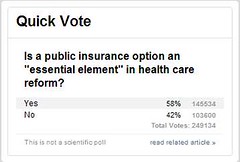
    They don't represent the majority of Americans who took this CNN poll. (Results as of 9:30 a.m. this morning.)

    public ins option


    And they don't represent the one in four Americans who now call health care the nation's most important problem - up from 16% a month ago and 6% a year ago.

    Consider this tough love, Dems. I can't show my displeasure at the ballot box until next year, but I can - and I will - stop enabling your bad behavior. When you're ready to start talking about public health insurance again, I'll consider making a donation, but until then you're on your own.

    Wednesday, August 12, 2009

    Health Care Debate Takes Compassionate Turn

    What two words have been missing from the health care debate on the right? Compassion and religion. The party of compassionate conservatism has always been quick to use religion when it served their purpose in the past, but curiously, neither word has been mentioned often in relation to health care reform. There have been a few exceptions though. While conducting a town hall in Lebanon, PA, Sen. Arlen Specter was threatened with God's wrath by one protester.
    "One day, God's gonna stand before you," he said. "And he's gonna judge you and the rest of your damn cronies up on the Hill, and then you can get your just desserts."
    I wonder if that person was referring to the lies being told by some critics? As Jim Wallis of Sojourners recently said, "one important moral principle for the health-care debate is truth-telling."

    The religious right may be keeping quiet about this issue, but a coalition of interfaith religious groups is backing health care reform. They've launched a 40 day campaign targeting 100 member of Congress and they'll participate in a telephone call-in event with President Obama on Aug 19.
    Members of the group said Monday that they intend to fight back against what they say are lies being told about health reform.

    “All of God’s children [have] got to be covered now,” said Rev. Jim Wallis, the CEO of Sojourners. “This is not a partisan political move. You are going to hear the moral drumbeat throughout this debate.”

    The campaign is sponsored and organized by PICO National Network, Faith in Public Life, Faithful America, Sojourners and Catholics in Alliance for the Common Good.
    Catholics in Alliance believe "health care is a basic human right, not a privilege," and Faithful America is letting Congress know people of faith support health care reform in a national TV ad.

    Christians aren't alone in this effort. The coalition also includes Jewish and Muslim leaders. In fact, the National Democratic Jewish Council launched a "Rabbis for Health Insurance Reform" webpage urging Congress to get legislation passed for "Democrats, Republicans, Christians, Muslims, and Jews."
    "Our tradition teaches us to pursue justice," the site reads. "Yet it is not a just society when families are forced to choose between paying their mortgages or paying for prescription drugs. It is not a just society when small businesses must choose between being profitable or providing coverage to their employees. It is not a just society when people are denied health insurance because they have a pre-existing condition for which they need medical care. Equal access to safe and affordable health care is an essential social justice issue of our time.
    If ever there was a time to bring religion and compassion into the discussion, this is it. As one Indianapolis pastor who is part of the coalition said, this "effort addresses the suffering parishioners they [clergy] see each week who can’t afford treatments until their ailments reach emergency room levels. ... This is as much a crisis of faith as it is a crisis of health care.”


    (Cross-posted at Blogging for MI.)

    Wednesday, July 29, 2009

    Mitch Albom defends the richest 1 percent

    Did you catch Mitch Albom's column in the Free Press defending rich people from having to pay more in taxes in order to fund health care reform? Prepare yourself to gag:
    In explaining why it was OK to sock a new 5.4% tax on the highest earners in this country — to pay for health care reform — President Obama’s press secretary, Robert Gibbs, said this:

    “The president believes that the richest 1% of this country has had a pretty good run of it for many, many, many years.”

    Ah. So that’s it. The old “You’ve had it good enough for long enough” policy. That’s why a family earning a million dollars a year should now cough up $54,000 of that — in addition to all the other taxes it pays...

    It is not that the rich should not pay fair taxes. They should.

    But to justify a grossly overweighted tax by saying “You people have had it good long enough” is to engage in the worst and most destructive form of politics: class warfare.
    "Grossly overweighted tax" is not only incorrect (which I'll get to later), but Mitch seems to forget who his target audience is: Poor slobs like me who bought his books and helped make him rich. I won't make that mistake again.

    Speaking of his books, David Sirota notes that Albom has "made millions of dollars writing books about sick people and death." He also assumed "that because his writing comes into contact with the most gut-wrenching parts of health care system, and because he portrays himself as a shining beacon of compassion and selflessness, that he is, in fact, a somewhat compassionate human being."

    However, after reading Albom's column in what Sirota calls "quite literally the most economically devastated city in the United States," he changed his opinion of him. "Albom is a run-of-the-mill royalist and right-wing psychopath."
    And yet, Albom -- the guy who has made his pile by trumpeting his alleged compassion for the plight of the sick and dying -- is spending the most crucial week in the health care debate insisting that the superwealthy pay too much in taxes and never avoid paying what they owe. And more importantly, Albom spends this week insisting the major problem facing America is a "class warfare" that would ask a Goldman Sachs executive making $1 million a year to devote just 9-tenths of one percent more of his taxpayer-subsidized income to a universal health care program. And he's doing all this in the flagship paper of the city that has been most devastated by the economy.
    Not only is Albom not compassionate, he's also a fool when it comes to that "grossly overweighted tax" he mentioned. His math is not only wrong, it's considerably off, by a factor of six according to A Tiny Revolution.
    Someone making $1,000,000 per year wouldn't pay $54,000 more in taxes under this bill. They'd pay $9,000.

    That's because the 5.4% surcharge would only apply to someone's income over $1,000,000. Your tax bill wouldn't suddenly go up by $54,000 if one year you made $1,000,000 instead of $999,999.
    Albom writes at a third grade reading level and isn't a tax accountant (he has a degree in journalism from Columbia University plus an MBA from Columbia's Graduate School of Business), but that doesn't justify passing along false information as the truth. Or could it be, as A Tiny Revolution points out, that it's just acceptable practice in his line of work.
    "There really is no field but right-wing punditry where you can make these kind of catastrophic errors and keep your job. You can't graduate from Columbia Medical School and become a surgeon if you believe human beings have six spleens, and you can't stay an anesthesiologist if you give someone six times too much Sevoflurane. But as long as your horrifying incompetence serves a right-wing agenda, there will always be a cozy home for you in journalism."
    It's too bad Mitch didn't take to heart Morrie's words:

    "So many people walk around with a meaningless life. They seem half-asleep, even when they're busy doing things they think are important. This is because they're chasing the wrong things. The way you get meaning into your life is to devote yourself to loving others, devote yourself to your community around you, and devote yourself to creating something that gives you purpose and meaning."


    (Cross-posted at Blogging for MI.)