Showing posts with label Democrats. Show all posts

Wednesday, January 27, 2010

Good News/Bad News On The Environmental Front

First, from the NYT, comes the bad news.
A new ranking of the world’s nations by environmental performance puts some of the globe’s largest economies far down the list, with the United States sinking to 61st and China to 121st.

In the previous version of the Environmental Performance Index, compiled every two years by Yale and Columbia University researchers, the United States ranked 39th, and China 105th.
The top performer was Iceland, which gets nearly all of its power from renewable sources, followed closely by Switzerland, Sweden, Norway and Finland.
“Countries that take seriously the environment as a policy challenge do improve, and those that don’t deteriorate,” said Daniel C. Esty, director of the Yale Center for Environmental Law and Policy, who oversees the index project.
The paper does note that because most of the data is from 2007 and 2008, "the index does not fully reflect new efforts by the Obama administration" to improve environmental performance. It also notes that the U.S. scores well in forestry and safe drinking water, but our ranking is abysmal because we score low in areas like heat-trapping emissions and urban air pollutants.

Increasing renewable energy would help decrease our emissions. The good news is that we're advancing quickly in one area - wind power.
Despite a crippling recession and tight credit markets, the American wind power industry grew at a rapid pace in 2009, adding 39 percent more capacity. The country is close to the point where 2 percent of its electricity will come from wind turbines.
According to the NYT, that's up from virtually nothing a few years ago, and they reported that the American Wind Association said "the amount of capacity added last year, 9,900 megawatts, was the largest on record, and was 18 percent above the capacity added in 2008, also a banner year."
The nation’s wind turbines generate enough electricity to power the equivalent of 9.7 million homes, according to the report. Last year, Texas consolidated its lead as the nation’s top wind producer, with a total capacity of 9,410 megawatts, about three times more than the second-largest producer, Iowa. They were followed by California, Washington and Minnesota.
And guess what the AWEA credits for the growth of wind power? “The U.S. wind industry shattered all installation records in 2009, and this was directly attributable to the lifeline that was provided by the stimulus package,” said Denise Bode, the trade association’s chief executive.

However, as extraordinary as growth has been in this area, they also point out that it would be better if Congress would pass a a federal mandate requiring that a certain percentage of power come from renewable sources. Mandates already exist throughout the European Union and in China, and in the U.S. 29 states have adopted a renewable power standard, including Michigan, which set a standard of 10% of electricity from renewable resources by 2015.
“The wind manufacturing sector has the potential to employ many more Americans in green jobs, but without a renewable electricity standard to provide a long-term market, the sector will be slow to grow,” the trade group said in its report.
I'm so tired of the U.S. falling behind in everything but the strength of our military. The U.S. should be leading the way in this area instead of falling further behind. And although we're fortunate to have Gov. Granholm and other Democrats with foresight and vision pushing for higher standards, we're still stuck with obstructionist Republicans who would rather help their fossil fuel cronies than our environment. Just imagine how much better our country could be if Republicans didn't always stand in the way.

(Cross-posted at Blogging for MI.)

Wednesday, December 23, 2009

Senate Health Bill Provides Enormous Help To Poor

Everyone seems to be trashing the Senate's health reform bill. That's fine, dissent is good, but I don't think we should let it blind us to the positives, such as the enormous good the bill will do for the poor and middle class. (Via Jonathan Cohn at TNR.)
This bill would mean Medicaid coverage for an additional 15 million people a year, all of them living below or just above the poverty line. For a sense of scale, that's more than double the entire population now covered by the state Children's Health Insurance Program.

This bill would also subsidize coverage in the exchanges for (roughly) another 15 million people a year, the majority of whom would also qualify as low-income by any reasonable standard.
"Do the math," he says, and we'll see that this bill is "arguably, the single most progressive initiative in a generation."

And if you don't believe Cohn, he asks you to consider what his colleague Harold Pollack at the Huffington Post had to say [emphasis mine]:
Fully implemented, the bill would provide about $200 billion per year down the income scale in subsidies to poor, near-poor, and working Americans.

$200 billion is a big number. It exceeds the combined total of federal spending on Food Stamps and all nutrition assistance programs, the Earned Income Tax Credit, Head Start, TANF cash payments to single mothers and their children, the Department of Housing and Urban Development, and the National Institutes of Health.
That money won't be allocated to wars or tax cuts for the rich, it's going to help the poor and middle class.

Trash the bill if you want, but don't let yourself lose sight of the good it will do.


(Cross-posted at Blogging for MI.)

Monday, December 21, 2009

Bottled Water Tax: "The People Deserve To Get Something In Return"

LG John Cherry has an op-ed in the Detroit News today that talks about his plan to restore the Michigan Promise Scholarship with a water bottle tax. Go read it, but here's the best part (emphasis mine):
Right now, bottlers across the state remove water from our wells essentially for free, and we lack the necessary funding to safeguard this precious resource. In other words, we're losing one resource -- our talented work force -- while giving away another resource, our water, for free.

You don't need a Ph.D. in mathematics to solve this terrible equation. It's time for the bottlers to pay their water bill, just like you and I do. We can use the proceeds from that water bill to fund the education that our young people need to compete, as well as protecting the water resources that Michigan desperately needs.

By conservative estimates, a charge of 10 cents per bottle, paid by bottling companies that operate in Michigan, would raise $118 million per year. The cost of the Michigan Promise Scholarship, on the other hand, is about $100 million per year. Not only would this modest charge on each bottle of water that leaves Michigan raise enough funds to pay for the entire Michigan Promise program, we'd still have $18 million a year to spend on wetlands regulation and other conservation initiatives. [...]

This is the people's water, and the people deserve to get something in return.
Ironically, employers like to point out they need an educated workforce to be successful and profitable, and Nestle, the parent company of Ice Mountain, is no exception.
Like every Michigan employer, we rely on an educated workforce.
Yet Nestle is complaining that Cherry's proposal penalizes Michigan employers, risks jobs, and that bottlers may resort to supplying products from outside the state in order to remain competitive on the price consumers pay for bottled water products.

A Nestle Water Company spokesman also claimed that the tax would nearly double the price consumers paid for a case of water.
"Let's look at the math," said Flaherty. "Most bottled water is purchased in cases of 24 bottles of .5 liter size, for about or less than $4.00 per case -- putting the price per bottle at about 16 cents. A 10-cent per bottle tax on Michigan manufactured products nearly doubles the price for consumers, and would be unsustainable in the highly competitive beverage marketplace.

"Consumers are very savvy, and rarely could be convinced to pay nearly double for Michigan-produced bottle water when lesser-priced options exist," said Flaherty. "I challenge you to ask consumers if they'd pay $6.50 for a case when they can pay less than $4 for the same product made elsewhere."
True, consumers are savvy, but we also care about educating our children. I have a suggestion for Nestle. You pay the 10 cent tax per bottle on the water you currently get for free without passing it on to consumers and in return you'll get an educated workforce, an improved "corporate neighbor" image and the gratitude of citizens who just might go out of their way to buy your product. I'd say that's a win-win for everyone involved. After all, your company admitted that bottled water profits were down in part because of public criticism. Why would you want to anger us even more?

Wednesday, December 16, 2009

Don't Give Up On Health Care Now

I am extremely disillusioned with the shape the healthcare bill has taken, but I'm not willing to say it shouldn't pass and/or we should start over. I'll let Kevin Drum speak for me. He makes a compelling argument for seeing this bill through.
With the public option now out of the healthcare bill, is it still worth passing? Regular readers will be unsurprised that I think the answer is pretty firmly yes—and that liberals who now want to pick up their toys and hand reform its sixth defeat in the past century need to wake up and smell the decaf. Politics sucks. It always has. But the bill in front of us—messy, incomplete, and replete with bribes to every interest group imaginable—is still well worth passing.
Six defeats. Think about that. More from Kevin:
When big legislative efforts go down in flames, they almost never spring back onto the calendar anytime soon — and that's especially true when big healthcare bills fail. It didn't happen in 1936, it didn't happen in 1949, it didn't happen in 1974, and it didn't happen in 1995. What makes anyone think it will happen in 2010?
Drum also makes the point that if healthcare reform dies this year, it dies for a good long time, and Republicans know it. And even though it's not the bill we wanted, it's a good start. Via Ezra Klein:
"This is a good bill," Sen. Sherrod Brown said on Countdown last night. "Not a great bill, but a good bill." That's about right. But the other piece to remember is that more than it's a good bill, it's a good start. With $900 billion in subsidies already in place, it's easier to add another hundred billion later, if we need it, than it would be to pass $1 trillion in subsidies in 2011. With the exchanges built and private insurers unable to hold down costs, it's easier to argue for adding a strong public option to the market than it was before we'd tried regulation and a new competitive structure. With 95 percent of the country covered, it's easier to go the final 5 percent. And with a health-care reform bill actually passed, it's easier to convince legislators that passing such bills is possible.
Here's some other things we'll be getting:
  • Insurers have to take all comers. They can't turn you down for a preexisting condition or cut you off after you get sick.

  • Community rating. Within a few broad classes, everyone gets charged the same amount for insurance.

  • Individual mandate. I know a lot of liberals hate this, but how is it different from a tax? And its purpose is sound: it keeps the insurance pool broad and insurance rates down.

  • A significant expansion of Medicaid.

  • Subsidies for low and middle income workers that keeps premium costs under 10% of income.

  • Limits on ER charges to low-income uninsured emergency patients.

  • Caps on out-of-pocket expenses.

  • A broad range of cost-containment measures.

  • A dedicated revenue stream to support all this.
  • Drum is right. This is still a huge achievement, one that will benefit tens of millions of people in very concrete ways and will do it without expanding our long-term deficit. And he also points out "this is more than Bill Clinton ever did, more than Teddy Kennedy did, more than LBJ did, more than Truman did, and more than FDR did."

    Don't throw in the towel now.

    Thursday, December 10, 2009

    Poll: Let The Wealthy Pay Higher Taxes

    A new Bloomberg poll shows Americans want the government to do something about the economy.
    Americans want their government to create jobs through spending on public works, investments in alternative energy or skills training for the jobless.

    They also want the deficit to come down. And most are ready to hand the bill to the wealthy.

    A Bloomberg National Poll conducted Dec. 3-7 shows two- thirds of Americans favor taxing the rich to reduce the deficit.
    Raising taxes on the rich was popular across party lines too: About half of Republicans back the idea and it is more popular among Democrats and Independents.

    Steve Benen summarized the polls results best:
    In other words, here's a poll showing widespread support for the Democratic economic agenda.
    That's because mainstream America is rational, unlike those teabagger Republicans whose only answer for every problem is cut taxes, cut taxes...


    (Cross-posted at Blogging for MI.)

    Tuesday, December 08, 2009

    Who's More Popular Than Traditional Republicans?

    Teabagger Republicans. According to the latest Rasmussen poll, Republicans have fallen to third place in terms of popularity.
    In a three-way Generic Ballot test, the latest Rasmussen Reports national telephone survey finds Democrats attracting 36% of the vote. The Tea Party candidate picks up 23%, and Republicans finish third at 18%. Another 22% are undecided.
    So are Republicans worried? Nope. Greg Sargent asked for the GOP's leadership view of the poll and this was one senior GOP aide's reply:
    This proves one of the major points that Democrats have tried hard to deny: the Tea Party movement is not some fringe group of ultra-conservatives, it is most popular among independents, many of whom believed President Obama’s campaign promises about doing things differently in Washington, and feel burned by the fact that he has governed in a relentlessly partisan fashion.
    Partisan? Did he really say partisan? Three words: Health care reform. Obama reached out to Republicans and they said NO.

    I think GOP leadership has to spin this in a favorable light. After all, several Glenn Beck inspired Tea Party candidates are causing problems for a number of GOP lawmakers, including John McCain. They're caught between a rock and a hard place. They can't afford to ignore the teabaggers, and they can't afford to embrace them at the risk of losing their moderate members.

    And I don't take too seriously the GOP spokesperson's comment that "the Tea Party movement is not some fringe group." Again, really? What else would you call a group that invited Sarah Palin and Michelle Bachman to speak at their national convention next year. And don't forget about Joe the Plumber.

    I'm sorry, but I have a hard time believing that any independents with a smidgen of commonsense will embrace the teabaggers, the same group that shows up at rallies with guns and posters comparing health care reform to pictures of dead bodies at the Dachau concentration camp. These people are not mainstream Americans, they're extremists.

    And when a fake party "that doesn't have organized candidates or organized fundraising is more highly thought of than one of the two traditionally dominant political parties," that's a sign that Republicans are in big trouble, no matter how much they spin this poll.

    Tuesday, November 17, 2009

    Health Care Reform: Keep It Separate From Religion

    Thank you for respecting a woman's right to choose, Congressman Schauer, and for also having the courage to say what many women think - "The government doesn't belong in the room when these very personal, private decisions are being made." And neither does the religious right, Council of Catholic Bishops and Bart Stupak. They certainly don't speak for all people of faith.

    From the United Church of Christ:
    UCC Minister and Co-Team Leader for the Cleveland-based Team, the Rev. Loey Powell, reiterated the UCC's 40-year history of support for reproductive health care and said of the amendment, "We join [partner faith] groups in expressing our disappointment that the House bowed to pressure exerted at the last minute from anti-abortion lobbyists ... Once again women's health and well-being have been compromised in the halls of Congress."
    United Methodist Church:
    The United Methodist Church’s official positions on abortion and immigration stand in opposition, however, to restrictions placed in the bill that limit coverage for all of God’s children living in the United States. H.R. 3962 excludes immigrants and women whose circumstances indicate need for an abortion. These restrictions even include persons who now have such insurance.

    The bill establishes a two-tiered system of health delivery. It essentially penalizes women and immigrants with fewer economic resources.
    National Council of Jewish Women:
    "This Stupak-Pitts amendment is an egregious assault on the rights of women and an enormous step backward for those who believe in the separation of religion and state. It enshrines one religious view of abortion into law and enlists the federal government to enforce it.
    Religious Coalition for Reproductive Choice:
    We call on the Senate to ensure that health care reform is freed of religious ideology and restrictions that will prevent women from making their own reproductive health care choices.
    Ideally, I think our leaders should heed JFK's words:
    I believe in an America where the separation of church and state is absolute, where no Catholic prelate would tell the president (should he be Catholic) how to act, and no Protestant minister would tell his parishioners for whom to vote. . . . That is the kind of America in which I believe. . . . Whatever issue may come before me as president - on birth control, divorce, censorship, gambling or any other subject - I will make my decision in accordance with . . . what my conscience tells me to be the national interest, and without regard to outside religious pressures or dictates.
    Along with 40 other Democrats, Stupak is threatening there will be hell to pay if his amendment is removed, and the Council of Catholic Bishops is threatening to withdraw their support for reform too. Their religion may condone turning their backs on the uninsured, but mine believes health care is a matter of social justice.

    There are hundreds of religions in this world and we'll never find common ground acceptable to everyone. However, as this blogger so eloquently put it...
    Freedom of religion in our nation means, first and foremost, the right of individuals to live their lives in accord with their most cherished religious beliefs, and free of government interference. [...]

    At the same time, though, the reciprocal of that freedom is an equally fundamental responsibility. This is the responsibility not to use the authority of the government to compel individuals to live their lives in accord with our "religious dictates" that they do not share. Muslims have the right not to consume pork, but they should not use the power of the government to forbid others to eat pork. Jews have the right not to work on Saturday, but they should not use the power of the government to prohibit others from working on Saturday. And Catholics have the right not to marry people of the same sex, but they should not use the power of the government to forbid others from marrying the person they love.
    And religion should not use the power of government to block health care reform.


    (Cross-posted at Blogging for MI.)

    Wednesday, November 04, 2009

    Health Care and Gay Rights Helped by Yesterday's Election

    Regardless of Republican gloating, I'm not reading too much into yesterday's election. They picked up a couple of governorships in Virginia and New Jersey, but Democrats picked up two seats in Congress, and those two seats might just make the difference in getting health care reform passed.

    Via Brian Beutler at TPM:
    The NY-23 seat abdicated by Republican John McHugh (who resigned to become Secretary of the Army) went to Democrat Bill Owens--the first Democrat to hold the seat in over a century. And the CA-10 seat abdicated by Democrat Ellen Tauscher (who resigned to become Under Secretary of State for Arms Control and International Security Affairs) went to Democrat John Garamendi.

    That creates some simple arithmetic. Yesterday, Democrats had 256 voting members in the House. By week's end, they'll have 258. Last week, House Speaker Nancy Pelosi could afford to lose no more than 38 Democratic votes on a landmark health care reform bill. Next week, after Owens and Garamendi are sworn in, she can lose up to 40. For legislation this historic and far-reaching, she'll need every vote she can get--and both seem likely to support reform.
    I'll give up two governorships in return for getting health care reform passed.

    And this news will be music to the ears of gay rights activists: "As gay marriage was being voted down in Maine, several openly gay candidates in the South scored victories."

    In the south!! So go ahead and gloat, Republicans. It doesn't matter, because mainstream America is not red. (Are you paying attention, Dems?)

    Tuesday, November 03, 2009

    Health Care Bill is a Pro-Life Issue Too

    In this FDL Action Health Care Update, I read that Bart Stupak is threatening to block the House health care bill from passing over the issue of tax dollars for abortion. He wants to vote his conscience and strip abortion-related provisions out of the House bill, in spite of the fact the bill already contains restrictions to prevent federal funding of abortions.

    Okay, I can respect that, but isn't health care for the uninsured a moral issue too? And how does Stupak square his concern for fetuses with the lack of respect he shows this group of people?
    In his letter to Secretary of the Army John McHugh, Stupak expressed concern over reports that terrorist suspects would have priority over United States citizens waiting for the vaccine.
    Apparently "suspected" terrorists are less worthy.
    It might only be 229 more vaccines but I would rather see 229 vaccines go to pregnant women of young children to be protected from H1N1 not to a group of people who are beheld as suspected terrorist against our country.
    I'm not trying to beat up on Stupak. I think his heart is in the right place, and he votes with Democrats more than 90% of the time, but I'm tired of the way this argument always gets framed. We should respect all life, including the lives of terrorists and the uninsured, not just the lives of fetuses.

    The good news is that Stupak does support health care reform and still plans to support it.
    If everything I want [is] in the final bill, I like everything in the bill except you have public funding for abortion, and we had a chance to run our amendment and we lost. OK, I voted my conscience, stayed true to my principles, stayed true to the beliefs of this district, could I vote for healthcare? Yes I still could.
    I hope the other 39 House Democrats aligned with Stupak vote Yes. Health care for the uninsured deserves their respect and support too.

    Tuesday, October 27, 2009

    Opting In, Opting Out, Why The Next Election Is Vitally Important

    As Cordelia Lear pointed out at Blogging for MI yesterday, the opt-out choice that allows states to withdraw from the public option is no panacea. Read what she says about Mike Bishop and Andy Dillon to understand why opt-out is a bad idea, but it's basically because the public option choice will literally be in the hands of lawmakers who don't care about us.

    I originally figured I could live with the opt-out plan because it's loosely modeled on Medicaid, "which originally allowed states to “opt-out” of the program and today enjoys the participation of all 50 states." And, as TPM pointed out, there was good reason to believe that the public option would have been a lot scarier as a GOP straw man than it would as a real world option for people who can't get private coverage.
    And if the public option is available in North Carolina, just to pick a hypothetical, and not South Carolina, after a while, people in the South Carolina might start to wonder what the logic was of denying them a lower cost health insurance option. And if that's true, presumably, pressure will build in the opt-out states to opt-in. So even if a substantial number of people aren't covered at the start, there's good reason to believe that will change over time.
    There's just one tiny problem with the "presumably, pressure will build to opt-in" scenario. We're dealing with politicians who often put party ideology ahead of people. If pressuring our leaders worked, we would have had health care a long time ago.

    And, as Cordelia mentioned, it's not exactly clear who gets to do the opting-out. Will governors be able to unilaterally make that decision or will it take action by both houses of the state legislature? As Jon Walker at FDL pointed out, depending on how the opt-out is written, millions of people in states controlled by Republicans could find themselves disenfranchised.

    If a Republican becomes Michigan's next governor, or they manage to pick up any seats, we can kiss opting-in goodbye. Seriously. That makes the next election extremely important because there's just one thing standing between national health care and the 1.13 million uninsured adults in our state - Republicans (and DINO's like Dillon).

    (Cross-posted at Blogging for MI.)

    Tuesday, October 20, 2009

    Mainstream America Is Not Red

    The Democracy Corps released a survey last week about conservative Republicans that highlights how they're a world apart from most of us. I know, shocking!
  • These voters identify themselves as part of a ‘mocked’ minority with a set of shared beliefs and knowledge, and commitment to oppose Obama that sets them apart from the majority in the country. They believe Obama is ruthlessly advancing a ‘secret agenda’ to bankrupt the United States and dramatically expand government control to an extent nothing short of socialism.

  • They also believe they possess a level of knowledge and understanding when it comes to politics and current events, one gained from a rejection of the mainstream media and an embrace of conservative media and pundits such as Glenn Beck and Rush Limbaugh.
  • There was one area where we shared common ground though: "These voters had virtually nothing positive to say about the Republican Party. They see their own party as weak, old, and out of touch."

    It's what the survey showed about independents that I found most interesting though:
    The independent voters ... share the conservative Republicans’ disdain for the current Republican Party, but their critique is not that the party has abandoned its conservative principles but instead that it advances the interests of the rich and big businesses at the expense of the middle class. They worry about the Democratic Party’s proclivity to spend tax dollars and provide ‘freebies’ to those who do not do their fair share, but they appreciate the Democrats’ focus on ‘the little people’ (among which they included themselves) and the fact that ‘it’s not all about the money.’
    It appears the GOP's single-minded focus on corporate America and tax breaks for the rich is a failure in terms of increasing market share - a.k.a. voters.
    In late January, a USA Today/Gallup poll recorded 27 percent of respondents saying they identified with the Republican Party, 36 percent with Democrats and 25 percent as unaffiliated or independent. Now in mid-October, the average data compiled from dozens of surveys over more than a year shows Republican ID at 22.5 percent, Democratic ID at 33.7 percent and Independent ID at 35 percent.
    Mainstream America is represented by nearly 70% of the electorate consisting of Democrats and Independents, a group that cares about the common good, the "little people." It is not represented by the 22% of Republicans that to a large degree are defined by voters who embrace Glenn Beck and Rush Limbaugh.

    If only we could get our lawmakers in Lansing and Washington to remember that.

    Tuesday, August 18, 2009

    Just Say No to DNC Donations

    The Democratic National Committee called me this morning and asked if I could contribute $100 dollars to help move the Democratic agenda forward. This was my not too lady-like response:
    I will not contribute another dime to Democrats until they get their shit together on passing health care reform that includes a public option.
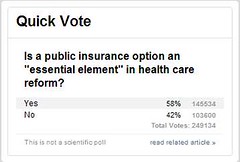
    What is the matter with Democrats? Voters handed them a mandate for change and they're wimping out on us. Quit listening to the teabaggers, deathers, Blue Dogs, and people like Grassley, Betsy McCaughey and Dick Armey and his Freedom Works. They don't represent the majority of Americans who say we should have the option of government-run health insurance.

    They don't represent the majority of Americans who took this CNN poll. (Results as of 9:30 a.m. this morning.)

    public ins option


    And they don't represent the one in four Americans who now call health care the nation's most important problem - up from 16% a month ago and 6% a year ago.

    Consider this tough love, Dems. I can't show my displeasure at the ballot box until next year, but I can - and I will - stop enabling your bad behavior. When you're ready to start talking about public health insurance again, I'll consider making a donation, but until then you're on your own.

    Wednesday, August 12, 2009

    Health Care Debate Takes Compassionate Turn

    What two words have been missing from the health care debate on the right? Compassion and religion. The party of compassionate conservatism has always been quick to use religion when it served their purpose in the past, but curiously, neither word has been mentioned often in relation to health care reform. There have been a few exceptions though. While conducting a town hall in Lebanon, PA, Sen. Arlen Specter was threatened with God's wrath by one protester.
    "One day, God's gonna stand before you," he said. "And he's gonna judge you and the rest of your damn cronies up on the Hill, and then you can get your just desserts."
    I wonder if that person was referring to the lies being told by some critics? As Jim Wallis of Sojourners recently said, "one important moral principle for the health-care debate is truth-telling."

    The religious right may be keeping quiet about this issue, but a coalition of interfaith religious groups is backing health care reform. They've launched a 40 day campaign targeting 100 member of Congress and they'll participate in a telephone call-in event with President Obama on Aug 19.
    Members of the group said Monday that they intend to fight back against what they say are lies being told about health reform.

    “All of God’s children [have] got to be covered now,” said Rev. Jim Wallis, the CEO of Sojourners. “This is not a partisan political move. You are going to hear the moral drumbeat throughout this debate.”

    The campaign is sponsored and organized by PICO National Network, Faith in Public Life, Faithful America, Sojourners and Catholics in Alliance for the Common Good.
    Catholics in Alliance believe "health care is a basic human right, not a privilege," and Faithful America is letting Congress know people of faith support health care reform in a national TV ad.

    Christians aren't alone in this effort. The coalition also includes Jewish and Muslim leaders. In fact, the National Democratic Jewish Council launched a "Rabbis for Health Insurance Reform" webpage urging Congress to get legislation passed for "Democrats, Republicans, Christians, Muslims, and Jews."
    "Our tradition teaches us to pursue justice," the site reads. "Yet it is not a just society when families are forced to choose between paying their mortgages or paying for prescription drugs. It is not a just society when small businesses must choose between being profitable or providing coverage to their employees. It is not a just society when people are denied health insurance because they have a pre-existing condition for which they need medical care. Equal access to safe and affordable health care is an essential social justice issue of our time.
    If ever there was a time to bring religion and compassion into the discussion, this is it. As one Indianapolis pastor who is part of the coalition said, this "effort addresses the suffering parishioners they [clergy] see each week who can’t afford treatments until their ailments reach emergency room levels. ... This is as much a crisis of faith as it is a crisis of health care.”


    (Cross-posted at Blogging for MI.)

    Tuesday, May 12, 2009

    Michigan Has Become a Buyer-Beware State

    Michigan has a dirty little secret and it's driving people out of our state.
    Lindsay Duneske said she discovered how weak Michigan's Consumer Protection Act has become after the company that built her new home in Milan kept putting off needed repairs.

    She said she and her husband bought the house in 2007 for $306,000, after receiving assurances that the builder would fix buckling roof shingles and vinyl siding, leaky windows and other problems.

    After the builder reneged, Duneske said, she couldn't find a lawyer to help her because home builders are no longer covered by the Consumer Protection Act.

    She said the builder eventually went out of business and its lawyer got a court order to stop her from pestering him.

    "We have been totally and completely cheated," Duneske said, adding that she feels betrayed by state officials. "We are looking to move, and it will be anywhere but Michigan." [emphasis mine]
    Builders aren't the only ones exempted from the law. Banks, mortgage brokers, debt collectors, finance companies, home improvement contractors, new and used car dealers, auto repair shops, funeral homes, and plumbers and electricians are included. And according to a State Bar of Michigan Consumer Law Section study, consumers are at risk:
    The study, titled "Consumers at Risk: Are Most of Michigan's Worst Business Practices Exempt from Our Consumer Protection Act?", examined businesses on the state Attorney General's list of top 10 consumer complaints for 2008. It found that 72 percent of businesses generating the most complaints are exempt from the state's Consumer Protection Act due to Michigan Supreme Court decisions. [emphasis added] That includes nearly all the businesses in the top three complaint categories – credit and finance; gasoline, fuel and energy; and telecommunications, satellite and cable TV.
    Michigan Supreme Court decisions (a Republican Supreme Court majority installed by former Gov. John Engler) in 1999 and 2007 turned the law into mush according to former State Attorney General Frank Kelley, leaving people in the lurch. Frank says he's "sick about what happened," and he added that, in his judgment, the court's interpretations have "been against the public."

    A decade ago we had some of the nation's best consumer protection laws on the books, now we're ranked with Rhode Island as "the Terrible Two" by the National Consumer Law Center.
    "While these two states have UDAP statutes that appear strong on paper, they provide almost no actual protection to consumers," the Boston-based advocacy group said. Such statutes are known in the consumer protection community as Unfair and Deceptive Acts and Practices (UDAP) laws.

    "In fact, the UDAP statutes in these states are worse than ineffective, as they give the appearance of providing protection for consumers while actually providing nothing."
    Where has AG Mike Cox been this whole time? He's been busy keeping his name in the papers and doing seminars on worthy projects which might just propel him to be the governor someday. And attempts to fix the law have gone nowhere because business groups and the MICOC oppose any changes.
    "The Chamber of Commerce has a long-standing policy in opposition to expanding the Consumer Protection Act," said its Lansing lobbyist, Wendy Block, who spoke out against a 2007 measure to restore the act. She said the legislation would open the flood gates to needless lawsuits.
    Because of their opposition, consumers are left holding the bag when unscrupulous companies take advantage of them.

    State Rep. Robert Jones (D-Kalamazoo) introduced corrective measures to protect consumers, but these groups opposed the plan and it died. The Democratic House plans to reintroduce the measure soon, not just to protect consumers, but also honest businesses that Jones says, "often can't compete with fly-by-night operations whose promises – although deceptive – sound better than the offers of honest merchants."

    The Free Press says it's time to pass the legislation. They also have some questions for Mike Cox, Mike Bishop and their Republican colleagues:
    Is it really their intent to exempt three-quarters of Michigan businesses from the ethical rules laid down in the MCPA? Or did the justices who defanged the state's consumer protection overreach?
    My money is on exempting three-quarters of Michigan businesses. When did Republicans ever do anything for consumers?

    Wednesday, May 06, 2009

    Passing the Healthy Families Act is Sensible

    The swine flu (aka H1N1) appears to be milder than experts initially anticipated, but what if it had turned out to be much worse? What if people felt early symptoms coming on and had to chose between staying home from work or going in and exposing their coworkers? That could be problematic.
    ...millions of Americans can’t just stay home because they’re under the weather. When EPI looked at corporate sick leave policies in 2007 it found that some 43% of all private-industry workers have no paid sick days. Rather than the common sense precaution the President advices, these workers have a more difficult choice of going to work sick or staying home without pay and risk losing their jobs. In this current climate of high unemployment and even higher job insecurity, workers without any formal sick leave are even less likely to risk taking a day off.

    Even more problematic, access to time off for health reasons is especially rare in low-paying jobs. In a 2006 compensation survey, the Bureau of Labor Statistics found that 79% of those earning more than $29.47 per hour had sick time, but only 16% of those earning less than $7.38 an hour had the same benefit.
    The EPI also points out what a challenge it is for working parents if their children get sick.
    The Huffington Post, citing data from the Institute for Women’s Policy Research, notes that fewer than one in three U.S. workers who do have sick leave are allowed to use that time to stay home and care for a sick child.
    The Institute argues that "workers who lack paid sick time are more likely to go to work with a communicable illness, and parents who cannot stay home with a sick child are more likely to send them to school or day care." That just spreads germs around even more.

    In Michigan, 1,725,000 residents — 48 percent of Michigan workers — are not able to take a paid sick day when they are ill.

    It's time to revisit "the Healthy Families Act, which Sen. Ted Kennedy (D-MA) and Rep. Rosa DeLauro (D-CT) plan to reintroduce in Congress next month. The bill would “guarantee workers up to seven paid sick days a year to recover from an illness or care for a sick family member.”

    There is also an economic advantage to passing the legislation.
    According to the National Partnership for Women and Families, “when sick workers are on the job, it costs our national economy $180 billion annually in lost productivity. For employers, this costs an average of $255 per employee per year and exceeds the cost of absenteeism and medical and disability benefits.”
    At least 139 other countries already provide some paid sick leave to workers as a matter of national law, and four out of five Americans think paid sick days should be a basic labor standard, so passing the legislation should be a no-brainer. This is clearly one of those "changes" Americans voted for last November.

    Tuesday, May 05, 2009

    Washington Has Public Health Care, So Should We

    Forty-eight million Americans now lack health insurance and 73% of voters want a choice of a private or public health plan. Support for that choice is bipartisan too - Democrats 77%, Independents 79%, and Republicans 63%.

    With that kind of consensus, you'd think health care reform would be a slam dunk, right? Think again. There are lots of rotten apples in the bushel (insurance, big Pharma and for-profit corporations) trying to sink public health care and their rot is spreading to Republicans and Democrats.

    Convert Arlen Specter is one example. He recently told David Gregory that he would not support a public plan. (News flash, Arlen. You're not really a Democrat, you're an opportunist.)

    Sen. Evan Bayh of Indiana said he is “agnostic” about having a public plan as part of health care reform, and Senate Finance Committee Chairman Max Baucus of Montana said that he believes health care reform can be accomplished “without” a public option. Ha-ha. Baucus is a real comedian. Private health insurers have been cherry-picking patients, denying claims and refusing to insure people for years, and their costs are higher than public plans like Medicare. In fact, when Republicans opened Medicare to private insurers in the name of competition, it ended up costing the federal government 12 percent more. That's not reform.

    Private insurers don't want to see their gravy train end and they're spending big money trying to keep public health care from expanding, just ask Sen. Ben Nelson of Nebraska. His biggest campaign donor is the insurance industry. According to Open Secrets, Nelson received $608,709 from the insurance industry in 2007-2008. That money won him over. Nelson said he's not interested in a public option. HuffPost explains why:
    Nelson’s problem, he told CQ, is that the public plan would be too attractive and would hurt the private insurance plans. “At the end of the day, the public plan wins the game,” Nelson said. Including a public option in a health plan, he said, was a “deal breaker.”
    So let me get this straight. Our politicians have the best public health care plan taxpayer money can buy, yet they're essentially saying we can't have it because they want to protect private insurers. What hypocrites. Americans voted Republicans out of power because they kowtowed to corporate greed and now we have Democrats doing the same thing. It looks like we need to do some housecleaning and throw some more rotten apples out of office.

    Monday, April 20, 2009

    Hate Crime Legislation Vote Later This Week

    I don't keep up with gay rights as much as I should, so I was surprised to read that Deb Price now writes the first nationally syndicated column on gay issues. Good for her. I only know her work in the Detroit News. (Does anyone else find it ironic that she writes for them?)

    Anyway, outside of reading quite a bit about gay marriage in recent months, I didn't realize the Obama administration has been reaching out to the gay community in so many ways. Here are some highlights from Price's recent column, including a mention about the hate crimes legislation that lawmakers will be voting on later this week.
    The Obama White House invited gay leaders to the health care and fiscal responsibility summits, the signing of the Lilly Ledbetter Fair Pay Act and the executive order creating the White House Council on Women and Girls, and an online town hall. Gay parents were encouraged to bring their kids to the Easter egg roll. [...]

    The White House outreach has included Mara Keisling of the National Center for Transgender Equality and Rebecca Fox of the National Coalition for LGBT Health. [...]

    And Obama is salting gay talent through his administration. Most noteworthy is John Berry, confirmed by the Senate as director of the Office of Personnel Management. That puts a gay man in charge of the 1.9 million federal employees, including overseeing their benefits.

    Other appointees include Emily Hewitt, an ordained Episcopal priest, as chief judge of the U.S. Court of Federal Claims. A peek at Hewitt's biography on her official court site shows the comfort Obama's gay choices feel: "Chief Judge Hewitt is married to Eleanor Dean Acheson."

    Obama tapped Fred Hochberg to chair the U.S. Export-Import Bank, Harry Knox to serve on the Advisory Council on Faith-Based and Neighborhood Partnerships, and Nancy Sutley to chair the White House Council on Environmental Quality.
    Price also reports that Obama told two leaders of the Human Rights Campaign that he intends to sign the hates crimes legislation when it reaches his desk, and he supports the need for a federal ban on job discrimination based on sexual orientation or gender identity.

    The Hate Crime Legislation (H.R. 1913) was introduced by John Conyers and has 42 sponsors. The House Judiciary Committee is set to vote on the bill this Wednesday. Language in the bill includes “sexual orientation," which has some "family groups" going bonkers. The Traditional Values Coalition released this statement:
    “The so-called hate crimes bill will be used to lay the legal foundation and framework to investigate, prosecute and persecute pastors, business owners, Bible teachers, Sunday School teachers, youth leaders, Christian counselors, religious broadcasters and anyone else whose actions are based upon and reflect the truths found in the Bible.”
    Not surprisingly, their position is inaccurate and irrational. The bill does not restrict free speech. In fact, the ACLU's support for this bill was contingent upon a provision that is the strongest protection for free speech in the entire federal criminal code.

    It'll be interesting to see how Republicans vote. Will they pander to extremists or vote to send the message that violent hate crimes have no place in our country?

    Wednesday, April 15, 2009

    Stabenow and Peters Talk Bankruptcy on "The Ed Show"

    Sen. Debbie Stabenow was on the Ed Show Monday night and Rep. Gary Peters was on last night. They discussed a possible GM bankruptcy, which could jeopardize the pensions of 670,000 retires, with 335,000 seeing benefit cuts.

    Both lawmakers agreed that bankruptcy should be a last resort, but Ed characterized Obama's Auto Task Force as throwing workers under the bus when it comes to their pensions. Stabenow had a different perspective:
    SCHULTZ: But what about those retirees—senator, I have to ask you, what about these retirees. They didn‘t vote to have their benefits cut. These are your constituents in Michigan.

    STABENOW: No question. If you‘re asking me, do I think bankruptcy is a good idea? The answer is absolutely not. I don‘t support bankruptcy as an option. And the reality is that taxpayers shouldn‘t either, because we‘re talking about 670,000 people with pensions with General Motors alone that would become potentially a federal responsibility. [...]

    SCHULTZ: -- that if it goes to the Pension Guarantee Corporation, and people have to take a cut, I don‘t know how they are going to be motivated to come back and vote for the Democrats.

    STABENOW: Well, first of all, people took a pay cut to get that pension, and they should not be cut in their pensions, period. People took pay cut after pay cut to keep their health care and to keep their pensions. And so there is a way to do this, even going into a bankruptcy.

    Northwest Airlines, based out of Detroit substantially, went into bankruptcy, kept their pension obligations. We worked with them to help protect their pensions. They came out of bankruptcy. They kept their pension commitments. So it is possible to do that. And I am strongly urging the administration, whatever happens, to keep those pensions intact, because people have worked hard all of their lives for those.
    Bloomberg reports that GM’s plan is in relatively better shape than others, because it’s about 87 percent-funded, but they also point out that as many as half of GM’s 670,000 pension-plan participants could see their benefits trimmed if the PBGC takes over the plan. Jack Dickinson, president of an advocacy group called Over the Hill Car People says, “Nobody really knows” what would happen with GM pensions in a bankruptcy." (The DetNews has more on how bankruptcy could affect workers' pensions.)

    One thing struck me in the interview above. Schultz wondered why people would be motivated to vote for Democrats if General Motors files bankruptcy. Is Ed serious? As the Free Press recently pointed out...
    Moreover, the government's track record setting policy that affects the auto industry is atrocious. Car companies have been flogged for not producing enough small, efficient vehicles, but the government eschews a national gas tax that would keep demand for such vehicles high. The companies have been derided for exorbitant labor costs, but in too many instances, government trade policy doesn't help them by holding other countries to decent labor standards.
    Democrats and Republicans are responsible for that track record, but Republicans have been in control of the White House for the past 8 years and in control of Congress for almost 20 years. They were the ones actively pushing their free trade, anti-tax, kill the unions, drill, baby, drill rhetoric all that time. And when the chips were down last fall and the auto industry needed help, it was Republicans who pulled the plug on the industry and voted no.

    If McCain had won the election, I have no doubt GM and Chrysler would be history already and the Republicans and their US Chamber of Commerce cronies would be giving one another high-fives.

    And I won't soon forget how Republicans voted on minimum wage, SCHIP, equal pay, etc. They don't even feel we should have universal health care.

    A vote for any member of the GOP is a vote against the middle-class, and General Motors filing for bankruptcy won't change how I feel about them. The lawmaker who does the most for the middle-class gets my vote, and the majority of the time that's a Democrat.

    Wednesday, February 18, 2009

    Republicans Say No to Largest Tax Cut in History

    Republicans not only voted against creating jobs when they voted no on the stimulus plan, they also voted against one of the biggest tax cuts in history. Robert Schlesinger at US News gives us the lowdown.
    Steven Waldman, a former U.S. News editor (well before I wandered these halls), makes an interesting case that the coming tax cut will indeed be the biggest ever.
    The compromise stimulus plan includes $282 billion in tax cuts over two years.

    According to the Wall Street Journal, Bush's first two years of tax cuts amounted to $174 billion. A second batch in 2004 and 2005 cost $231. And those were thought to be bigger than the tax cuts offered by Reagan, Kennedy, or others.

    But wait, you say, wasn't Bush's 2001 tax cut, at $1.35 trillion (funny how the GOP didn't mind draining one trillion dollars from the government coffers then), the largest in history?
    Yes, over the full 10 years of its existence. But over the first two years, as Waldman points out above, the price tag was much smaller. So the Obama stimulus tax cut would be the biggest ever for the first two years.
    It's common knowledge that Republicans love tax cuts, so what motivated them to vote against these? I think Steve Benen nails it with this remark:
    George W. Bush's tax cuts were long-term income-tax rate cuts, which amounted to a generous break for those at the top, since the wealthy pay most income taxes. Obama's tax cuts, meanwhile, are short-term refunds paid directly to working and middle class families (some of which Republicans have denounced as "welfare").
    We can't have money trickling down to the masses. That would ruin their plans to redistribute even more money up to the already wealthy.

    By the way, with this stimulus bill, Obama kept his campaign promise to deliver tax cuts, and he's only been in office one month. Meanwhile, we're still waiting for Republicans to deliver on some of that compassionate conservatism they said we'd be seeing.

    Monday, February 16, 2009

    Buy American, Buy Local

    In spite of the U.S. Chamber of Commerce's opposition to the "Buy American" provisions in the stimulus bill, the progressive movement (i.e. unions, consumer groups, the blogosphere) won according to David Sirota.
    First, the Buy America provisions survived the conference committee and remain in the stimulus package. These provisions, which were vehemently opposed by multinational corporate lobbyists, encourage government agencies to purchase American-made goods in spending the stimulus money, so as to make sure the money creates as big an economic multiplier effect for our economy as possible.

    Second, I'm told by Capitol Hill sources that the Sanders-Grassley amendment prohibiting bailed-out banks from using taxpayer money to outsource jobs remains in the final bill. The amendment followed the Associated Press's report that many banks were using the cash in conjunction with their ongoing efforts to abuse the H-1B program and outsource information sector jobs.
    Of course, you won't hear the Mackinac Center, Republicans, or conservative mouthpieces like Lesley Stahl singing the praises of Buy American. They argue we're being protectionists and other countries will look upon these provisions as hostile. That's garbage according to this CEO who told 60 Minutes...
    "The whole purpose of your stimulus package, and it's the right purpose, is to stop the bleeding of jobs and to create new jobs here in America, not overseas, not in China, not in Europe," Dan DiMicco, the CEO of Nucor ...

    DiMicco said that the counter argument - trade retaliation by other countries - is not true. "It's all garbage," he told Stahl. "People can say what they want. What we have around the world, all right, is a trade war against the United States that we have not showed up for."

    DiMicco denied he is a protectionist. "I am a person who says there's no such thing as free trade. Free trade is an academic luxury the real world doesn't enjoy. If you want to study it at Harvard, study it at Harvard. It doesn't work in the real world. It has no application."
    The EPI agrees: "These companies are self-interested, simply wanting unlimited access to imports, many of which are illegally subsidized and unfairly traded."

    Our economy is badly crippled and people are hurting. Taxpayer money should be used to help Americans and put our own house in order first, and that means the government has to make sure the money isn't used to widen the trade deficit, not if it wants to create and preserve jobs.
    Suppose the government spends, say, $100 billion on bridges and buildings, and that $500 million of that is used to buy steel. If it is used to buy imported steel, and if that $500 million doesn't come back to the United States in the form of demand for its exports, then you can subtract $500 million from the stimulus. And you can be pretty sure--given our current trade deficit--that something like that would happen. So, without a requirement that these government projects use domestic steel (with mills currently running at 43 percent capacity!), there is a very great possibility that the government would be throwing away money rather than doing anything about the problem. [emphasis added]
    Republicans are hoping Obama fails. What better way to make sure that happens than to push to use the stimulus money to buy materials from foreign countries?

    How do most Americans feel about the "Buy American" provisions? A national poll found that 84 percent favor the requirements and only 4 percent strongly oppose them. The overwhelming support was consistent regardless of gender, age, income level, education, or region, proving once again that Republicans are out of touch with mainstream America.

    Republicans are out of touch with local Michigan communities too. A group in Genesee County says it's important to think about the American economy, and they're going even further with a campaign to buy local. A series of business leaders in Grand Blanc, Swartz Creek, Flint and other communities recorded a series of messages that play regularly on four radio stations that are part of the local Cumulus Radio Group.

    Jet Kilmer, President of the Grand Blanc Chamber of Commerce, recorded one message that explains how 83% of money spent with a local merchant stays in the community vs. 43% spent outside. The message urges people to consider buying local, or to hire local contractors to do needed work.

    And according to Crain's Detroit, "the state Agriculture Department projected that if Michigan households earmarked $10 a week in their grocery purchases to made-in-Michigan food products, it would generate $30 million a week in economic impact."

    What's good for big business isn't always good for Americans. If we don't have jobs and decent wages, we won't be able to buy what they're selling no matter how much they mark it down. That's why we need to keep the stimulus money in this country. Americans should come first. Period.