Showing posts with label auto industry. Show all posts

Monday, August 31, 2009

No Word Of Thanks From Foreign Automakers For Cash For Clunkers Program

Cash for Clunkers was a real bonanza for foreign automakers. Toyota's market share was 19.4 percent, Honda's was 13 percent, Nissan's was nearly 9 percent and Hyundai's was 7 percent. (Ford sales topped 14 percent, GM reported 17 percent and Chrysler's share was 6.6 percent.)

Correct me if I'm wrong, but wasn't the intent of Cash for Clunkers to stimulate domestic auto manufacturing by increasing sales (along with taking old gas-guzzlers off the road)? Oh, that's right, I forgot that when Democrat Betty Sutton proposed restricting the cash coupons to cars made in the U.S., foreign manufacturers threw a fit.

"The (Sutton) bill as written is unfairly protectionist," said a spokesman for Mazda North America.

"Any program must treat all manufacturers equally, regardless of where their corporate headquarters is located," said a spokesman for Volkswagen in the United States.

Foreign automakers got their way and it paid off handsomely, particularly for Toyota, which sold nearly 1 out of every 5 cars that were purchased. A "Thank You" would have been nice, along with a vow to treat workers "equally" with their domestic counterparts. Instead, this is how Toyota returned the favor for its uptick in U.S. market share.
Toyota said it would close its New United Motor Manufacturing Inc. plant in Fremont, Calif., in 2010, after General Motors decided to pull out of the 25-year-old joint venture as part of its broad reorganization plan. The NUMMI plant employs 4,500 UAW-represented autoworkers and an estimated 35,000 supplier and other spin-off jobs are expected to be indirectly impacted.
The NUMMI plant is also their only UAW facility in the country, which probably played a roll in their decision, especially considering the now-infamous memo from several years ago where Toyota's brass expressed their concern that "workers’ wages are growing faster than the company's profits." To rectify this situation, Toyota announced their newest plants would pay workers based on "local manufacturing wages" – not UAW scale. That's doublespeak for low wages in right-to-work states.

It doesn't appear Toyota bargained in good faith with the UAW either. As far back as 2007, the UAW started making nice with management, offering proposals for the increased use of temporary employees and other cost-cutting measures. And, according to this NUMMI employee, "'there’s plenty of blame to go around' and the union knows that they aren’t wanted. However, "the union has generally been willing to do their part to support the company. Toyota just hasn’t negotiated anything with the union. Our contract ended last month."

I've resigned myself to the fact that globalization is here to stay and people are free to spend their money where they want, but as Peter De Lorenzo wrote in The United States of Toyota...
Toyota earned a $13.2 billion profit in 2006. And where, exactly, did those profits go? It seems there's one very big thing that isn't American about Toyota, and that is where those profits go at the end of the day. To me, that makes Toyota a Japanese company, plain and simple. A company that is now inexorably woven into the fabric of this country, but a Japanese company nonetheless.
The profits earned by Honda, Mazda, Hyundai and other foreign manufacturers go back to their respective countries too. It infuriates me that these companies are given free access to the U.S. auto market, yet their home countries aren't as open, imposing higher tariffs and restrictions on the number of imported vehicles allowed. And, adding insult to injury, they intentionally strive to drive down the wages of American workers by locating in low wage, right-to-work states where they usually receive large tax subsidies to build their plants. I don't know about you, but I don't allow guests to dictate how I run my household, and I don't find myself inclined to buy these companies cars because I know that it comes with a price to my fellow Americans.

In Toyota's case, their lack of respect for American workers and families may be coming back to haunt them. According to Freep columnist Sarah Webster, the automaker is facing a lawsuit that could be a public relations nightmare, and "a former Toyota attorney is accusing the automaker of illegally withholding evidence in hundreds of rollover death and injury cases, in a "ruthless conspiracy" to hide evidence of "its vehicles' structural shortcomings."

Americans have opened their wallets to Toyota and other foreign automakers for decades, but maybe it's time for people to ask just what we've gained in return. I just don't see the benefits.

(Cross-posted at Blogging for MI.)

Wednesday, August 05, 2009

Michigan Highest Ranked State in Cash for Clunker Voucher Requests

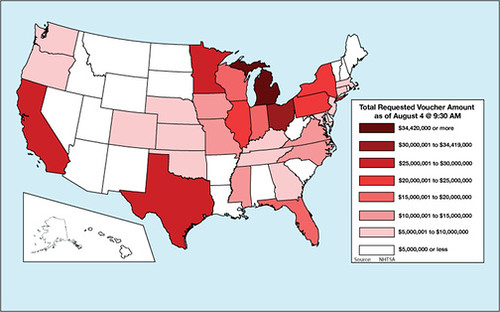
Jalopnik reports that domestic car-producing states who have a large stake in the industry are where most Cash for Clunker vouchers are being requested, and Michigan leads the pack.
According to data from the NHTSA, Michigan is the highest-ranked state in terms of spending with $34,420,500 in voucher requests through Monday afternoon. This far outpaces Ohio, which is in second with $29,274,000 in requested vouchers. California is the most populous state in the nation, but is in third with $26,433,000, followed closely by Minnesota with $26,168,000 in requests.
The area with the least number of trades was Washington, DC, where not a single person took advantage of the program.

Jalopnik concluded that Cash for Clunkers appears to be popular across the map, but the highest concentration is in areas where people are concerned with the performance of the Not-So-Big Three (their words, not mine). That makes sense. The trickle down effect from these car sales won't just help our automakers, but Michigan stands to gain in terms of tax revenue and our local communities benefit when salespeople start spending their commissions at stores, restaurants, etc.

504x_Cash_For_Clunker_State5


These were the ten most purchased cars according to Jalopnik (approximately 47% of the sales are vehicles from the Big-3).

1. Ford Focus
2. Toyota Corolla
3. Honda Civic
4. Toyota Prius
5. Toyota Camry
6. Ford Escape FWD
7. Hyundai Elantra
8. Dodge Caliber
9. Honda Fit
10. Chevrolet Cobalt

Jalopnik theorizes that foreign cars took 6 of the 10 slots because domestic automakers don't have the most fuel efficient vehicle choices on the road. I have to agree. The Big-3 were warned, but they ignored fuel efficiency because they were making tons of money on SUVs and trucks. Better late than never I guess. And, as Jalopnik points out, "the news is still slightly better for them that they're able to keep pace with their foreign competition."

(Cross-posted at Blogging for Michigan.)

Friday, June 19, 2009

Increase the Train Fund, Give the Work to Detroit

A journalist writing in The Atlantic argues that the relative chump change being thrown at high speed rail (AIG and Citibank got 55 times as much, roughly $460 billion vs $8 billion) could become diluted across so many states that no one "will end up with a top-of-the-line system that could provide thousands of new jobs and an envy-inducing model for America." He offers a better alternative that benefits Michigan.
Instead of scattering nickels and dimes across dozens of states, a better idea would be to increase the train fund at least tenfold so America can have at least one legitimate high-speed rail line like Spain’s Madrid-to-Seville train, which runs at 186 mph (Amtrak averages only 79 nationwide). And let this man-on-the-moon project start in Detroit.

Yes, Detroit. The city that was once part of FDR’s “Arsenal of Democracy,” for its part in retooling auto plants to make World War II tanks and bombers, has easily a dozen empty auto plants that could be making train engines and train cars.
We also have the trained workforce. According to UAW Local 651 President Art Reyes, he has “a workforce of 900 that’s been downsized from 9,000, but every one of them is computer-literate and ready for cutting-edge, green-technology stuff, whether it’s wind turbines, next-generation auto batteries, or rail."

Increasing the train fund tenfold is a nice dream, but I doubt there's the political will, especially on the right. That's too bad, because - once again - we lag behind the rest of the world in progress. This is China's plan.
China, as part of their two-year stimulus plan, is poised to spend 3% of their GDP a year on public investments in renewable energy, low-carbon vehicles, high-speed rail, an advanced electric grid, efficiency improvements, and other water-treatment and pollution controls. This is about $12.6 million every hour. In the United States, the American Recovery and Reinvestment Act invests about half as much as China on comparable priorities. This represents less than half of one percent of our 2008 gross domestic product.
There is good news though. The Midwest appears to be a frontrunner in the race for $8 billion in funds because we're part of the Midwest Interstate Passenger Rail Commission, along with seven other states, and federal guidelines give an edge to states that have banded together. It's a start.

Cross-posted at Blogging for Michigan.)

Wednesday, June 10, 2009

Auto Industry Problems Prolong Nation's Misery

The NY Times has an article about our state's efforts to remake ourselves without "King Auto" that touches on things most of know - film incentives, green jobs, battery production, and worker retraining. It also touched on the fact that our problems are impacting the country as a whole.
On a broader level, the troubles of the auto industry are having a profound impact on the overall United States economy. The industry — with Michigan as its center — now accounts for only 1.5 percent of the nation’s economic output, down from 3 percent in 2007 and 5 percent at its peak in the 1950s.

The automakers have historically played a big part in ending recessions. Car companies, in the past, would increase production and add workers to satisfy pent-up consumer demand after a downturn. But now, the industry’s troubles may be prolonging the misery.

“If not for the problems in the auto industry, this recession would have been much milder,” said Ben Herzon, an economist at Macroeconomic Advisors, in St. Louis. [emphasis added]
Okay, that's something most of us know too, but I pointed it out for all the Limbaugh and Hewitt trolls that might be reading this. Hoping that GM or Chrysler fails is not in the best interest of the country. When we lose jobs, we lose money, and in turn we stop spending. When we stop spending, businesses lose money and they're forced to layoff people or cut wages. Unless you're independently wealthy, the pain will eventually trickle down to you too. Understand?

Monday, June 01, 2009

Follow G.M. Restructing on the Web

I'm still recharging my batteries and taking a break from blogging, but I thought I'd pass along a few links regarding GM that I thought you might find useful.

You can follow the GM bankruptcy proceedings online at GM Reinvention.com. The website answers questions about their restructuring and will post updates as they become available.

Want instant updates? Turn to Twitter.com/GMBlogs.

Finally, you can also check out FastLane Blog where Fritz Henderson had this to say:
We’re committed to open communications and I am personally putting a high priority on transparency. One way we’ll do this is by launching a series of live web chats on this website. I’ll kick things off later this week for one hour on Thursday, June 4 at 3 p.m. EDT. Following me, a steady stream of GM leaders from throughout the company will host additional chats, about two a week, on whatever topics are of most concern to you.
The weekly chats are a great idea and so is the high priority on transparency. It sounds like G.M. learned something from the Obama administration.

Friday, May 15, 2009

A High Stakes Game of Chicken

Remind me never to play poker with President Obama. I have a feeling he's good.

After receiving $25 billion in taxpayer-funded TARP funds, greedy J.P. Morgan Chase decided to play hardball with the auto task force when it came time to negotiate over debt recovery before and during the Chrysler bankruptcy. According to the WSJ:
President Barack Obama's auto task force heard a blunt message early this spring from J.P. Morgan Chase & Co., the largest lender to Chrysler LLC. In any deal to remake the troubled auto maker, Chrysler would have to repay its lenders all $6.9 billion it owed.

"And not a penny less," said James B. Lee Jr., vice chairman at the bank, in a call to auto task-force boss Steven Rattner on March 29.

The next day, Mr. Obama called the banker's bluff. The president stepped before a podium to announce that Chrysler could face a disorderly bankruptcy or even liquidation. His meaning was clear: If that happened, the lenders would get nowhere near $6.9 billion.

A few hours later, Mr. Lee called Mr. Rattner back. "We need to talk," he said.

The banker's about-face was a vivid example of the government's tightening grip on a humbled financial industry. Pulling a trick from the hedge-fund playbook, the government used its leverage as the sole willing lender to Chrysler, either in bankruptcy court or out, to extract deep concessions from some of the country's biggest banks.
h/t to Epicurean Dealmaker who explains that the WSJ made it appear that almost all the lenders involved understood exactly what type of game they were playing:
Many of the lenders believed the administration wouldn't let Chrysler file for bankruptcy. "The plan was to call the government's bluff. The game was to game the government," said a manager of a distressed-debt fund.
Gaming the government is essentially the same as gaming the taxpayers. The good news according to E.D. is that the system worked exactly as it should.
The government simply did what any hedge fund driven by fiduciary duty and self interest would have done if it held the reins: it dictated the terms it wanted to see, and it told the creditors to pound sand if they didn't like it. The creditors, on the other hand, seemed to sally forth onto the field of battle without fully considering who was supplying their reinforcements (the Treasury), where they were fighting (in the forum of public opinion, as well as the arena of commerce), and the outside chance that their primary opponent might be smarter than a bag of hammers (and therefore realize and exploit its advantages). In return, they got schooled, but good.
Oh, yeah, he also had a comment for the whiners complaining about the government's involvement in economic affairs:
Deal with it. Buck up, and move on. Find a less lopsided game to play in.

Because I can guarantee you the government and 95% of the people who elected it to power don't give a rat's ass that you're going to lose money on your Chrysler bonds.
Yeah!


(Cross-posted at Blogging for MI.)

Wednesday, May 13, 2009

Buy It Here; Build It Here

USW President Leo Gerard is a soft-spoken man, but he has some blunt words about General Motors restructuring plans:
The proposition General Motors has presented to the United Auto Workers and American taxpayers in its latest restructuring plan is simple: You must pay for your own execution.

GM, which already took $15.4 billion in bailout money, wants another $11.6 billion and is offering in return this deal: It will close 16 of its American manufacturing plants, terminate 21,000 of its factory workers and double the cars it builds in low-wage Mexico, China and South Korea and ships back to the U.S. to sell.

There it is: GM is demanding that Americans pay to send their own jobs overseas.

In the world where corporate executives live, the one in which boards of directors grant CEOs multi-million dollar bonuses even after companies tank, maybe that’s not a perverse proposition.

But in the world where real Americans live, we’ve had enough of this crap. Decades of foolish tax and other federal policies that encouraged American manufacturing firms to throw Americans out of work and expatriate were bad enough. To expect American taxpayers to bankroll GM’s plans to layoff American workers and move their jobs overseas goes too far.
Gerard goes on to point out that this isn't just about the UAW or GM. This is about American manufacturing and the millions of people in good-paying jobs who depend on the auto industry - steelworkers, rubber workers, glass workers, healthcare, education, retail - a total of more than 7 million people.

What will we be left with if manufacturing dies? "America is in danger of attempting to subsist on an economy based on nothing more than amorphous derivatives, credit default swaps and Ponzi schemes." Manufacturing jobs helped millions of people achieve the American Dream and that dream is now under assault.
In just the past eight months of this recession, caused in huge part by recklessness on Wall Street, this country has lost 1.2 million manufacturing jobs, according to the U.S. Department of Labor. GM cannot take tax dollars to slash more. Former U.S. Labor Secretary Robert B. Reich agrees. Here’s what he told the Washington Post, “. . . it raises fundamental questions about the purpose of bailing out these big companies. If GM is going to do more of its production overseas, then why exactly are we saving GM?”
Gerard says, "We have no intention of buying our own noose. We intend to win this fight." He's being joined in that fight by Sen. Debbie Stabenow, the Rev. Jesse Jackson, actor Danny Glover and Lansing Mayor Virg Bernero, as well as the USW, the Alliance for American Manufacturing, and the Mayors and Municipalities Automotive Coalition, among others. They're conducting an 11-state, 32-city protest bus tour: “Keep it Made in America.” The idea is simple. If we buy it here, we should build it here, which Gerard points out is not impossible for a U.S. auto company to do.
Ford Motor Co., which is not taking any bailout money, is investing $500 million in retooling its Michigan Truck plant outside Detroit so that it can make small cars that it will sell worldwide, including its next-generation, battery-electric Focus. And Chrysler, which is getting bailout money, has made a deal with Fiat under which the Italian car company will manufacture a small car in one of Chrysler’s U.S. assembly facilities, which, along with other long-term commitments, will eventually create 4,000 U.S. jobs.
At each stop along the tour, people are being asked to sign their petition supporting "Buy it here; build it here." Please click over and add your name too. They'll present the petitions at a teach-in conference in Washington, D.C. on May 19 when they'll explain to elected officials why GM’s plan fails America and why they must require GM to submit a new plan supporting American jobs.

Thursday, April 30, 2009

Greedy Hedge Funds Stomp Feet and Pout

Wizardkitten asked if hedge funds were trying to force Chrysler into bankruptcy and Jonathan Tasini answered: American Car Industry Held Hostage by Greedy Hedge Funds
...in a blazingly short amount of time, the Administration has forged a deal that could save thousands of jobs at Chrysler--the major banks are on board, the UAW has made more significant concessions. But all that may come crashing to a halt because of a few hedge funds who are holding the entire car industry hostage because, boo-hoo, they aren't getting enough out of the deal. What a spectacle.
Spectacle? Yeah, in a Bonnie & Clyde or Godfather sort of way.

As Tasini points out, the president lived up to his pledge, the UAW accepted concessions...
On top of concessions already given in 2005, 2007 and 2008, the UAW members have agreed to accept cuts in pay and benefits.
And even the major debt holders were on board.
Led by J.P. Morgan, the banks holding 70 percent of Chrysler's debt agreed to a deal that would effectively mean they would have to write-off a health chunk of change.
Everyone sacrificed and the administration even tossed more cash on the table and it still wasn't enough for the greedy hold outs.
Three of the bank-debt holders on the bank-steering committee, Oppenheimer Funds, Perella Weinberg Partners' Xerion Capital Fund and Stairway Cap Management, told J.P. Morgan and the other large lenders on a bank call Tuesday that they wouldn't support the deal and would advise other lenders not to support it.
I'm not a financial expert, but I think that's just dumb. Tasini thinks it's dumb too.
Even if the hold-out hedge funds refuse to make a deal by midnight tonight, forcing Chrysler to file for bankruptcy, they are unlikely to do any better in the swift bankruptcy proceedings envisioned. Do the geniuses at Perella et al. think that a bankruptcy judge, looking at a deal that has the blessing of the U.S. Treasury, the banks holding 70 percent of the debt, and the the union representing tens of thousands of workers (not to mention Fiat, which is waiting in the wings to scoop up Chrysler) will dramatically alter the outlines of the deal? No.

But, here we are: American workers, the Administration and the public generally is being held hostage by a few deal makers who run the very kind of financial firms that evaporated trillions of dollars in wealth. [emphasis mine]
And they wonder why a majority of the public believes corporate America (and particularly the financial industry) needs a new moral direction.

Wednesday, April 15, 2009

Stabenow and Peters Talk Bankruptcy on "The Ed Show"

Sen. Debbie Stabenow was on the Ed Show Monday night and Rep. Gary Peters was on last night. They discussed a possible GM bankruptcy, which could jeopardize the pensions of 670,000 retires, with 335,000 seeing benefit cuts.

Both lawmakers agreed that bankruptcy should be a last resort, but Ed characterized Obama's Auto Task Force as throwing workers under the bus when it comes to their pensions. Stabenow had a different perspective:
SCHULTZ: But what about those retirees—senator, I have to ask you, what about these retirees. They didn‘t vote to have their benefits cut. These are your constituents in Michigan.

STABENOW: No question. If you‘re asking me, do I think bankruptcy is a good idea? The answer is absolutely not. I don‘t support bankruptcy as an option. And the reality is that taxpayers shouldn‘t either, because we‘re talking about 670,000 people with pensions with General Motors alone that would become potentially a federal responsibility. [...]

SCHULTZ: -- that if it goes to the Pension Guarantee Corporation, and people have to take a cut, I don‘t know how they are going to be motivated to come back and vote for the Democrats.

STABENOW: Well, first of all, people took a pay cut to get that pension, and they should not be cut in their pensions, period. People took pay cut after pay cut to keep their health care and to keep their pensions. And so there is a way to do this, even going into a bankruptcy.

Northwest Airlines, based out of Detroit substantially, went into bankruptcy, kept their pension obligations. We worked with them to help protect their pensions. They came out of bankruptcy. They kept their pension commitments. So it is possible to do that. And I am strongly urging the administration, whatever happens, to keep those pensions intact, because people have worked hard all of their lives for those.
Bloomberg reports that GM’s plan is in relatively better shape than others, because it’s about 87 percent-funded, but they also point out that as many as half of GM’s 670,000 pension-plan participants could see their benefits trimmed if the PBGC takes over the plan. Jack Dickinson, president of an advocacy group called Over the Hill Car People says, “Nobody really knows” what would happen with GM pensions in a bankruptcy." (The DetNews has more on how bankruptcy could affect workers' pensions.)

One thing struck me in the interview above. Schultz wondered why people would be motivated to vote for Democrats if General Motors files bankruptcy. Is Ed serious? As the Free Press recently pointed out...
Moreover, the government's track record setting policy that affects the auto industry is atrocious. Car companies have been flogged for not producing enough small, efficient vehicles, but the government eschews a national gas tax that would keep demand for such vehicles high. The companies have been derided for exorbitant labor costs, but in too many instances, government trade policy doesn't help them by holding other countries to decent labor standards.
Democrats and Republicans are responsible for that track record, but Republicans have been in control of the White House for the past 8 years and in control of Congress for almost 20 years. They were the ones actively pushing their free trade, anti-tax, kill the unions, drill, baby, drill rhetoric all that time. And when the chips were down last fall and the auto industry needed help, it was Republicans who pulled the plug on the industry and voted no.

If McCain had won the election, I have no doubt GM and Chrysler would be history already and the Republicans and their US Chamber of Commerce cronies would be giving one another high-fives.

And I won't soon forget how Republicans voted on minimum wage, SCHIP, equal pay, etc. They don't even feel we should have universal health care.

A vote for any member of the GOP is a vote against the middle-class, and General Motors filing for bankruptcy won't change how I feel about them. The lawmaker who does the most for the middle-class gets my vote, and the majority of the time that's a Democrat.

Wednesday, April 08, 2009

Save American Jobs: Boycott Chase Bank

This is cross-posted from Emptywheel. Marcy Wheeler is asking everyone to help save American jobs by boycotting Chase Bank.
JP Morgan Chase wants to push Chrysler into bankruptcy so it can jump the line ahead of retirees and US taxpayers to get paid back.

If JP Morgan Chase does that, 300,000 people will lose their jobs.

That's sorry thanks we get from a company that has gotten $25 billion in TARP funds from American taxpayers--plus billions more in other benefits from the Wall Street bailout.

My husband and I decided the only way to pressure JP Morgan Chase to negotiate in good faith with Chrysler was to close our Chase accounts. We want our money to go to a bank that is investing in rebuilding Michigan--not bankrupting it.

Now, FDL and Progress Michigan are calling on others to join our Chase boycott.

Sign the petition

Join the FaceBook group

Find your Michigan Chase branch and close your account

Explain why you're closing your account
Michigan resident and progressive radio host Nancy Skinner is joining the boycott and closing her accounts. She'll have Jane Hamsher on her show today, at 3PM ET, to talk about this action. You can listen in here.

One other thing: PASS THIS ALONG and ask your friends and family to take action.

(If you're reading this and don't live in Michigan, it doesn't matter. These job losses won't be confined to Michigan alone, so find your branch, close your account and/or sign the petition.)

Wednesday, April 01, 2009

More on that "surgical" bankruptcy

An auto bankruptcy could cost one-third of the three million people employed in the industry and shave four percentage points from our GDP according to a Deutsche Bank analyst. I guess that's why Obama called it a "surgical bankruptcy" in his address on Monday. Losing that many people would be like losing a limb in order to save your life. That's the bad news.

There is some good news though, at least for GM. An article in the NY Times reports the "government may seek to ease General Motors into what it calls a “controlled” bankruptcy, somewhere between a prepackaged bankruptcy and court chaos, by persuading at least some creditors to agree to a plan that would cleave the company into two pieces."

This is how it would work:
Under a plan being worked out by the administration, G.M. would file for prearranged bankruptcy, according to these people. It would then use a sale authorized under Section 363 of the bankruptcy code to quickly sell off the desirable assets to a new company financed by the government. These good pieces might include Cadillac and Chevrolet, as well as assets the company needs to run the business.

Less desirable assets, brands like Hummer and underperforming factories, would be left in the old company. Proceeds from the sales, including stock in the new company, would be given to the old G.M., helping to settle claims.
I mentioned Section 363 bankruptcy the other day. The goal the administration seeks is to create a new, healthier, competitive G.M. by leaving behind its liabilities and less valuable assets, which is also similar to the way the government handled Lehman Brothers last year.

The administration would also have to win support from some of G.M.’s creditors, "notably the United Automobile Workers, which would be forced to pare its health care benefits and whose pension obligations would probably remain in the old company." That's bad news, but...
There will be pressure to keep plants open, to keep employment in communities high, he said, “because typically G.M. or Ford or Chrysler are very substantial contributors to the local tax receipt flow.”
They're telling us something we already know all too well. Experts are also saying history offers almost no precedent for a G.M. bankruptcy simply because no other company ever matched their size and interconnectedness.

The news for Chrysler isn't as good. Obama is prepared to let Chrysler go bankrupt and be sold off piecemeal if they can’t form an alliance with Fiat.

Bankruptcy is only at a possibility at this point, but it's looking likelier by the day - or at least within 30-60 days, and there's no doubt Michigan will suffer more pain if it happens. All we can do is trust Obama. He said he would direct a comprehensive effort to lift the hardest hit areas "by using the unprecedented levels of funding available in our Recovery Act and throughout our government to create new manufacturing jobs and new businesses where they are needed most – in your communities." He also said he would fight for us and help put us back on our feet. Things look bleak now, but not hopeless. With Obama helping us, we can come through this and be made whole again.

Tuesday, March 31, 2009

Maybe it's time to talk about the "B" word

Like DJ, I'm feeling a combination of anger and fear about our auto industry's future, but I also feel a sense of resignation. How much longer can we continue this way? We're dying slowly, one excruciating job loss at a time, and it's like torture. I'm beginning to think maybe it's time to call in the triage team, or in this case the restructuring team.

Michigan native Jonathan Cohn expands on the "surgical bankruptcy" Obama mentioned this morning. He believes the administration is serious about that possibility, and he also notes that people involved in the debate see Section 363 of the bankruptcy code as a way for the company to continue operating without the burden of their huge debts. ((Fritz Henderson was quoted yesterday as saying a "strategic" bankruptcy supported with government money would be less risky than traditional Chapter 11 protection too.) Cohn provided a link to Harvard Law Professor Mark Roe that basically explains it like this...
GM files for chapter 11. The company puts together the automotive operations, and leaves behind the legacy obligations to retired workers and the bond obligations. It takes the auto operations and sells them intact. Section 363 of the Bankruptcy Code provides for these kinds of sales. This would leave behind restructuring the bond debt and the legacy claims. Whatever GM gets from the automotive sale will go to pay off the bonds and pay off the legacy claims. That part is in some ways straightforward. If it can be completed, consumers would be looking at a viable GM that has exited bankruptcy. Then the claims–the legacy claims and the like–will be resolved.
Is Section 363 what Obama has in mind? It does have some benefits. GM would continue operating without the burden of their legacy debts, or what we call pensions and lifetime health care benefits. That would help free up cash and strengthen the company, which could end up protecting jobs that would be lost if they were allowed to completely fail. But what about the thousands of retired employees? Does that mean the PBGC would assume GM's pensions and people would lose their health care? Maybe someone familiar with bankruptcy laws could fill us in and help alleviate our fears.

As dark as it seems right now, there is reason to be hopeful about Obama's plans if history is any guide. According to an article in Washington Monthly, "any honest reading of history suggests that the federal government has quite an impressive record of rescuing institutions considered too big to fail." From banks to Lockheed, Chrysler, airlines and Penn Central Railway [Nixon came to the conclusion help was necessary - it's known as Conrail today], government help turned out better than anyone hoped and the companies returned to profitability. Those successes also left a good checklist for the Obama administration to follow:
...leave your ideology at the door, pay more attention to the engineers and managers on the ground than to the financiers in the corner offices, and remember that social returns, not profits, are the ultimate measure of success.
Our future is still uncertain, but I'm confident that if Bush and the Republicans were still in control, we'd be writing an obituary for GM and Chrysler today. I trust President Obama to remember those social returns and do his best to turn things around for us. I just hope he can fight off the Republicans and Wall Street types who'd prefer to just pull the plug and let us die.

And remember, Obama didn't say he's letting us die. He said he'd fight for us and that he's sending us help, which is like sending us to rehab. That's where patients go to have their quality of life restored. It's where they go to become whole again. We need that. We need to be whole again.

Thursday, February 19, 2009

Creating jobs in America is the whole point

Following up on my earlier post about the "Buy American" provisions in the stimulus package - provisions designed to stop the bleeding of jobs and to create new jobs here in America - is a post from Robert Reich that admonishes us not to "confuse American companies with American jobs."
The new stimulus bill, for example, requires that the money be used for production in the United States. Foreign governments, along with large U.S. multinationals concerned about possible foreign retaliation, charge this favors American-based companies. That's not quite true. Foreign companies are eligible to receive stimulus money for things they make here (as long as the nations where they're headquartered have signed the WTO procurement agreement). [...]

I'm not defending the "buy American" provisions of the stimulus bill. I'm just saying they're not the same as "buy from American companies." And although these provisions skate close to protectionism and risk foreign retaliation, at least a case can be made that if American taxpayers are footing the bill in order to create American jobs, the jobs should be created, well, here in America.
I added that emphasis because it's an important distinction. If we buy steel slabs produced in Canada or China, jobs will be created or maintained over there and fewer jobs will be created here, which defeats the whole purpose of the stimulus plan.

Reich also applied this line of reasoning to the auto bailout:
I’m not arguing against an auto bailout. But it ought to be focused on helping American auto workers rather than helping global auto companies headquartered in America. [And he points out that the Big Three themselves are global.] Why pay the Big Three billions of taxpayer dollars to stay afloat when, even after being bailed out, they cut tens of thousands of American jobs, slash wages, and shrink their American operations into small fractions of what they used to be?

That’s backwards. The auto bailout should help American autoworkers keep their jobs or get new ones that pay almost as well.
We're between a rock and a hard place place in this country. I agree with E.J. Dionne's opinion that "there are no good solutions for fixing the auto industry," but I also agree with USW President Leo Gerard who said...
Saving the domestic auto industry is crucial to the economic renewal of the U.S. The steel, glass, auto parts, tires, and paper industries produce products for this industry and employ a quarter million of our members alone.
Our livelihoods are all interconnected, and as Reich concluded, "Whether it’s stimulus or bailout, policy makers must remember that American companies aren’t the same as American workers – and our first responsibility is to the latter."

Absolutely. That's why spending money from the stimulus bill on products created here is so important. It keeps Americans working, helps restore our economy and may save our domestic auto industry. Isn't that the whole point?

Thursday, January 08, 2009

Congress doesn't think much of American workers

GM and UAW officials are holding meetings because, under terms of the bailout approved by the Bush administration, GM must bring its own hourly wage costs in line with those of Toyota and other Japanese automakers that operate nonunion factories in the United States. Aside from the fact that I find it outrageous foreign companies have been allowed to push our wages down in this country, I'm also outraged by Congress.

I'm not the only one. Check out this editorial from The Livingston Daily: FEDERAL PAY RAISES: Pay hikes show what Congress thinks of American workers
Remember, during the whole debate over a bridge loan for auto companies, how members of Congress kept saying autoworkers are overpaid? Some U.S. senators and representatives claimed United Auto Workers members were knocking down $73, even $75, per hour.

That led federal lawmakers, like U.S. Sen. Bob Corker, R-Tenn., to call for a cut in pay for auto workers as a condition of the "bailout."

It turns out the figure was wildly wrong. You can only get to figures that high if you include all kinds of things not typically considered wages — health care, benefits, vacation time, pension costs, retirees' health care, etc.
The paper did the math and pointed out that full-time workers actually earn between $58,240 and $61,942 annually, which they point out is a decent living but won't make a person rich. Compare that to our lawmakers in Washington.
Still, it is a far cry from the $169,300 that U.S. senators and representatives were paid this year. If Congress members really work 40 hours a week for 52 weeks out of the year (and they don't), it is well over the $73 per hour rate they so objected to. It would in fact be more than $81 per hour, and that's not counting their benefits, their health care or their pension costs.

What's more, lawmakers are going to get a raise. Yup, that $81 an hour isn't good enough for them. They deserve more. Come January, U.S. senators and representatives get an additional $4,700 in their yearly paycheck, bringing their annual haul to $174,000. Assuming again, a 40-hour week for 52 weeks, that pay rate comes to a whopping $83.65 per hour.
They drew the following conclusion:
So let's make sure we have the logic correct — people who actually build things, in this case automobiles, deserve a pay cut from their $29.78 an hour ... it is lawmakers who deserve a boost in pay to $83.65 an hour ... for getting their facts wrong when they debate issues, like how much autoworkers get paid.
Yep, that pretty much sums it up. Lawmakers get raises when they make mistakes and spread lies. They even get them in the midst of the worst recession since the Great Depression. That's a sweet deal.

Hypocrisy aside, higher pay was supposed to translate into better government when Congress voted to raise their pay in 1989 from $89,500 to $135,000 annually. So much for that theory. We're fighting a war based on lies, inequality is at levels not seen since the Depression, our economy is in a deep recession, unemployment numbers could be 10% or higher by summer, millions of people have lost their homes to foreclosure, and millions more live in poverty and/or without health insurance.

In the real world, they'd be fired for such gross negligence.

Monday, December 15, 2008

Thanks for nothing, senators

Author and Free Press columnist Mitch Albom wrote a response to the senators who killed the auto loan deal last week and it's generating a lot of attention here in Michigan. (It's been recommended more than 1,000 times so far.) He pretty much expresses the collective outrage most of us have been feeling since Friday, starting with the title - Hey, you senators: Thanks for nothing.

Here's a sample of what Albom had to say. Click over to read the rest.
Kill the car, kill the country. History will show that when America was on its knees, a handful of lawmakers tried to cut off its feet. And blame the workers. How suddenly did the workers — a small percentage of a car’s cost — become justification for crushing an industry?

And when did Detroit become the symbol of economic dysfunction? Are you kidding? Have you looked in the mirror lately, Washington?

In a world where banks hemorrhaged trillions in a high-priced gamble called credit derivative swaps that YOU failed to regulate, how on earth do WE need to be punished? In a bailout era where you shoveled billions, with no demands, to banks and financial firms, why do WE need to be schooled on how to run a business?

Who is more dysfunctional in business than YOU? Who blows more money? Who wastes more trillions on favors, payback and pork?

At least in the auto industry, if folks don’t like what you make, they don’t have to buy it. In government, even your worst mistakes, we have to live with.
Ain't that the truth. Remember Iraq, senators? That was supposed to be cheap, and quick too. The only thing cheap about that mistake was the way you tried to cut corners and save money at the expense of our troops. From inadequate bullet proof vests and armored trucks to the horrid conditions at Walter Reed Hospital, you turned your backs on the soldiers just like you turned your back on middle-class jobs last week.

And don't try to sell us the idea that your vote was designed to protect taxpayer money. The same day the Free Press ran Albom's column, they also ran one by Susan Tompor describing the financially struggling Pension Benefit Guarantee Board, who may also find themselves needing a bailout. Allowing the Big 3 to fail would only add to the problem according to one expert:
He said that the PBGC could inherit more than $100 billion of pension obligations if Ford or GM filed for bankruptcy and the pension funds were turned over to the agency.
That $14-25 billion bridge loan is chump change by comparison. Add in unemployment compensation, increased Medicaid spending, the loss of tax revenues, etc., and that loan looks like a better deal by the moment.

Adding another 2-3 million people to the ranks of the unemployed is a huge mistake too. Obama wants to pass a stimulus package pushing $1 trillion dollars in order to create 2.5 million jobs, which won't even replace the jobs lost under the Bush administration. How does killing even more jobs help? Washington might as well double that package to $2 trillion if the Big 3 go down.

Thanks for nothing, senators. Do me a favor and take Albom's advice.
You’re so fond of the foreign model, why don’t you do what Japanese ministers do when they screw up the country’s finances?

They cut their salaries.

Or they resign in shame.
In order to resign in shame, these senators would have to feel some shame first. And in order to feel shame they would have to care. They don't.

Thursday, December 11, 2008

How will the Big 3's cries for help be answered?

Tom Walsh has a very thoughtful column at the Free Press that reminds certain GOP senators of the Big 3's response after Hurricane Katrina:
...the automobile companies of Detroit did not harrumph that the Gulf Coast should have been better prepared.

They didn’t sit back and wait for New Orleans to submit a detailed plan for future repair of the ruptured levees.[...]

Between them, the three Detroit auto companies gave more than $18 million in cash and vehicles to the Katrina relief effort in the ensuing months. No strings attached.
That's just one example. Detroit's Big 3 are known for their charity and generosity in communities across our country. Now its their turn to ask for help. Before you just brush them off and say no, consider what else Walsh had to say:
If you see a fellow American is drowning, gasping for air, do you quiz him for awhile about whether he’s drunk or why he never learned to swim better? Or do you throw him a lifebuoy and ask questions later?

That, it seems to me, is where we are with America’s car companies.

You can do nothing and watch them die, senators.

Or you can rush in immediately with emergency aid – as GM, Ford and Chrysler did in the case of Hurricane Katrina, and after the Sept. 11 terrorist attack, and during countless other disasters.

And you can hold their feet to the fire afterward, empowering a strong auto czar to make sure they do what’s needed to withstand future shocks.
Millions of lives are hanging in the balance, senators, including those of children, seniors and others who rely on the workers for their incomes. Please consider them when you make your decision. This is about more than unions or poorly managed companies. This is about families. They don't deserve to have their feet held to the fire.

“The quality of mercy is not strained, It droppeth as the gentle rain from heaven, Upon the place beneath: it is twice blest, It blesseth him that gives and him that takes.” - William Shakespeare's The Merchant of Venice.


(Cross-posted at Blogging for MI.)

Sunday, December 07, 2008

The legacy of WWII veterans

Today is the anniversary of Pearl Harbor and the Flint Journal observed it by telling the story of one man who survived the attack, Staff Sgt. Ward Anderson of Chesaning.

It was 7:55 a.m., Dec 7, 1941 and Anderson and some friends had just left church and were thinking about going to the PX for breakfast.
Suddenly planes appeared overhead, flying low and loud. The men didn't pay much attention at first.

"We thought it was probably Navy maneuvers," said Anderson, then 20.

Then they noticed "big red suns" painted on the planes' wingtips: The Rising Sun emblem of Japan.

"I said, 'Oh, hell,'" Anderson said. "Or probably something worse."

Anderson counts himself lucky to have survived the first foreign attack on U.S. soil, which claimed the lives of more than 2,000 and pulled America into the second World War -- 67 years ago today.
His service to our country does not go unnoticed. Anderson wears his "Pearl Harbor Survivor" hat while out in his community and he's often approached by grateful people, rightly so, but we shouldn't let this day pass by without recognizing the sacrifice and service of an industry that has been maligned quite a bit lately - the Big 3. The Detroit News stepped up and recognized them in an editorial today: Remember the Arsenal of Democracy
We note with considerable irony that today, as the fate of Detroit's automakers rests in the hands of Congress, the nation marks the 67th anniversary of the Japanese bombing of Pearl Harbor.

In the days after that attack, as the nation geared up for war, the federal government turned to Detroit's automotive industry and asked it to convert its factories to produce military hardware.

In a matter of weeks, Ford, Chrysler, General Motors and the other automakers of the time were churning out tanks, planes, Jeeps and other machinery of war. They stopped making passenger cars and turned their full energies toward defending the nation, and agreed to only a minimal profit for their work.

When America's survival was on the line, Detroit didn't ask questions; it pitched in with all its industrial might to save the country. The Big Three's survival is now on the line. We hope Congress remembers the sacrifice the auto industry has made for America and considers carefully whether it would ever want to go into a war of that magnitude again without the Arsenal of Democracy.
I hope Congress also remembers the survivors of WWII, who came home after the war and worked in factories across the country to build a better future for their children and grandchildren. Unionization grew to one-third of the workforce, every income group grew (incomes grew fastest for the lowest-income Americans) and most middle-class Americans had good health care and could look forward to a secure retirement.

The "Greatest Generation" fought in WWII because it was the right thing to do, and they came home and fought for shared prosperity and better living standards for everyone because that was the right thing to do too. As Americans, we honor them by fighting to protect what they worked so hard to give our country.

Thursday, December 04, 2008

Washington Should Protect U.S. Cars and U.S Jobs

Gettelfinger appeared before the Senate Banking Committee today in Washington and was asked a question that I can't recall now (I'll keep searching for the transcript), but I do remember he referred to the Level Field Institute when giving his answer. It's an interesting site with a wealth of information and statistics on quality, R&D, jobs, suppliers, etc. But more importantly, they have the facts you need if you want the car you buy to support jobs and investment in your community.

Here's some information I gathered from their pages.
  • Ford, GM and Chrysler sell about half the cars bought in the U.S., but they buy nearly 80% of the parts made here.

  • On average, Ford, GM and Chrysler cars use two and a half times more "domestic" parts.

  • GM and Toyota use approximately the same numbers of workers to build each car. The difference is, only 12% of Toyota's workforce is here. At GM, it's nearly 40%.

  • The bulk of Ford's engineering, design, financing and marketing are here, while Toyota conducts much of that work in Japan.

  • U.S. automakers invest more in R&D than any other industry - and Ford, GM and Chrysler invest approximately 80% of that spending here in the U.S.

  • Ford, GM and Chrysler spend nearly fifteen times more than the Energy Department spends on energy efficiency/alternative fuels programs.

  • Buying a Ford, GM or Chrysler supports about 6 times more U.S. jobs, on average, than buying a Hyundai - and 2.5 times more U.S. jobs, on average, than buying a Toyota. Does that mean the Big 3 are 6 times less efficient than Hyundai, or 2.5 times less efficient than Toyota? It's where the work gets done that matters most to U.S. jobs.

  • "Made in America" matters even more when you look at the men and women working for auto parts suppliers that serve automakers. These companies employ about twice as many Americans as the automakers themselves. And Ford, GM and Chrysler purchase nearly 80 percent of the parts these people make. Based on their market share, foreign automakers should be buying about twice what they are.

  • Tomorrow's jobs will depend, in part, on today's R&D, particularly in fuel efficiency and safety. The Japanese Automobile Manufacturers Association (JAMA), an association of 14 Japanese automakers doing business in America, notes that they collectively employ 3,600 R&D workers at 36 facilities nationwide. Honda operates 10 facilities employing 1,300 R&D professionals. Level Field welcomes these jobs, but more than 65,000 Americans (nearly 20 times JAMA's total) work in 215 automotive R&D facilities in Michigan alone.
  • Check out the Level Field Institute for yourself. I only touched on a few areas, but one thing is certain - the U.S. car industry is huge and allowing it to fail will kill jobs we'll never get back.

    Gettelfinger touched on that today when he noted the following (I'm paraphrasing):
    For every 2500 cars made in U.S. plants by the Big 3, approximately 78 people are employed to make them. If the domestic automakers fail and foreign makers in our country pick up their production, only 33 jobs will be created per 2500 cars. That's because the foreign automakers buy more of their parts from overseas. We'd still experience net job losses of about 45 jobs per 2500 cars produced.
    Once those jobs go, they'll be gone forever, and foreign automakers will reap the profits. R&D will suffer too. Is that Washington's idea of putting America first?


    (Cross-posted at Blogging for MI)

    Monday, November 24, 2008

    The Problems Facing Big Three Belong to All of Us

    Finally. A journalist with some common sense comes to the Big Three's defense. Thank you, Warren Brown.
    According to the MOP [Mob of Pundits] crowd, American car companies have messed up -- making too many trucks and sport-utility vehicles, ignoring consumer and governmental demands for more fuel-efficient vehicles and, as Will stated in a column last week, entering "improvident labor contracts" with the UAW.

    It's baloney.

    Americans went truck crazy in the 1990s and in the early years of this century, making light trucks more than 50 percent of new vehicles annually sold in this country, for the same reason they are in danger of re-embracing that madness -- cheap gasoline. They were enabled by lawmakers who, with one hand, pushed car companies to increase technical fuel efficiency while using the other to give American consumers the least-expensive gasoline in the developed world.

    Increased technical fuel efficiency plus low-cost gasoline fueled consumer demand for more driving and bigger and more powerful vehicles with which to do that driving. Gasoline consumption in the United States soared . . . until high fuel prices restored some sanity to the U.S. consumer automotive market.
    As Brown reminds us, Honda, Nissan, Toyota and even Mercedes-Benz all had some kind of truck or SUV too because they were following "market demand." Nobody twisted our arms and forced us to buy the gas guzzlers.

    What about the critics who say, "but look at that fuel-efficient, gas-electric Toyota Prius hybrid?"
    Go ahead and look at it, preferably in Japan, where the Ministry of International Trade and Industry (MITI) has done a marvelous job of coordinating industrial and energy policy into a vehicle development and consumption strategy that makes sense. We have no such government-industry cooperation in the United States. We have no industrial policy, no energy policy, which largely is why we now have a core segment of our natively owned manufacturing infrastructure teetering on the brink of collapse.
    Furthermore, Brown points out that European and Asian countries tax horsepower. The least-efficient motor fuels are taxed heavily, while favorable treatment is given to more efficient fuels, such as diesel.
    That cost-sharing creates a kind of honesty. Car companies aren't inclined to design, develop and produce gas-guzzlers because European and Asian consumers are not inclined to buy them. It creates market predictability, contrary to what we have in the United States, where vehicle markets can flower or wither in an instant, depending on the price of fuel.
    What did Brown have to say about the unions?
    It is the rankest hypocrisy for well-paid journalists to decry the "high" pay of UAW-represented employees. I doubt that there is one UAW critic in the media, or on Capitol Hill, who would be willing to settle for a UAW paycheck. I'm almost certain there isn't one who would be willing to trade his or her relatively cushy employment for a year on an auto plant assembly line.

    Criticism of "improvident labor contracts" thus smacks of class bias. It reeks of the notion that some work, such as that involving manual labor, inherently deserves less compensation than others, such as expressing one's opinion. It's more baloney.
    Brown doesn't excuse the Big Three and he admits they've made mistakes, but he also points out they've done many things right - "contributing to the defense of this country; helping to create a viable middle class, especially in America's minority communities; and contributing to technological advancements in the global automobile industry."

    The bottom line: "The potential failure confronting GM, Ford and Chrysler is not Detroit's alone. It belongs to all of us."

    The solution to this problem belongs to all of us too - consumers, domestic automakers and the government. We have to keep pushing for meaningful energy policies regardless of the price of gas and we have to demand industrial policies that level the playing field for our domestic automakers and workers.