Showing posts with label Obama. Show all posts

Tuesday, January 19, 2010

Broadband Suffers From Lack Of Big Government

Yet another area where the U.S. trails the rest of the world. Via Paul Waldman at TAPPED:
But a new report on global broadband shows that the country that invented the Internet, the microchip, and most of what makes our global digital village possible ranks a pathetic 18th in broadband speeds. The top spot is taken, as usual, by South Korea, where their smoking fast connections give them an average speed over three times as fast as what our pokey little modems give us. We also don't score too well when it comes to broadband penetration (the proportion of households that have broadband, as opposed to the actual speed people are getting). Our slow broadband is also really expensive. So that's nice.
We trail countries like Romania, Sweden and the Czech Republic. And on a year-to-year basis, all the countries in the top 10 saw a boost in speed. Ireland topped the list with a 73 percent gain. What about the United States? We were hit by a 2.4 percent decline in speed.

Waldman says they are multiple reasons we lag so far behind, but "the most important one is probably that we don't have enough big government. With a combination of public infrastructure investments and regulations forcing ISPs to share lines, other countries have driven down prices and driven up speeds."

Republicans have been too busy giving tax breaks to the rich and taking care of their corporate cronies over the past couple of decades to care about our public infrastructure. Thankfully, the stimulus bill President Obama signed in February provides $7.2 billion for projects that will increase the spread of broadband. He also instructed the FCC to come up with a plan to achieve universal high-speed access.

Those are good first steps, but something also needs to be done about bringing the price down or making it available for free to low income individuals. Voters depend on the media for information about our democracy and that information shouldn't be limited only to those who can afford to buy it.

Thursday, October 01, 2009

The White House Fact Checks Glenn Beck

The Michigan Chamber of Commerce's keynote speaker lied in an attempt to discredit President Obama's efforts to bring the 2016 Olympics to our country and the White House called him and Fox News on it. As they point out, "hosting the Olympics has been a source of pride and unity for the country, but once again Fox News' Glenn Beck program has shown that nothing is worthy of respect if it can be used as part of a partisan attack to boost ratings."

Lie #1:
RHETORIC: BECK SAID VANCOUVER LOST $1 BILLION WHEN IT "HAD THE OLYMPICS." Glenn Beck said, "Vancouver lost, how much was it? they lost a billion dollars when they had the Olympics." [Transcript, Glenn Beck Show, 9/29/09]

REALITY: VANCOUVER'S OLYMPICS WILL NOT TAKE PLACE UNTIL 2010. Vancouver will host the 2010 Olympic and Paralympic Games from February 12 – 28, 2010 and March 12-21, 2010, respectively. [Vancouver2010.com, accessed 9/29/09]
Lie #2:
RHETORIC: CHICAGO IS CLOSING THE GOVERNMENT SEVERAL DAYS A WEEK BECAUSE THEY CANNOT AFFORD TO BE OPEN. Beck's guest Caddell said, "Chicago is closing the government several days a week because they cannot afford to be open. They are going to go and reward -- this is the biggest scandal." [Transcript, Glenn Beck Show, 9/29/09]

REALITY: CHICAGO HAS HAD ONE REDUCED-SERVICE DAY IN 2009, AND WILL HAVE TWO MORE ON THE FRIDAY AFTER THANKSGIVING AND ON CHRISTMAS EVE. [...]
Lie #3:
RHETORIC: VALERIE JARRETT [who is accompanying Obama to Copenhagen] WILL BENEFIT FINANCIALLY. Beck asked, "Is it possible that she is going to benefit if the Olympics come to Chicago?" Caddell responded, "Well, that’s the word. She has certainly had a lot of dealings going on in real estate." [Transcript, Glenn Beck Show, 9/29/09]

REALITY: UPON ENTERING GOVERNMENT, VALERIE JARRETT DIVESTED ALL HER REAL ESTATE INVESTMENT HOLDINGS EXCEPT FOR A SINGLE INVESTMENT THAT HAS NOTHING TO DO WITH THE OLYMPIC BID. Valerie Jarrett divested all her investment real estate holdings upon entering government except for a single real estate holding that she was unable to sell. This single real estate investment has been determined by White House Counsel and the independent Office of Government Ethics to present no conflict of interest in performing her duties as a White House advisor. It has nothing to do with the Olympic bid.
Our country is the throes of the Great Recession and the Olympics could generate $22.5 billion in economic activity and create 315,000 new full-time jobs. It makes me wonder why Glenn Beck hates America, and why business chambers embrace a liar like him.

(There's more on the White House blog.)

(Cross-posted at Blogging for MI.)

Thursday, August 20, 2009

Health Care and Personal Responsibility

Free Press columnist Brian Dickerson asked a provocative question in his column today: Do we all have the same right to health care?

What about these men he saw last weekend at the Woodward Dream Cruise?
...a trio of well-fed spectators wedged into identical lawn chairs on the public right-of-way. [...] Each held a beer in one hand and a cigarette in the other, and all three sported pendulous bellies that spilled over their beltlines and glistened in the midday sun."
Why shouldn't those men be entitled to health care? Obesity and obesity related-conditions like hypertension have been blamed for our rising health care costs, but other major factors include spending on prescription drugs and new medical technologies, longer life spans, a greater prevalence of chronic illnesses, an aging population, and high administrative costs. Poverty, stress, air pollution and environmental hazards affect our health too.

And healthy habits do not necessarily translate into lower costs (via Economix blog/NYT).
Vermonters have the healthiest behaviors, including less smoking and more exercise, according to the latest Gallup-Healthways Healthy Behavior Sub-Index numbers. [...]

The states with the unhealthiest behaviors were primarily located in the Midwest and the South; the worst were Kentucky, Arkansas, West Virginia and Indiana.

How do these healthy behaviors factor into health spending in each state? Not a whole lot, or so it appears on its face. ...

The Western states showed both healthy behavior and lower health costs, but the Northeastern states spent a lot per capita on health care despite their relatively healthy habits. Vermont, for example, spent $6,069 per person on health care in 2004, the ninth-highest level out of the 50 states and the District of Columbia.
Dickerson believes everyone should enjoy access to some minimum level of preventative and acute care, but he wants to add stipulations, i.e. "reimbursement for the cost of treating many chronic health problems should depend, at least to some extent, on what steps the patient has taken to avoid them."

I'm in favor of personal responsibility too, although I'm not sure how possible it is to accurately measure a person's efforts. And in the case of drinking, smoking and overeating, there are often underlying emotional and psychological problems that make quitting extremely difficult. Is it fair to penalize them for falling off the wagon?

Fortunately, helping people live healthier lives is being addressed by President Obama whose principles for health reform include prevention and wellness initiatives. They're also included in the Senate HELP Committee and House Tri-Committee plans. (See a side-by-side comparison of all plans here.)

We need to get health care reform passed and make available to Americans the tools and information they need to live healthier lives today. Nitpicking about personal responsibility and unhealthy habits only serves to slow down or sink reform.


(Cross-posted at Blogging for MI.)

Thursday, July 23, 2009

Racial profiling or not, the Cambridge police were wrong

It's probably safe to say President Obama could have been more tactful last night.
"The Cambridge police acted stupidly in arresting somebody [Skip Gates] when there was already proof that they were in their own home."
Tactful or not, police officers are no different from the rest of us - some of them do a good job and some of them don't. (See here, here and here.) In this case, I agree with the president that the police acted stupidly (and unprofessionally).

It should have been handled differently according to this former policeman.
I was an auxiliary police officer for 20 years, 11 in Michigan where a wise chief told us never, under any circumstances, were we to arrest someone for disorderly conduct. He said that if we couldn't find a more serious charge it was up to us to calm the person down. Otherwise he told us that using this charge was just an easy way to end a situation with a disruptive citizen without using the skill we were supposed to have to de-escalate. ...

As far as I'm concerned the police should have used their skills to de-escalate. This is part of their training.
It's possible Skip Gates blew up and got confrontational, but that doesn't justify arresting the man for breaking into his own house. As the president also said, "I think it's fair to say...any of us would be pretty angry." That seems like a reasonable assumption.

I actually have experience with "profiling" and can identify with Gates. Not too many people know this, but I have a disability that limits my walking distance so I use a wheelchair in public. About 15 years ago, while shopping at Lechters Housewares with my then 14-year-old daughter, I noticed that a salesclerk kept following behind us as we moved through the store. (My daughter was pushing me.) I assumed she was waiting to see if we needed any help so I turned around, told her we'd be fine and that she didn't need to wait on us. Her answer? I have orders to follow customers in wheelchairs to make sure they don't shoplift. I was flabbergasted. Had I been standing up, I probably would have fallen over!

Was I angry? You betcha, but I'm the type of person who busts into tears when I get angry. The yelling comes later. Anyway, the clerk took one look at my face and felt compelled to defend management's policy. She explained that disabled people in wheelchairs are a higher security risk because we can hide kitchen gadgets down by our sides or sit on stuff in order to smuggle it out.

Needless to say, I wasn't too pleased that she treated me like a criminal. I left the store and took my business elsewhere. Lechters went out of business in 2001, proving there is cosmic karma!

I don't know if racial profiling was the motivation behind Gate's arrest or not, but I can understand how a black man might feel in a situation like that because of my experience. Trust me. It's not a good feeling.


(Cross-posted at Blogging for MI.)

Friday, May 15, 2009

A High Stakes Game of Chicken

Remind me never to play poker with President Obama. I have a feeling he's good.

After receiving $25 billion in taxpayer-funded TARP funds, greedy J.P. Morgan Chase decided to play hardball with the auto task force when it came time to negotiate over debt recovery before and during the Chrysler bankruptcy. According to the WSJ:
President Barack Obama's auto task force heard a blunt message early this spring from J.P. Morgan Chase & Co., the largest lender to Chrysler LLC. In any deal to remake the troubled auto maker, Chrysler would have to repay its lenders all $6.9 billion it owed.

"And not a penny less," said James B. Lee Jr., vice chairman at the bank, in a call to auto task-force boss Steven Rattner on March 29.

The next day, Mr. Obama called the banker's bluff. The president stepped before a podium to announce that Chrysler could face a disorderly bankruptcy or even liquidation. His meaning was clear: If that happened, the lenders would get nowhere near $6.9 billion.

A few hours later, Mr. Lee called Mr. Rattner back. "We need to talk," he said.

The banker's about-face was a vivid example of the government's tightening grip on a humbled financial industry. Pulling a trick from the hedge-fund playbook, the government used its leverage as the sole willing lender to Chrysler, either in bankruptcy court or out, to extract deep concessions from some of the country's biggest banks.
h/t to Epicurean Dealmaker who explains that the WSJ made it appear that almost all the lenders involved understood exactly what type of game they were playing:
Many of the lenders believed the administration wouldn't let Chrysler file for bankruptcy. "The plan was to call the government's bluff. The game was to game the government," said a manager of a distressed-debt fund.
Gaming the government is essentially the same as gaming the taxpayers. The good news according to E.D. is that the system worked exactly as it should.
The government simply did what any hedge fund driven by fiduciary duty and self interest would have done if it held the reins: it dictated the terms it wanted to see, and it told the creditors to pound sand if they didn't like it. The creditors, on the other hand, seemed to sally forth onto the field of battle without fully considering who was supplying their reinforcements (the Treasury), where they were fighting (in the forum of public opinion, as well as the arena of commerce), and the outside chance that their primary opponent might be smarter than a bag of hammers (and therefore realize and exploit its advantages). In return, they got schooled, but good.
Oh, yeah, he also had a comment for the whiners complaining about the government's involvement in economic affairs:
Deal with it. Buck up, and move on. Find a less lopsided game to play in.

Because I can guarantee you the government and 95% of the people who elected it to power don't give a rat's ass that you're going to lose money on your Chrysler bonds.
Yeah!


(Cross-posted at Blogging for MI.)

Thursday, April 30, 2009

Greedy Hedge Funds Stomp Feet and Pout

Wizardkitten asked if hedge funds were trying to force Chrysler into bankruptcy and Jonathan Tasini answered: American Car Industry Held Hostage by Greedy Hedge Funds
...in a blazingly short amount of time, the Administration has forged a deal that could save thousands of jobs at Chrysler--the major banks are on board, the UAW has made more significant concessions. But all that may come crashing to a halt because of a few hedge funds who are holding the entire car industry hostage because, boo-hoo, they aren't getting enough out of the deal. What a spectacle.
Spectacle? Yeah, in a Bonnie & Clyde or Godfather sort of way.

As Tasini points out, the president lived up to his pledge, the UAW accepted concessions...
On top of concessions already given in 2005, 2007 and 2008, the UAW members have agreed to accept cuts in pay and benefits.
And even the major debt holders were on board.
Led by J.P. Morgan, the banks holding 70 percent of Chrysler's debt agreed to a deal that would effectively mean they would have to write-off a health chunk of change.
Everyone sacrificed and the administration even tossed more cash on the table and it still wasn't enough for the greedy hold outs.
Three of the bank-debt holders on the bank-steering committee, Oppenheimer Funds, Perella Weinberg Partners' Xerion Capital Fund and Stairway Cap Management, told J.P. Morgan and the other large lenders on a bank call Tuesday that they wouldn't support the deal and would advise other lenders not to support it.
I'm not a financial expert, but I think that's just dumb. Tasini thinks it's dumb too.
Even if the hold-out hedge funds refuse to make a deal by midnight tonight, forcing Chrysler to file for bankruptcy, they are unlikely to do any better in the swift bankruptcy proceedings envisioned. Do the geniuses at Perella et al. think that a bankruptcy judge, looking at a deal that has the blessing of the U.S. Treasury, the banks holding 70 percent of the debt, and the the union representing tens of thousands of workers (not to mention Fiat, which is waiting in the wings to scoop up Chrysler) will dramatically alter the outlines of the deal? No.

But, here we are: American workers, the Administration and the public generally is being held hostage by a few deal makers who run the very kind of financial firms that evaporated trillions of dollars in wealth. [emphasis mine]
And they wonder why a majority of the public believes corporate America (and particularly the financial industry) needs a new moral direction.

Monday, April 20, 2009

Hate Crime Legislation Vote Later This Week

I don't keep up with gay rights as much as I should, so I was surprised to read that Deb Price now writes the first nationally syndicated column on gay issues. Good for her. I only know her work in the Detroit News. (Does anyone else find it ironic that she writes for them?)

Anyway, outside of reading quite a bit about gay marriage in recent months, I didn't realize the Obama administration has been reaching out to the gay community in so many ways. Here are some highlights from Price's recent column, including a mention about the hate crimes legislation that lawmakers will be voting on later this week.
The Obama White House invited gay leaders to the health care and fiscal responsibility summits, the signing of the Lilly Ledbetter Fair Pay Act and the executive order creating the White House Council on Women and Girls, and an online town hall. Gay parents were encouraged to bring their kids to the Easter egg roll. [...]

The White House outreach has included Mara Keisling of the National Center for Transgender Equality and Rebecca Fox of the National Coalition for LGBT Health. [...]

And Obama is salting gay talent through his administration. Most noteworthy is John Berry, confirmed by the Senate as director of the Office of Personnel Management. That puts a gay man in charge of the 1.9 million federal employees, including overseeing their benefits.

Other appointees include Emily Hewitt, an ordained Episcopal priest, as chief judge of the U.S. Court of Federal Claims. A peek at Hewitt's biography on her official court site shows the comfort Obama's gay choices feel: "Chief Judge Hewitt is married to Eleanor Dean Acheson."

Obama tapped Fred Hochberg to chair the U.S. Export-Import Bank, Harry Knox to serve on the Advisory Council on Faith-Based and Neighborhood Partnerships, and Nancy Sutley to chair the White House Council on Environmental Quality.
Price also reports that Obama told two leaders of the Human Rights Campaign that he intends to sign the hates crimes legislation when it reaches his desk, and he supports the need for a federal ban on job discrimination based on sexual orientation or gender identity.

The Hate Crime Legislation (H.R. 1913) was introduced by John Conyers and has 42 sponsors. The House Judiciary Committee is set to vote on the bill this Wednesday. Language in the bill includes “sexual orientation," which has some "family groups" going bonkers. The Traditional Values Coalition released this statement:
“The so-called hate crimes bill will be used to lay the legal foundation and framework to investigate, prosecute and persecute pastors, business owners, Bible teachers, Sunday School teachers, youth leaders, Christian counselors, religious broadcasters and anyone else whose actions are based upon and reflect the truths found in the Bible.”
Not surprisingly, their position is inaccurate and irrational. The bill does not restrict free speech. In fact, the ACLU's support for this bill was contingent upon a provision that is the strongest protection for free speech in the entire federal criminal code.

It'll be interesting to see how Republicans vote. Will they pander to extremists or vote to send the message that violent hate crimes have no place in our country?

Tuesday, April 14, 2009

Job Creation: Green Investment vs. Defense Spending

Republicans believe government spending does nothing to create jobs, unless we're spending money on defense. Actually, we're better off spending money on green investments according to Robert Pollin, professor of economics.
In fact, the green-investment agenda is a highly effective engine of job creation, much more so, for example, than two favored Republican forms of spending, military outlay and the oil industry.

Thus, for a given billion dollars of spending, the Obama green-investment program will generate about 17,000 jobs. Spending the same amount on the military will produce only 8,500 jobs, 50 percent less than green investments. Spending an additional $1 billion on the oil industry -- the "drill, baby, drill" agenda advanced by the McCain/Palin campaign -- will produce only 4,500, about one-fourth the total created by green investments.
Pollin says three factors are at play to explain why investment spending devoted to the green economy creates more jobs than military or oil spending.
Relative labor intensity. This means more spending on people and less on machines, buildings, supplies, and energy. In weatherizing a home, the machinery and supplies needed are relatively low, while the demand for construction workers is high. Drilling for oil requires huge amounts of sophisticated machinery and relatively few people to operate that equipment. A military base employs lots of people. But it also involves heavy equipment purchases and consumes lots of energy.

Domestic production versus imports and spending abroad. With Obama's green-investment agenda, well over 90 percent of total spending will occur within the U.S. economy. Energy-efficiency measures, such as building retrofits, public transportation, and upgrading the electrical grid, can only occur on-site. Weatherization projects for buildings in North Dakota can only be done in North Dakota. The New York City subway system must be upgraded in New York. By contrast, the U.S. now imports about 50 percent of all the oil it consumes, and about 20 percent of total spending within the oil industry occurs abroad. The proportion of the military budget spent abroad is even higher.

Differences in pay levels. The average annual pay for employees associated with the green investment, including both wages and benefits, is about $52,000. This is roughly 20 percent below the $65,000 average for both the military and oil industries. This means that a given amount of spending for workers in the green-investment areas yields more job creation at lower average wages -- stretching out a given sum of wage and benefit payments.
That last point about lower average wages isn't actually a bad thing according to Pollin, because many more jobs overall are being created and more money is going into more workers' pockets.
All told, the green-investment agenda still creates far more jobs paying over $16 an hour than either the military or the oil industry does -- 75 percent more than the military and three times more than the oil industry.

And in the green economy, even many of the relatively low-paying jobs in construction and manufacturing offer decent job ladders for entry-level workers. There are fewer such prospects for advancement in even lower low-paying service-sector jobs, such as those of janitors, waiters, and health-care assistants.
President Obama's economic stimulus program includes between $50 billion and $140 billion in clean-energy spending. That's a drop in the bucket compared to the $1339 billion the world spent on the military in 2007, of which we're responsible for 45 per cent of that total, distantly followed by the UK, China, France, and Japan each with 4 to 5 per cent of the world share. Instead of increasing defense spending by 8 percent next year, the President should take the $40 billion or so difference and put it toward green investment. It'll create new industries and put more people to work, and we'll still be a superpower.

Wednesday, April 01, 2009

More on that "surgical" bankruptcy

An auto bankruptcy could cost one-third of the three million people employed in the industry and shave four percentage points from our GDP according to a Deutsche Bank analyst. I guess that's why Obama called it a "surgical bankruptcy" in his address on Monday. Losing that many people would be like losing a limb in order to save your life. That's the bad news.

There is some good news though, at least for GM. An article in the NY Times reports the "government may seek to ease General Motors into what it calls a “controlled” bankruptcy, somewhere between a prepackaged bankruptcy and court chaos, by persuading at least some creditors to agree to a plan that would cleave the company into two pieces."

This is how it would work:
Under a plan being worked out by the administration, G.M. would file for prearranged bankruptcy, according to these people. It would then use a sale authorized under Section 363 of the bankruptcy code to quickly sell off the desirable assets to a new company financed by the government. These good pieces might include Cadillac and Chevrolet, as well as assets the company needs to run the business.

Less desirable assets, brands like Hummer and underperforming factories, would be left in the old company. Proceeds from the sales, including stock in the new company, would be given to the old G.M., helping to settle claims.
I mentioned Section 363 bankruptcy the other day. The goal the administration seeks is to create a new, healthier, competitive G.M. by leaving behind its liabilities and less valuable assets, which is also similar to the way the government handled Lehman Brothers last year.

The administration would also have to win support from some of G.M.’s creditors, "notably the United Automobile Workers, which would be forced to pare its health care benefits and whose pension obligations would probably remain in the old company." That's bad news, but...
There will be pressure to keep plants open, to keep employment in communities high, he said, “because typically G.M. or Ford or Chrysler are very substantial contributors to the local tax receipt flow.”
They're telling us something we already know all too well. Experts are also saying history offers almost no precedent for a G.M. bankruptcy simply because no other company ever matched their size and interconnectedness.

The news for Chrysler isn't as good. Obama is prepared to let Chrysler go bankrupt and be sold off piecemeal if they can’t form an alliance with Fiat.

Bankruptcy is only at a possibility at this point, but it's looking likelier by the day - or at least within 30-60 days, and there's no doubt Michigan will suffer more pain if it happens. All we can do is trust Obama. He said he would direct a comprehensive effort to lift the hardest hit areas "by using the unprecedented levels of funding available in our Recovery Act and throughout our government to create new manufacturing jobs and new businesses where they are needed most – in your communities." He also said he would fight for us and help put us back on our feet. Things look bleak now, but not hopeless. With Obama helping us, we can come through this and be made whole again.

Tuesday, March 31, 2009

Maybe it's time to talk about the "B" word

Like DJ, I'm feeling a combination of anger and fear about our auto industry's future, but I also feel a sense of resignation. How much longer can we continue this way? We're dying slowly, one excruciating job loss at a time, and it's like torture. I'm beginning to think maybe it's time to call in the triage team, or in this case the restructuring team.

Michigan native Jonathan Cohn expands on the "surgical bankruptcy" Obama mentioned this morning. He believes the administration is serious about that possibility, and he also notes that people involved in the debate see Section 363 of the bankruptcy code as a way for the company to continue operating without the burden of their huge debts. ((Fritz Henderson was quoted yesterday as saying a "strategic" bankruptcy supported with government money would be less risky than traditional Chapter 11 protection too.) Cohn provided a link to Harvard Law Professor Mark Roe that basically explains it like this...
GM files for chapter 11. The company puts together the automotive operations, and leaves behind the legacy obligations to retired workers and the bond obligations. It takes the auto operations and sells them intact. Section 363 of the Bankruptcy Code provides for these kinds of sales. This would leave behind restructuring the bond debt and the legacy claims. Whatever GM gets from the automotive sale will go to pay off the bonds and pay off the legacy claims. That part is in some ways straightforward. If it can be completed, consumers would be looking at a viable GM that has exited bankruptcy. Then the claims–the legacy claims and the like–will be resolved.
Is Section 363 what Obama has in mind? It does have some benefits. GM would continue operating without the burden of their legacy debts, or what we call pensions and lifetime health care benefits. That would help free up cash and strengthen the company, which could end up protecting jobs that would be lost if they were allowed to completely fail. But what about the thousands of retired employees? Does that mean the PBGC would assume GM's pensions and people would lose their health care? Maybe someone familiar with bankruptcy laws could fill us in and help alleviate our fears.

As dark as it seems right now, there is reason to be hopeful about Obama's plans if history is any guide. According to an article in Washington Monthly, "any honest reading of history suggests that the federal government has quite an impressive record of rescuing institutions considered too big to fail." From banks to Lockheed, Chrysler, airlines and Penn Central Railway [Nixon came to the conclusion help was necessary - it's known as Conrail today], government help turned out better than anyone hoped and the companies returned to profitability. Those successes also left a good checklist for the Obama administration to follow:
...leave your ideology at the door, pay more attention to the engineers and managers on the ground than to the financiers in the corner offices, and remember that social returns, not profits, are the ultimate measure of success.
Our future is still uncertain, but I'm confident that if Bush and the Republicans were still in control, we'd be writing an obituary for GM and Chrysler today. I trust President Obama to remember those social returns and do his best to turn things around for us. I just hope he can fight off the Republicans and Wall Street types who'd prefer to just pull the plug and let us die.

And remember, Obama didn't say he's letting us die. He said he'd fight for us and that he's sending us help, which is like sending us to rehab. That's where patients go to have their quality of life restored. It's where they go to become whole again. We need that. We need to be whole again.

Tuesday, March 10, 2009

Obama on education and chewing gum

President Obama delivered a speech before the Hispanic Chamber of Commerce this morning that accomplished two things at once. First, he answered Republican critics who think he isn't focusing on the economy enough.
I know there are some who believe we can only handle one challenge at a time. They forget that Lincoln helped lay down the transcontinental railroad, passed the Homestead Act, and created the National Academy of Sciences in the midst of Civil War. Likewise, President Roosevelt didn’t have the luxury of choosing between ending a depression and fighting a war. President Kennedy didn’t have the luxury of choosing between civil rights and sending us to the moon. And we don’t have the luxury of choosing between getting our economy moving now and rebuilding it over the long term.
I guess Republicans never heard of multi-tasking. Unlike GWB, Obama can chew gum and walk at the same time.

The president also spoke about his education agenda.
America will not remain true to its highest ideals – and America’s place as a global economic leader will be put at risk – unless we not only bring down the crushing cost of health care and transform the way we use energy, but also do a far better job than we have been doing of educating our sons and daughters; unless we give them the knowledge and skills they need in this new and changing world.
Obama explained why we can't afford to wait on education: "By 2016, four out of every ten new jobs will require at least some advanced education or training." He also pointed out that workers without four-year degrees have borne the brunt of recent layoffs, and what is at stake is nothing less than the American dream.

Read the lengthy speech to learn more, but these are the four areas of reform he outlined:
  • Investing in early childhood initiatives like Head Start.

  • Encouraging better standards and assessments by focusing on testing itineraries that better fit our kids and the world they live in.

  • Recruiting, preparing, and rewarding outstanding teachers by giving incentives for a new generation of teachers and for new levels of excellence from all of our teachers.

  • Promoting innovation and excellence in America’s schools" by supporting charter schools, reforming the school calendar and the structure of the school day.
  • On additional money to teachers, Politico reports that Obama proposes spending cash in up to 150 additional school districts, which apparently once earned him boos from the National Education Association. However, TAPPED reports that Obama is talking about developing "performance pay" plans, something unions are on board with.
    The language here is key. "Performance pay" is supported by teachers' unions, and awards salary bonuses to teachers based on a variety of factors, including classroom observations, teaching in hard-to-staff subjects and schools, and improving student achievement. "Merit pay," on the other hand, is understood as directly aligning teacher salaries to student test scores.
    Disclaimer, my sister is a teacher, my son is a teacher and so are several friends, and I've heard them all say they favor "performance pay" because it would help school districts retain good teachers. In my son's case, one of his friends was a crackerjack math teacher who left teaching to take a better paying job in business. He had $50,000 dollars in student loans and felt he didn't have much choice. (Obama wants extra pay for Americans who teach math and science.)

    Performance pay would also help hard-to-staff schools attract top teachers. One reason districts like Detroit, Saginaw, Flint and other poor areas keep under-performing teachers is because they have trouble recruiting new teachers, and a bad teacher is better than no teacher at all. As a result, students suffer.
    Eric Hanushek, an economist at Stanford, estimates that the students of a very bad teacher will learn, on average, half a year’s worth of material in one school year. The students in the class of a very good teacher will learn a year and a half’s worth of material. That difference amounts to a year’s worth of learning in a single year.
    Excellence doesn't come cheap, but excellence in education shouldn't be something only rich parents can buy for their children. Businesses pay top dollars to attract the best talent, our schools shouldn't be any different.

    And Republican critics should just shush up. Preparing our children for the future shouldn't wait for anything - not even the mini-depression we inherited from them.

    (Cross-posted at BFM.)

    Friday, March 06, 2009

    Republican CEO Says "Yes" To Socialism

    Limbaugh won't be happy when he hears this. The CEO of a construction company awarded the first recovery project from the stimulus package is a big Republican donor. (h/t HuffPo and ProPublica)
    The selection of the company, American Infrastructure, was announced by Obama at a news conference highlighting how stimulus money was helping transportation projects. The $2.1 million road resurfacing project in Silver Spring, Md., will support 60 jobs and be completed by late fall, Gov. Martin O'Malley's office said.

    In 2008, the company's chief executive, A. Ross Myers, gave $25,000 to McCain Victory 2008 and $20,400 to the Republican National Committee, according to Federal Election Commission records. He has donated thousands of dollars each to Rudolph Giuliani's presidential campaign, RNC chairman Michael Steele's Senate campaign and Rep. Jim Gerlach, R-Pa., who sits on the House Transportation and Infrastructure Committee.

    Myers was one of the top donors to Lynn Swann, a Republican who unsuccessfully tried to unseat Pennsylvania Gov. Ed Rendell, according to Pennsylvania campaign finance records. Democrat Rendell was often mentioned as a potential Obama pick for transportation secretary, and his deputy chief of staff was appointed undersecretary for transportation policy this week.
    But, but...I thought Republicans didn't want any part of this socialism stimulus package?

    It is all about the jobs, and this money will allow the company to call 60 employees back to work (they've had to lay off 350 people), but I love how they rant against spending money while putting their hands out to grab it. What hypocrites.

    One more thing, I hope someone keeps an eye on American Infrastructure to make sure every last cent gets spent on employees wages and material. I don't want Myers donating any taxpayer dollars from the stimulus package to Republicans - and I especially don't want him pocketing any of the money.

    Thursday, February 19, 2009

    Creating jobs in America is the whole point

    Following up on my earlier post about the "Buy American" provisions in the stimulus package - provisions designed to stop the bleeding of jobs and to create new jobs here in America - is a post from Robert Reich that admonishes us not to "confuse American companies with American jobs."
    The new stimulus bill, for example, requires that the money be used for production in the United States. Foreign governments, along with large U.S. multinationals concerned about possible foreign retaliation, charge this favors American-based companies. That's not quite true. Foreign companies are eligible to receive stimulus money for things they make here (as long as the nations where they're headquartered have signed the WTO procurement agreement). [...]

    I'm not defending the "buy American" provisions of the stimulus bill. I'm just saying they're not the same as "buy from American companies." And although these provisions skate close to protectionism and risk foreign retaliation, at least a case can be made that if American taxpayers are footing the bill in order to create American jobs, the jobs should be created, well, here in America.
    I added that emphasis because it's an important distinction. If we buy steel slabs produced in Canada or China, jobs will be created or maintained over there and fewer jobs will be created here, which defeats the whole purpose of the stimulus plan.

    Reich also applied this line of reasoning to the auto bailout:
    I’m not arguing against an auto bailout. But it ought to be focused on helping American auto workers rather than helping global auto companies headquartered in America. [And he points out that the Big Three themselves are global.] Why pay the Big Three billions of taxpayer dollars to stay afloat when, even after being bailed out, they cut tens of thousands of American jobs, slash wages, and shrink their American operations into small fractions of what they used to be?

    That’s backwards. The auto bailout should help American autoworkers keep their jobs or get new ones that pay almost as well.
    We're between a rock and a hard place place in this country. I agree with E.J. Dionne's opinion that "there are no good solutions for fixing the auto industry," but I also agree with USW President Leo Gerard who said...
    Saving the domestic auto industry is crucial to the economic renewal of the U.S. The steel, glass, auto parts, tires, and paper industries produce products for this industry and employ a quarter million of our members alone.
    Our livelihoods are all interconnected, and as Reich concluded, "Whether it’s stimulus or bailout, policy makers must remember that American companies aren’t the same as American workers – and our first responsibility is to the latter."

    Absolutely. That's why spending money from the stimulus bill on products created here is so important. It keeps Americans working, helps restore our economy and may save our domestic auto industry. Isn't that the whole point?

    Wednesday, February 18, 2009

    Republicans Say No to Largest Tax Cut in History

    Republicans not only voted against creating jobs when they voted no on the stimulus plan, they also voted against one of the biggest tax cuts in history. Robert Schlesinger at US News gives us the lowdown.
    Steven Waldman, a former U.S. News editor (well before I wandered these halls), makes an interesting case that the coming tax cut will indeed be the biggest ever.
    The compromise stimulus plan includes $282 billion in tax cuts over two years.

    According to the Wall Street Journal, Bush's first two years of tax cuts amounted to $174 billion. A second batch in 2004 and 2005 cost $231. And those were thought to be bigger than the tax cuts offered by Reagan, Kennedy, or others.

    But wait, you say, wasn't Bush's 2001 tax cut, at $1.35 trillion (funny how the GOP didn't mind draining one trillion dollars from the government coffers then), the largest in history?
    Yes, over the full 10 years of its existence. But over the first two years, as Waldman points out above, the price tag was much smaller. So the Obama stimulus tax cut would be the biggest ever for the first two years.
    It's common knowledge that Republicans love tax cuts, so what motivated them to vote against these? I think Steve Benen nails it with this remark:
    George W. Bush's tax cuts were long-term income-tax rate cuts, which amounted to a generous break for those at the top, since the wealthy pay most income taxes. Obama's tax cuts, meanwhile, are short-term refunds paid directly to working and middle class families (some of which Republicans have denounced as "welfare").
    We can't have money trickling down to the masses. That would ruin their plans to redistribute even more money up to the already wealthy.

    By the way, with this stimulus bill, Obama kept his campaign promise to deliver tax cuts, and he's only been in office one month. Meanwhile, we're still waiting for Republicans to deliver on some of that compassionate conservatism they said we'd be seeing.

    Monday, February 09, 2009

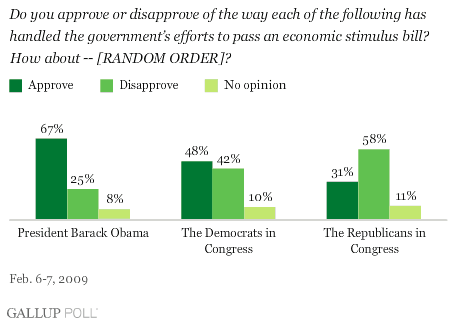
    Americans approve of Obama's handling of the stimulus bill

    Republicans are feeling pretty smug about their Taliban-like disruptive tactics in opposing the president's stimulus package, but it turns out a majority of Americans see things differently. h/t Gallup
    The American public gives President Barack Obama a strong 67% approval rating for the way in which he is handling the government's efforts to pass an economic stimulus bill, while the Democrats and, in particular, the Republicans in Congress receive much lower approval ratings of 48% and 31%, respectively.

    gallup poll

    Americans understand the seriousness of this situation because they're living with the results of eight years of Republican trickle down economics. The bottom line:
    President Obama would appear to have the upper hand in the current focus on Congress' efforts to pass a major economic stimulus bill. Not only does Obama get much higher approval ratings for the way in which he is handling the stimulus issue than do either the Democrats or, in particular, the Republicans in Congress, but a majority of Americans agree with him that passing such a bill is critically important for improving the nation's economy.
    Critical is the key word. Americans want action, Republicans want to play games with our lives.


    (Cross-posted at Blogging for MI.)

    Thursday, February 05, 2009

    We have inherited a deep and dire economic crisis

    The bad news just keeps on coming. The Labor Department reported today that the number of laid-off workers seeking jobless benefits rose to 626,000, from last week's figure of 591,000.

    As President Obama put it in an editorial in today's WaPo:
    By now, it's clear to everyone that we have inherited an economic crisis as deep and dire as any since the days of the Great Depression.

    Because each day we wait to begin the work of turning our economy around, more people lose their jobs, their savings and their homes. And if nothing is done, this recession might linger for years. Our economy will lose 5 million more jobs. Unemployment will approach double digits. Our nation will sink deeper into a crisis that, at some point, we may not be able to reverse.
    At some point we may not be able to reverse the crisis. Do the Republicans bent on obstructing the stimulus package understand the seriousness of our situation? It doesn't appear they do, or why else would they keep pushing tax cuts that major economists have already discredited? They're playing Russian roulette with our country and hoping Obama fails so they can score political points. Are the lives and livelihoods of millions of Americans that inconsequential to them?

    And it's not just Republicans putting our country in danger. The media shares a lot of the blame too. They promote Republican talking points as the truth and focus on stories that seem rather inconsequential compared to what's going on around us.

    As John Cole put it:
    Our media is simply failing us. Why have they not asked the Republicans how tax cuts are going to provide jobs? Why are they not laughing openly when the Republicans bring up capital gains tax cuts as part of a stimulus package. Why are they not asking the Republicans to explain how infrastructure spending is not stimulus? Why are they pretending this woman’s minor tax oversight is on par with outing a CIA agent or letting tens of thousands of people soak for a week in New Orleans. Why are they gleefully reporting about Joe the Plumber giving economic advice to the House republicans while their colleagues are writing about the Republicans being unified in opposition to the stimulus and putting two and two together and realizing that the opposition to the stimulus from Republicans is based on the deep thoughts of a drug addled radio host and a guy who installs toilets?
    And why is the media not reminding people that President Obama voted against the war in Iraq, a war that likely will cost us $3 trillion dollars? He had the intelligence to look at the facts and do the right thing then, so we should be trusting him to do the right thing now.

    Time is of the essence. Asking the right questions and doing the right thing might not be popular or sell many television ads, but it just might save our country from a crisis we may not be able to reverse. Is that a chance the media and Republicans are willing to take?

    Wednesday, February 04, 2009

    We supported their war, tell them to support us

    Conservatives are busy calling Congress trying to block Obama's stimulus plan. The word on the street is that calls are running 100 to 1 against the plan. We know Michigan Senators Levin and Stabenow support creating jobs for Americans and setting our country on the road to economic recovery, but they still need to hear from you. As someone commented on another blog yesterday, "Repubs are calling into our "safe" states also, we need to make our voices heard."

    Please call 1-866-544-7573 (toll-free) and ask as many senators as you can reach to pass the American Recovery and Reinvestment Act. Be prepared to try several times. The lines are busy.

    If you don't have to worry about using a toll-free number, you might have better success getting through with these:

    Sen. Carl Levin at (202) 224-6221
    Sen. Debbie Stabenow at (202) 224-4822
    Via the Senate Switchboard at (202) 224-3121 (for people in other states)

    What's at stake? Under the Senate version of the stimulus plan, this is what Michigan stands to gain:
    Total - $19,975,801,863
    School Modernization - $642,876,538
    Higher Educ. Repair and Modernization - $125,670,301
    Home Investments Partnership Program - $64,794,416
    Highway Infrastructure Investment - $790,185,174
    Mass Transit - $170,947,191
    Public Housing Capital Funds - $53,135,372
    Neighborhood Stabilization Program - $151,279,933
    Homeless Prevention Fund - $55,062,292
    Clean Water State Revolving Fund - $171,560,760
    Drinking Water Revolving Fund - $69,200,000
    State Fiscal Stabilization - $2,145,703,599
    Title I Grants - $522,337,187
    IDEA, Part B State Grants - $461,265,518
    Pell Grants - $472,621,650
    Training and Employment Services - $200,786,089
    Weatherization Assistance Program - $148,292,700
    State Energy Program - $13,775,009
    And don't forget the thousands of jobs this spending will create in Michigan (and across the country).

    We supported Republican's spending on their unnecessary and ill-begotten war in Iraq. Tell them to support economic recovery and jobs for Americans.

    Monday, February 02, 2009

    Republicans turn their backs on the middle class

    Joe Biden is right. It's time to put the middle class front and center. That's the goal of the Obama administration which seeks to put people back to work immediately and create economic growth, and long-term make sure the benefits of that growth reach the people responsible for it - the lower and middle class workers.

    I have a question for Republicans. Why are you treating us like the enemy? Some of you are threatening to filibuster the recovery bill and others are complaining the plan is too expensive and could be done cheaper (ergo, the middle class is only worthy of crumbs). Meanwhile, Sen. Jim DeMint (R-SC) offers an alternative plan that would actually cost 3.5 times as much as Obama's. I guess it's okay to spend trillions more if corporations and the rich are the main beneficiaries, eh?
    The only comprehensive alternative being offered by Senate conservatives is DeMint’s “American Option: A Jobs Plan That Works,” a series of permanent tax breaks for corporations and wealthy Americans. A new analysis from the Center for American Progress Action Fund finds that the DeMint plan would cost over $3.1 trillion over ten years — more than three times the amount of President Barack Obama’s plan — and be largely ineffective at creating jobs.

    The DeMint plan includes permanently cutting the corporate tax rate, totally eliminating the Alternative Minimum Tax, lowering income tax rates for the wealthiest Americans, and eliminating scores of tax deductions that help students pay for college, sick families pay medical bills, and teachers purchase supplies for their classrooms.
    How many times does this need to be repeated?
    Permanent tax cuts are one of the least effective ways of stimulating the economy according to both Moody’s Economy.com and the Congressional Budget Office. Furthermore, slashing government revenues this permanently would leave deep structural deficits for generations to come.
    The whole purpose of DeMint's plan is to make the tax policy changes of 2001 and 2003 permanent. Let's revisit that era, shall we?
    "The economy has slowed down, in which case we need to accelerate tax cuts," Bush said in a March 2001 radio address. "You see, tax relief will put money in people's pockets, which will help give the economy a second wind." "By ensuring that Americans have more to spend, to save and to invest, this legislation is adding fuel to an economic recovery," announced Bush in 2003, as he signed his tax cut legislation.
    That's not how ten Nobel Laureates saw it. They signed a letter saying the Bush tax cuts were wrong, and 450 economists across the nation agreed.

    They were right and Bush and the Republicans were wrong. Bush's tax cuts didn't work.
    As Center for American Progress Senior Fellows Christian Weller and John Halpin noted in 2006, the outcome of the 2001 tax cuts was "the weakest employment growth in decades." The 2003 tax cuts didn't fare much better, resulting in job creation that was "well below historical averages." When Bush's White House proposed the 2003 cuts, they promised that it would add 5.5 million new jobs between June 2003 and the end of 2004. But "by the end of 2004, there were only 2.6 million more jobs than in June 2003." As Paul Krugman has pointed out, the belief that Bush's tax cuts successfully stimulated the economy is a form of mythology. CAP's Michael Ettlinger and John Irons wrote in September, "Economic growth as measured by real U.S. gross domestic product was stronger following the tax increases of 1993 than in the two supply-side eras" that followed Reagan's 1981 tax cuts and Bush's 2001 tax cuts. Indeed, employment growth was much stronger post-1993 than post-2001. The average annual employment growth was 2.5 percent after 1993 and just 0.6 percent after 2001. Unfortunately, the supply-side myth that tax cuts cure all still lives on today, as conservatives complain about progressive approaches to fixing the mess left by Bush.
    Middle class misery is real. We need real solutions, not mythological ones of the sort being pushed by Republicans. If they really cared about the pain being felt by families across America, they'd stop the games, grow up and get serious about helping us. That hasn't happened and leads me to believe they don't give a damn.

    Thursday, January 22, 2009

    Not so smart Republican economic calls

    Time Magazine looks back at what they see as Bush's biggest economic mistakes, adding that "by almost every measure — GDP growth, jobs, median incomes, financial-market performance — he stacks up as probably the least-successful President on the economic front since Herbert Hoover. ... As the decider in the White House for the past eight years, George Bush made some economic calls that don't look smart today. Here are eight of them."

    The Big Picture clicked through the list so we wouldn't have to.
    1. The Return to Deficits: Bush’s tax cuts and spending increases — and clear disdain for the pay-as-you-go approach that had brought deficits down in the 1990s — brought a return to permanent deficits.
    2. Iraq: Even if you think the war did bring benefits to the U.S., they would have to be pretty gigantic to justify the costs of $1-3 trillion dollars;
    3. Tax Cuts for the Rich: Bush came to Washington facing almost diametrically opposing economic conditions, yet he offered up the same solutions as Reagan.
    4. Financial Regulation: What is true is that most Bush-era financial regulators were less than enthusiastic about the very act of regulating, and that Bush’s “ownership society” push glossed over a lot of potential dangers.
    5. Telling Us to Go Shopping: After the 9/11 terrorist attacks, President Bush didn’t call for sacrifice. He called for shopping.
    6. Energy Policy: Not much to say here, except that there wasn’t an energy policy.
    7. A State of Denial: Every Administration spins and sugarcoats the economic truth. But the Bush White House took this disingenuousness to new levels.
    8. The Muddled Bailout: The main problem has been the ambivalence with which both Paulson and the White House have approached the financial rescue.
    Bush was the decider, but Republicans were the enablers. They rubber-stamped every idea Bush threw their way, and questioning or discussing the merit behind his plans was verboten or "unpatriotic." After all, Republicans must not be challenged or questioned. They know best.

    It turns out they weren't so smart after all, so why do they feel they deserve to be heard?
    Republicans, who said they were receptive to Obama's call for a "unity of purpose," promptly tested the day-old administration. They criticized Democratic spending initiatives and requested a meeting with the president to air their tax-cutting plans.
    There they go again! Tax cuts, tax cuts, tax cuts. I hope Obama politely listens and then tells them don't let the door hit you "thanks, but no thanks." Why? I'll let this economist speak for me:
    Tax cuts won't build schools, or any other public good.

    And right now, with so much of our infrastructure in need of attention, we need public goods.

    We tried the tax cut approach to stimulating the economy once, we had no choice since Bush and the Republicans would not have passed any other type of stimulus package.

    Guess what? It didn't work very well, and we have little to show for it. Had we, say, rebuilt water systems instead, at the very worst we'd have better water.
    Republicans, please go back and read #7 above. You don't deserve to be heard as long as you continue to sing the same old song.

    Friday, January 16, 2009

    Oh, My God

    That was House Minority Leader John Boehner's reaction yesterday after Democrats unveiled their $825 billion stimulus plan, which includes twice as much money for spending vs. tax cuts. He's not happy with the all the spending and told PBS NewsHour's Margaret Warner "that we need more in tax relief."

    Oh, my God. Is that the only answer Republicans have for every problem? In this case, their answer is wrong according to Joseph Stiglitz (Nobel Prize in economics in 2001) who warns we should not squander America’s stimulus on tax cuts.
    What is clear is that tax cuts will not help much. ...

    Tax cuts have increased our national debt. They encouraged America to live beyond its means, increasing our liabilities without commensurate increases in assets. Further tax cuts would do the same. Good accounting looks at assets and liabilities. Spending on infrastructure, education and technology create assets; they increase future productivity.

    Some of the spending in the stimulus serves multiple ends. Increased unemployment benefits have the largest multiplier effects – cash-strapped families spend every cent given – and meet vital social needs. It is imperative to provide health insurance to the unemployed: without that, a single serious incident can push a family into bankruptcy. Helping the unemployed meet house payments reduces foreclosures, addressing one of the underlying causes of the crisis. There are thus triple benefits.

    We are in uncharted territory in this crisis. But household tax cuts, except for possibly the poorest, should have no place in the stimulus. Nor should business tax breaks, except when closely linked with additional investment. The one tax cut that should be included is a temporary incremental investment tax credit; it provides a big bang for the buck, encouraging companies to invest now when the economy needs the spending. Increased investments in infrastructure, education and technology, relief to states, and help to the unemployed need pride of place.
    Stiglitz has some expert advice for state Republicans who also see cutting taxes as the only solution to budget problems.
    Joseph Stiglitz of Columbia University, and Peter Orszag, until recently director of the Congressional Budget Office and now the nominee to direct the federal Office of Management and Budget — wrote during the last recession that spending cuts could actually be more harmful for a state’s economy during a recession than tax increases. ...

    “The conclusion is that, if anything, tax increases on higher-income families are the least damaging mechanism for closing state fiscal deficits in the short run. Reductions in government spending on goods and services, or reductions in transfer payments to lower-income families, are likely to be more damaging to the economy in the short run than tax increases focused on higher-income families.
    And if Republicans think they're appealing to voters with their continual tax cut rhetoric, they're wrong again. By a nearly 2-to-1 ratio, people preferred government spending to create jobs over tax cuts to give Americans more money to spend.

    Tax cuts for people who don't have jobs is not the answer. Most Americans understand that. Republicans don't.