Showing posts with label senior citizens. Show all posts

Monday, August 24, 2009

Republicans Using Seniors for Partisan Purposes

Sen. Grassley is making up excuses as he goes along. He's the top Republican on the Senate Finance Committee and his group recently decided to exclude end-of-life counseling from the House bill because, in Grassley's words, "We should not have a government program that determines if you're going to pull the plug on grandma."

However, yesterday, on Face the Nation, Grassley admitted that the House bill would not "pull the plug on grandma." He lied and got called on it, so now Grassley is using the cost to justify dumping the counseling provision.
SCHIEFFER: Well, that’s what I was trying to get from you this morning. You’re not saying that this legislation would pull the plug on grandma, you’re just saying there are a lot of people out there who think that it would. Or do you want to say this morning that that is not true, that it won’t do that?

GRASSLEY: It won’t do that, but I wanted to explain why my constituents are concerned about it, and I also want to say that there is an $8 billion cost with that issue, and if you’re trying to save money and you put an $8 billion of doctors giving you some advice at the end of life, doctors are going to take advantage of earning that $8 billion and constituents see that as an opportunity to save some money. [emphasis added]
Grassley is being penny wise and pound foolish. Counseling may cost $8 billion, but according to the Urban Institute, the government could save $90.8 billion over 10 years by better managing end-of-life care.

Also, according to Harvard Science, "in the Archives of Internal Medicine, investigators... found that patients who reported having an EOL conversation had an estimated average of $1,876 in health care expenses during their final week of life, compared with $2,917 for those who didn't, a difference of $1,041, or 36 percent."

Savings aside, a new study offering end-of-life counseling to dying cancer patients found that it improved their mood and quality of life, and the patients who got counseling also lived an average of 5 months longer. Death is scary for most of us, but if counseling improves our mood and helps us enjoy what time we have remaining on earth, that's a good thing.

Besides, Republicans like Grassley (and McCotter) are simply grasping at straws in their opposition because end-of-life counseling is already included in Medicare, and has been since 2005 when Republicans championed the plan.
People aged 65 are entitled to a "Welcome to Medicare" exam that includes a physical and mental assessment, counseling on how Medicare works and what it covers, tips on how to prevent falls at home and the now-controversial counseling. The government would pay for this up to one year after Medicare enrollment. [emphasis added]
The proposed health care legislation that Grassley's Senate Finance Committee dumped would have paid for end-of-life discussions every five years instead of the one time, and it was "milder than legislation sponsored by Sen. Johnny Isakson, R-Ga., that would have required Medicare patients to have a living will."

Republicans are shameful. They've thrown our senior citizens under the bus for partisan purposes, along with our democracy. Or, as Joe Klein said, "How can you sustain a democracy if one of the two major political parties has been overrun by nihilists?


(Cross-posted at Blogging for Michigan.)

Wednesday, June 17, 2009

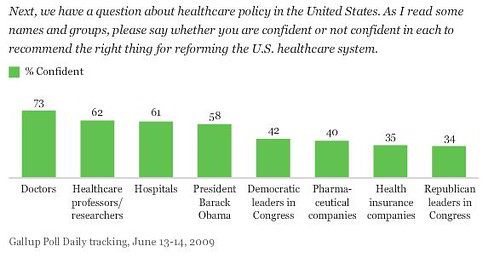
Who Do Americans Trust On Health Care Reform?

Gallup asked Americans who they trust to make the right recommendations on health care reform. Guess who came in last. Republicans. Behind insurance companies!

gopinsurance

Why don't Americans trust Republicans? Possibly because they continue to peddle lies and scare stories (socialism, socialism!).

Or because the Medicare Advantage program they rammed through during Bush's first term will give insurance companies "an estimated $177 billion in excess payments over 10 years to compete with Medicare - subsidies that Obama would sensibly cut to help pay for health care reform."

Or because Republicans blocked Medicare from negotiating for lower drug prices, blocked importing drugs from Canada or Mexico, and argued that competition would lower prices. How did that work out?
Today, seniors pay 60% more for the same drugs than the price charged veterans because the Veteran's Administration does negotiate lower prices.
Republicans just aren't credible. They had an opportunity to do something good for seniors and they blew it, choosing instead to side with powerful pharmaceutical lobbyists.

Friday, August 17, 2007

Can I get my social security converted into pesos?

I'm a grandmother now, so I need to start thinking about my - gulp - old age. Will my money last as long as I do? What happens if I get sick and need to go to a nursing home? If you're like me, then you've probably worried about these things too, but don't despair, we might make it to the end before our nest egg does after all. USA Today has the scoop:

Seniors head south to Mexican nursing homes
After Jean Douglas turned 70, she realized she couldn't take care of herself anymore. Her knees were giving out, and winters in Bandon, Ore., were getting harder to bear alone.

[...] After searching the Internet for other options, she joined a small but steadily growing number of Americans who are moving across the border to nursing homes in Mexico, where the sun is bright and the living is cheap.

For $1,300 a month — a quarter of what an average nursing home costs in Oregon — Douglas gets a studio apartment, three meals a day, laundry and cleaning service, and 24-hour care from an attentive staff, many of whom speak English. She wakes up every morning next to a glimmering mountain lake, and the average annual high temperature is a toasty 79 degrees.
According to USA Today, retirement homes are relatively new in Mexico and there's little government regulation, but the U.S. Embassy doesn't report any complaints against Mexican nursing homes. That doesn't mean residents haven't complained though. One woman reported her home was staffed by "gossips and thieves" and another claimed "It was filthy, and the food was very bad. It was all made in the microwave."

Those are legitimate complaints, but they're also similar to ones lodged against nursing homes here in the U.S. My mother is in a nursing home and she often complains about people stealing from her, but 90% of the time the missing item ends up being found in her wastebasket or pocket. Gossip is one of her complaints too, yet she's guilty of the same behavior. I think some old people just like to complain. That's not the case for this gentleman:
Residents such as Richard Slater say they are happy in Mexico. Slater came to Lake Chapala four years ago and now lives in his own cottage at the Casa de Ancianos, surrounded by purple bougainvillea and pomegranate trees.

He has plenty of room for his two dogs and has a little patio that he shares with three other American residents. He gets 24-hour nursing care and three meals a day, cooked in a homey kitchen and served in a sun-washed dining room. His cottage has a living room, bedroom, kitchenette, bathroom and a walk-in closet.

For this Slater pays $550 a month, less than one-tenth of the going rate back home in Las Vegas. For another $140 a year, he gets full medical coverage from the Mexican government, including all his medicine and insulin for diabetes.
Hmmm...the health care issue could be a problem. I haven't really heard much about the quality of health care in Mexico. Slater relies on the Mexican SSI, which runs clinics and hospitals nationwide and allows foreigners to enroll in its program even if they never worked in Mexico or paid taxes to support the system, because Medicare, Medicaid, the Department of Veterans Affairs and most U.S. insurance companies will not cover care or medicine as long as patients are outside the United States. Slater has firsthand experience with their medical care though. He recently had gallbladder surgery and reports he paid nothing.

Any doubts Americans may have about retiring to Mexico haven't gone unnoticed by developers and officials, who see an opportunity to fill a need and make a lot of money.
Developers of "independent living" facilities for seniors are also beginning to look to Mexico. A Spanish-U.S. venture is building Sensara Vallarta, a 250-unit condominium complex aimed at Americans 50 and older in the Pacific Coast resort of Puerto Vallarta. And in the northern city of Monterrey, El Legado is marketing itself as a "home resort" for seniors.

Academics and government officials are beginning to take notice. In March, the University of Texas at Austin held a forum for developers, hospital officials, insurance companies and policymakers to discuss health care for retirees in Mexico.

"With the right facilities in place, Mexico could give (American retirees) a better quality of life at a better price than they could find in the United States," says Flavio Olivieri, a member of Tijuana's Economic Development Council, which is seeking funding from Mexico's federal government to build more retirement homes. "We think this could be a very good business as these baby boomers reach retirement age," he says.
Mexico could give American retirees a better quality of life at a better price than they could find in the United States? That's disturbing to even read those words. I think we should be taking care of one another here at home. If a person makes the choice to move to Mexico because they like the climate, culture or country, that's their choice. However, if a person moves to Mexico because they can't afford to maintain their same quality of life here, that's just wrong and we should be ashamed.

It's great to know Mexico is an option for retirees, and we all like to have options, but our golden years should not be at the whim of dollars and cents - or pesos.

Friday, August 10, 2007

It's time to redefine compassion

I have to give credit where credit's due. The person responsible for "compassionate conservatism" was a marketing genius. He/she managed to paint Republicans as people who really care about the needs and concerns of average Americans. The public knows otherwise now and sees the hypocrisy behind the words, but I wonder if the person responsible for that term ever felt any remorse?

Moving along, Mother Jones has a rather
lengthy list of the ways all that compassion dings the poor and middle class. You can read the whole thing for yourself, but here's a sample.
1 in 4 U.S. jobs pay less than a poverty-level income.

During the 1980s, 13% of Americans age 40 to 50 spent at least one year below the poverty line; by the 1990s, 36% did.

Bush’s tax cuts (extended until 2010) save those earning between $20,000 and $30,000 an average of $10 a year, while those earning $1 million are saved $42,700.

Bush has proposed cutting housing programs for low-income people with disabilities by 50%.

83% of those earning $75,000 or more work for companies that offer insurance, versus 24% of those who earn less than $25,000.

2 in 5 elderly live on less than $18,000 a year, including Social Security benefits.

Since 1983, college tuition has risen 115%. The maximum Pell Grant for low- and moderate-income college students has risen only 19%.

Credit card late fees are 194% higher than in 1994.
And the item I found absolutely horrifying was this one:
Last fall, Minnesota firefighters let an elderly man’s mobile home burn down because he hadn’t paid a $25 “fire fee.”
Why is that allowed to happen in a country as rich as ours? Is that how a "compassionate" country treats their elderly?

Reading through that list again, I find myself shaking my head and asking is that how a "compassionate" country treats their poor, their uninsured, their students, and the people who work hard to provide for their families?

It's time for the Democrats to step up and redefine "compassion." The Republicans have corrupted and twisted the term to exclude the majority of us. They don't even respect our troops serving our country, as witnessed by their unwillingness to give them more time at home with their families between tours of duty. In fact, they don't even respect our troops after they serve. The Bush administration said it will resist restoring full educational benefits for returning veterans.

Some compassion, eh? You have to be a corporate crony if you expect to get any compassion from the Bush bunch.

Wednesday, August 08, 2007

A reason to be thankful for Mike Bishop (snark)

I thought Sen. Mike Bishop (R-MI) was over-the-top when he censored BFM from senate computers for saying bad things about him, but Rep. Randy Kuhl (R-NY) makes him look almost rational. Kuhl has been under pressure from protesters lately for his continued support of Bush's war policy, but his thoughts on how to deal with them sends shivers down my spine.

From the
Huffington Post:
In an interview yesterday with the editorial board of the Rochester Democrat and Chronicle, Kuhl said he has "thought about packing" firearms to fend off protesters:

"Kuhl said that he wasn't at his offices when the protesters in Bath and Fairport were there. When I asked him if he had ever protested, he said "Yes, when I walked off the floor in Congress recently." I asked if that means he thinks the protesters have a right to do so and he again said "yes, just not over the line." He said that the types of protests have caused him to rethink security at his offices and that means securing doors. He said they are "more protective now" and that he "thought about packing."" [emphasis mine]
Just how "over the line" were those protesters that Kuhl is considering carrying a gun? You be the judge.

Friday, July 20, 2007

My wish for future generations

As a parent and grandparent, I'm like most people in that I'd like future generations to have a bigger piece of the American Dream than I did. What I'm seeing isn't too encouraging. Consider this statistic from the EPI:

Employer-provided health coverage declining for college grads in entry-level jobs
A college degree is no guarantee of receiving health insurance on the job. Over the recent recession and recovery, college graduates in entry-level jobs (defined as employed college graduates between 23 and 27 years old) have become increasingly less likely to receive employer-provided health insurance coverage.1 The Chart below illustrates the recent trends in employer-provided health insurance for this group. Their incidence of employment-based insurance has fallen roughly nine percentage points from 1999-2000 to 2004-05, from 69.6% to 60.5%.
Among those lucky enough to have employer-provided insurance, how many pay a hefty monthly premium toward the cost? Jobs for the college-educated used to include health insurance that was totally paid for by the employer. Not anymore.

Maybe the stock market will provide a good life for future generations. After all, the market just surged past 14,000. That's not too realistic according to DetNews columnist Brian O'Connor:

Dow: Big number, big disconnect
As a reflection of the biggest and best public companies in the nation, a healthy Dow means a healthy stock market, and a healthy stock market means a healthy economy.

If by "healthy" you mean "all but completely disconnected from the reality of U.S. citizens." [...]

Sure, many (OK, some) of us participate in the broader economy thanks to mutual funds in our retirement plans, and it's nice to see those go up with the Dow. That way, if we hang on until retirement we'll have money for milk, gas and mortgages.

For right now, though, we're seeing very little of the growth from "the economy" showing up in our personal economies.
Money isn't everything though. It can't buy piece of mind or health, and it can't buy security. Those are all intangibles that make up what I believe to be part of the American Dream. The rest of America appears to see it that way too according to Democratic pollster Celinda Lake.
"There have been times in our history when the American dream was rooted in opportunity, and there have been times in our history where the dream was rooted in security. This is a time, and has been for a couple for years now, where the dream is rooted in security."

There's not a lot of security in a fast-paced global economy where workers get ahead by chasing opportunities (not obediently following office rules), by constantly reinventing their careers (not relying on seniority), by self-investing their savings (not counting on company pensions).
Face it, the global economy is here to stay, but that doesn't mean the American Dream is no longer relevant. Looking into the future, my dream includes health care for all, social security for our elderly, children who never have to go to bed hungry, and jobs that pay a living wage.

There's no good reason we can't leave future generations some security and peace of mind.

Friday, June 08, 2007

The GOP is trying to privatize Medicare

It appears Congressman Dave Camp is rubber stamping the Bush administration by calling for the private sector to take a greater role in health care. From the AFL-CIO Blog:
Two years after the American people rejected the Bush administration’s plan to privatize Social Security, the White House now is trying quietly to privatize Medicare.

Here’s how: The Republican Congress gave big insurance companies that provide Medicare insurance what amounts to a huge subsidy under the so-called “Medicare Advantage” program. These private insurers were supposed to introduce competition into the Medicare system and reduce costs.

But after the private insurers got their hands into the cookie jar, they began taking more than their share. Instead of reducing costs, the new plan means the federal government, on average, is paying private plans 12 percent more than it costs to treat people on traditional Medicare, according to the Congressional Budget Office and the Medicare Payment Advisory Commission.

This year alone, according to the Alliance for Retired Americans, the federal government will overpay the insurance industry $7.5 billion this year and an estimated $160 billion over the next 10 years. [...] [emphasis mine]

As Edward Coyle, executive director of the Alliance, which represents 3 million retirees and seniors, told a Capitol Hill press conference:

Medicare Advantage threatens the solvency of the Medicare Trust Fund. As the Bush administration continues to sound alarms bells about the Trust Fund, they ought to start by ending these egregious subsidies to the insurance industry.

The outrageous waste and abuse in the Medicare Advantage program is part of our larger, misguided privatization of Medicare. We’ve turned too much of Medicare over to Wall Street at the expense of the people who need help on Main Street.
Coyle goes on to point out how that $160 billion overpayment could go a long way toward eliminating the donut hole. Further, by reining in those payments, the federal government could improve benefits for lower-income families and provide coverage to millions of uninsured low-income children.

The Bush administration and Congressman Dave Camp should be concerned about our senior citizens and millions of uninsured instead of the private sector. As Coyle says:
Something is very wrong with our Medicare program—the big drug and insurance companies keep getting more, and retirees keep getting less. It is time to change this. It is time to end the corporate welfare subsidies in the Medicare Advantage program.
It's also time for the Republican Party to back up their "values" claim with action. In case they need their memories refreshed about the definition of values, Michael Moore explains in the DetNews how his Catholic boyhood helped shape the core values that are on display in "Sicko" [emphasis mine]:
"This film comes from a spiritual place," Moore says, "so I wanted to go to the headquarters of the sisters who taught me in my early years. They had a profound impact on me."

The idea that it's about "the we, not the me," came from the nuns. "Instead of calling it 'socialized medicine,' it should be called 'Christianized medicine.'"

"This was one of the ground rules that was laid down by Jesus. He said, 'I'm going to ask you a bunch of questions when you get to the pearly gates. When I was hungry did you feed me? When I was homeless, did you give me shelter? When I was sick, did you take care of me? And if you didn't do these things, and you didn't do these for the least of my people, then I'm going to have to say that you can't come in the big house.'"

Wednesday, May 30, 2007

Who cares about people?

I read something in the State News that accurately depicts the mindset of too many politicians today - primarily Republicans. It was said by Terry Denbow, spokesman for MSU, about our lawmakers budget deal that will cut millions of dollars from higher education:
"The disinvestment action Friday was indicative of a core problem in our state," he said. "Higher education is deemed more an expense than an investment."
The cuts could result in double-digit tuition increases for thousands of college students, but that doesn't matter to state Republicans who were adamantly opposed to any tax increase. The Flint Journal calls their actions "callous political maneuvering."

I think callous pretty much hits the nail on the head. State Republicans essentially put their Grover Norquist, no-tax constituents ahead of Michigan's college students, but who cares if they have to pay more to get an education? It's more important to serve the interests of a minority of anti-tax zealots.

Investing in people isn't important to President Bush either according to the CBPP:
The President’s budget for fiscal year 2008 proposes to cut $2 billion (5 percent) from the Department of Housing and Urban Development (HUD), compared to the 2007 funding level, adjusted for inflation.[1] The deepest cuts would be made in housing for the elderly and disabled (a 29 percent cut), Community Development Block Grants (a 22 percent cut), public housing (an 8 percent cut), and Section 8 Project-Based Rental Assistance (a 5 percent cut) ...

The President is proposing these cuts despite evidence that growing numbers of low-income families have serious housing affordability problems. Some 15 million low-income households have rent and utility costs that are unaffordable under federal standards (i.e., costs that exceed 30 percent of their modest incomes).
Who cares if the poor, disabled or elderly can't afford to put a roof over their head? It's more important to continue to pass along tax cuts to the rich or fund this illegal war that's making millions for contractors.

To be fair, some politicians get it. Some politicians understand that we need to invest in people. Take this example from Lucas County, Ohio:

Lucas County offering needy families $200 gasoline cards/Officials hope $1.5M program will help workers keep jobs
The initiative will be announced at a press conference today at the Speedway gas station on Central Avenue and Holland-Sylvania Road in Sylvania Township. The county partnered with Speedway because they offered cards that can only be used for fuel and not other items sold inside the gas stations.

This is the second year of the gas card program.

[...] There is about $1.5 million available for the program this year, which is funded through the state Prevention, Retention, and Compliance program, a part of the federal Office of Temporary Assistance for Needy Families.

[...] "It really is pretty helpful, especially for some of our single families that are struggling," said Deb Ortiz-Flores, executive director of the local Job and Family Services.

She said the cost of transportation is one of the greatest employment obstacles faced by residents in Lucas County.
Getting a higher education is right up there at the top of that list too, but who cares? Not Michigan's callous politicians.

Thursday, April 19, 2007

Republicans vote to keep fleecing American seniors

Sen. Stabenow and Sen. Levin voted to save senior citizens money on prescriptions, but in the end it wasn't enough to overcome corporate aligned Republicans.

From the AFL-CIO blog:
Republican Senate leaders today blocked a bill that would have allowed Medicare to negotiate with the drug giants for lower prices. In doing so, they came down on the side of big pharmaceutical companies that make billions in profits on which America’s seniors rely—and against consumers who depend upon the Medicare program for affordable medication.

The 55-42 vote fell five votes short of the 60 needed to shut off Senate floor debate and move the bill to a vote on passage. Senate Majority Leader Harry Reid (D-Nev.) voted to end debate, but switched his vote to maintain the right to bring the bill up again.
That's small comfort since President Bush said he'd veto the drug negotiation bill if it made it to his desk anyhow.

What hypocrites. Republicans worry about saving their corporate cronies and high-income friends billions of tax dollars, but they won't vote to save senior citizens a few lousy dollars on medication. I'm sure this explains part of it:
The pharmaceutical industry has joined the Bush White House in vigorously opposing lower Medicare prices through negotiations. After the House passed the bill, drug companies launched a massive lobbying and PR campaign aimed at the Senate. The Pharmaceutical Research and Manufacturers of America (PhRMA) spent hundreds of thousands of dollars on TV spots and newspaper ads to foment against the bill, and its lobbyists swarmed the Capitol as the Senate vote neared.
Big Pharma could pass along price reductions to seniors. The industry is in good health and major pharmaceutical companies are reporting first quarter earnings that beat expectations.

And they certainly have plenty of money to lavish on CEO's. According to the AFL-CIO Executive PayWatch:
The head of Wyeth took home $32.8 million in 2006. A few others: Abbott Laboratories, $26.9 million; Pfizer Inc., $19.4 million; and Baxter, $13.5 million.
Edward Coyle, executive director of the Alliance for Retired Americans, said this prior to the vote yesterday:
This is the moment of truth for senators and for President Bush: Do they stand with retirees struggling to afford their drugs, or do they stand with the big drug companies who want to keep fleecing American seniors?
Well, we know where they stand now. And they call themselves the values party?