Friday, July 11, 2008

Pocketbook issues and landslides

I came across something interesting as I read about McCain's visit to Michigan yesterday. In case you didn't know, McCain met with about 250 invited guests, mostly small-business owners and auto industry employees, to talk about pocketbook issues facing businesses and individuals. The Detroit Free Press gave this account of one person's opinion following the meeting.
Rich Keenan, 48, of Canton said he would never vote for Illinois Sen. Barack Obama, the presumptive Democratic nominee for president. But he also was wary of McCain's vote against tax cuts enacted under President George W. Bush and the environment. [...]

By the end of the discussion, Keenan said he was closer to a vote for McCain.
I was curious to see how the national media described the meeting so I checked out the Washington Post. This is their description [emphasis mine]:
But a day after a top McCain economic adviser dismissed the nation's struggles as a "mental recession," the presumptive Republican presidential nominee's message landed with a thud, as workers sat in stony silence. [...]

But the 100 or so in the crowd sat on their hands throughout most of McCain's speech, especially during his remarks about the need for free trade -- a policy that is generally reviled in manufacturing areas.
That's quite a bit different from the description in the Free Press. However, that's not what I found so interesting. Near the end of the Post's article was this [emphasis mine]:
With most Americans blaming President Bush for their troubles, McCain faced an uphill climb even before his campaign's recent miscues. Macroeconomic Advisers, a St. Louis-based economic forecasting firm, will release a report next week that factors in such variables as the growth rate of real disposable income, unemployment rate, real oil price increases, the power of the incumbent party as well as the impact of party fatigue to forecast the outcome of the election. The result projects a victory of more than 10 percentage points for presumptive Democratic nominee Barack Obama, said Chris P. Varvares, the firm's president.

"How do you define a landslide?" he asked.
It'll be interesting to see if McCain really loses by a large margin. The latest Pew report has Obama leading McCain 48% to 40%, which isn't a landslide, but give McCain and his advisers a few more weeks and that margin should grow. Voters are quickly being turned off by their flip-flops, insults and jokes.

Wednesday, July 09, 2008

Democrats waste money on biased media outlets

Could you imagine the media treating McCain this way?
The major news networks are considering cutting back on DNC coverage because Barack Obama will be giving his speech at a separate venue [Invesco Field], thereby increasing their production costs.
You still don't believe the media is biased against Obama? Maybe this fact from The Jed Report will convince you:
Earlier this year, the NFL and NBC announced plans to reschedule the football season opener so as not to conflict with John McCain's convention appearance. If the networks news divisions can't manage a similar degree of flexibility, it will be an outrage.
And a real display of bias.

Monday, July 07, 2008

We all suffer when journalists lower the bar

Christine is right, professional journalists should set a higher standard, and I'm not pointing a finger at any one journalist, I'm pointing a finger at all of them. People like Bob Schieffer, Rick Klein and others criticized General Wesley Clark (and his defenders) for attacking John McCain’s military service record when he actually only questioned the relevance of McCain’s combat experience as it relates to being president. A good journalist would have handled it differently according to the Columbia Journalism Review:
Clark’s comments may (or may not) have been impolitic. But that has no bearing on their validity or lack thereof — which is how the news media should be evaluating them.
In fact, if the media had bothered to look a little, they would have found that McCain himself has argued that military service is not sufficient alone to qualify a person to be president. The Wonkroom found these McCain statements:
  • During an interview with National Journal, John McCain was asked if “military service inherently makes somebody better equipped to be commander-in-chief.” McCain said, “Absolutely not…I absolutely don’t believe that it’s necessary.” [National Journal, 2/15/2003]

  • I believe that military service is the most honorable endeavor an American may undertake. But I’ve never believed that lack of military service disqualifies one from occupying positions of political leadership or as Commander and Chief. In America, the people are sovereign, and they decide who is and is not qualified to lead us. [American Legion Speech, 9/7/1999]

  • Earlier this year at Washington’s Gridiron Club, where humor is the required fare, McCain lay bare what underlies his candidacy. Wearing a jacket outlandishly festooned with dozens of fake military medals, McCain said, “The question I ask myself every morning while shaving in front of the mirror is: OK, John, you’re an incredible war hero, an inspiration to all Americans. But what qualifies you to be president of the United States?” [Minneapolis Star Tribune, 11/7/1999]
  • In fact, there's reason to believe McCain even questioned his own military accomplishments or lack thereof. The NY Times wrote in 2000 that McCain did a little soul searching back in 1979 and lamented that he would never make admiral like his father and grandfather. The Times said...
    ...he had always dreamed of doing something great, of imprinting his name on the history books, but at age 42 he found himself with a stuttering military career and no base from which to go into politics.
    Shortly after that soul searching, McCain found a way to jump start his political career. He met Cindy at a cocktail party, divorced his first wife the following year, and then married Cindy, heiress to the one of the largest Anheuser-Busch beer distributors in the country. It was her father's business and political contacts that helped McCain gain a foothold into Arizona politics, and McCain's war hero status helped give him name recognition.

    The media was so busy slamming Wesley Clark that they failed to mention those points. They also failed to mention that the General had actually been shot four times in Vietnam, and left the country on a stretcher. If anyone had a right to question McCain's military service, Clark did. A good journalist would have mentioned that.

    In fact, a good journalist would have quoted McCain from an interview on NPR on May 1, 2004, when he said, “some of our greatest presidents have not [had military experience]. … And all of them turned out to be fine commanders in chief.”

    (Cross-posted at Blogging for Michigan.)

    Tuesday, July 01, 2008

    McCain, you can't have my social security

    In case you haven't been paying attention to the stock market, this will make you sit up and take notice. (my emphasis)
    Stocks struggled Monday at the end of the worst June for the S&P 500 and the Dow industrials since the Great Depression, amid rocketing oil prices and ongoing financial market woes.
    How's your 401K doing? Thank heavens we still have social security to depend on in our old age - today. If McCain wins the election, all bets are off. McCain recently told the Wall Street Journal that "as part of Social Security reform, I believe that private savings accounts are a part of it - along the lines of what President Bush proposed."

    I thought McCain wasn't McSame? He sure does embrace a lot of Bush's failed policies for someone who claims he's a maverick.

    On the other hand, Sen. Obama isn't afraid to be a straight talker:
    Well let me be clear: privatizing Social Security was a bad idea when George W. Bush proposed it. It's a bad idea today. It would eventually cut guaranteed benefits by up to 50%. It would cost a trillion dollars that we don't have to implement on the front end, permanently elevating our debt. And most of all, it would gamble the retirement plans of millions of Americans on the stock market. That's why I stood up against this plan in the Senate, and that's why I won't stand for it as President.
    You can read more about McCain's support for privatizing social security here and here (YouTube video).

    Millions of Americans depend entirely on social security in their old age, yet McCain wants to gamble with it. That's because McCain has never had to worry about money, as Joe Conason recently pointed out in the New York Observer:
    As one of the wealthiest men in the Senate, thanks to the highly profitable liquor company bequeathed to him and his wife years ago, Mr. McCain faces no economic difficulty. He never has to worry about how he will afford retirement or the value of his assets, which is why risky schemes like privatization look so brilliant to him. But in the coming campaign, he may find that working families have no desire to turn Social Security over to the same companies now seeking bailouts from the federal government -- or to the politicians who would enact that bankers’ daydream.
    McCain and his wife own at least nine houses across the country valued at an estimated $13,123,269, and like DeVos, Romney and so many other rich Republicans, he has no idea what it means to stretch his money from paycheck to paycheck. Trusting him to look out for my best interests is like trusting Dr. Kervorkian not to pull the plug.

    Saturday, June 28, 2008

    American Axle strike paid off for one already rich man

    Remember the American Axle strike earlier this year? Workers settled after 11 weeks for a contract that cut wages as much as $10 an hour, froze pensions for those with less than 20 years seniority, and scheduled two plants for closure.

    Union workers ratified the contract, but the fallout continues:
    American Axle & Manufacturing Holdings Inc shares surged 10 percent on Wednesday after analysts said the parts supplier plans to eliminate about 670 salaried jobs on top of factory job cuts now underway.

    Analysts at Lehman Brothers and JPMorgan said in research notes that hourly headcount cuts will be accompanied shortly by white-collar cuts at a three-to-one ratio, citing a meeting with American Axle's executives late on Tuesday.
    There was one person who came out smelling like a rose. [my emphasis]
    American Axle and Manufacturing Holdings Inc. Chairman and CEO Richard Dauch has been awarded an $8.5 million bonus in part for leading the auto parts supplier through a bitter strike.

    The bonus revealed Friday in a filing with the Securities and Exchange Commission is in addition to his earlier reported 2007 compensation valued at $5.55 million.
    And the rich get richer...


    (Cross-posted at BFM)

    Friday, June 27, 2008

    Good news, bad news about the economy

    Incomes surged in May after the government sent out $48 billion in tax stimulus checks. Personal income rose 1.9%, the largest increase since September 2005, and after taxes and adjusted for inflation, real disposable income increased 5.3%, the biggest increase since 1975. Good news, right? Not so fast.
    Excluding the impact of the rebates and inflation, real disposable incomes were flat.
    And looking ahead, there's little reason to be optimistic according to this economist:
    Over the next few months we'll see a return to non-stimulus numbers. And those probably won't be that good. Why you ask? How can someone get a raise when the job market is deteriorating?

    Year over year job growth has been deteriorating for a long time, and unemployment is increasing. This is not an environment where an employee can say, "I need a raise."
    Wages and salaries grew just 0.3 percent in May according to the Commerce Department, and inflation only increased 0.1 percent, but that's not taking into consideration food and fuel inflation. (Inflation is actually above 5%.) The middle-class is barely treading water, and in many cases we're drowning.

    There is one group that's doing well according to the EPI - the wealthy. [my emphasis]
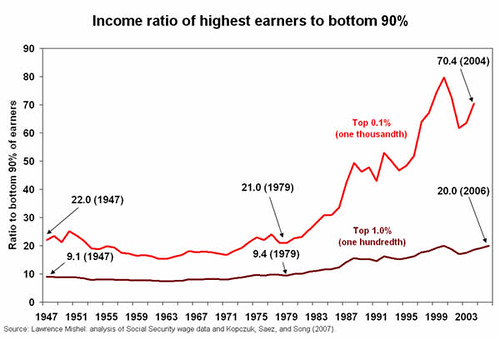
    Inequality in the United States continues to worsen. Huge gains at the top of the income scale have been fueled by, among other things, a surging inequality in wages (illustrated in the chart below). The ratio of the wage income of the top 1% of earners to that of the bottom 90% more than doubled between 1979 and 2006, increasing from a ratio of 9.4-to-1 to 19.9-to-1. [...]

    But when it comes to the wage income of the highest of the high earners, the staggering gap has become a chasm: in 2004 the upper one-tenth of 1% earned 70.4 times as much as the average person in the bottom 90% of the income scale. Just 25 years earlier in 1979, the ratio that was only 21.0-to-1. In other words, in 1979 it took the highest-paid earners 12.4 days to make what most other earners did in a year, but by 2004 that feat was accomplished in a mere 3.7days.
    wage inequality No wonder the University of Michigan's latest survey shows consumers are growing more pessimistic.
    The consumer sentiment index fell to 56.4 in June from 59.6 in May and 56.6 in mid-June. It's the lowest since 1980 and the third-lowest reading in the 56-year history of the survey.
    Also...
    "Moreover, gas prices have risen to an all-time peak, food prices posted the largest increases in decades, home prices have fallen faster than any time since the Great Depression, and there has been widespread distress associated with foreclosures," the report added.
    You know conditions are bad when middle-class professionals resort to sleeping in their cars.

    Wednesday, June 25, 2008

    Disability experts or cronies?

    Pres. Lyndon Johnson signed the Architectural Barriers Act in 1968 so buildings would be accessible to people with disabilities, and forty years later Washington still can't get it right.
    Disabled employees at Department of Transportation headquarters are most unhappy these days with their new digs down by the Navy Yard in Southeast Washington.

    Agency officials say the building -- the first entirely designed and constructed for a federal agency since 9/11 -- was built with guidance from disability experts and help from the U.S. Access Board and the General Services Administration.

    But dozens of employees with disabilities began to have problems -- some caused by security precautions -- as soon as the 6,000 workers moved in last summer. There were several safety issues, such as fire alarms without blinking lights for the hearing-impaired, and there were doors that required too much strength to open.

    Employees were especially frustrated by cafeteria tray slides that are so high that employees who use wheelchairs cannot reach their food, a violation of standards and a constant annoyance.
    Who was their disability expert? Michael Heckuva-Job Brown? I bet he/she made sure employees could get to their desks to do their work though. Eating in the cafeteria? Not a priority.

    I wonder if it occurred to anyone to ask the disabled employees for feedback and suggestions. Who better to evaluate accessibility than a disabled person?

    To make matters worse, Assistant Secretary for Administration Linda Washington sent an e-mail with "an outline of how cafeteria staff and DOT employees needing assistance can work together to provide employees with a positive experience" getting their meals. These were some of her suggestions:
  • When in the cafeteria [employees needing assistance] should let a cashier... know by politely requesting assistance.

  • Whenever possible, employees are encouraged to visit the cafeteria during 'non-peak' times to ensure the most efficient use of their time and prompt service. This would be prior to 12:00 pm and after 1 pm.

  • Employees can also consider visiting the cafeteria with a co-worker.
  • Someone near and dear to me is disabled, so I feel qualified to translate:
  • Disabled employees are normally rude, so this is a reminder to them to use some manners.

  • Disabled employees (who didn't create this problem) create a lot of work for the cafeteria staff during peak hours. They should come in early or eat late so they don't inconvenience anyone.

  • If a disabled employee can impose on a co-worker to help them get their food, all the better for us.
  • As you might have guessed, the department started sensitivity training after that e-mail went out. I hope part of that training includes eating in the cafeteria during "non-peak" times. I bet they'll get an earful from the disabled employees eating with them!

    Thursday, June 19, 2008

    Blackwater Seeks Shari'a Law Defense

    I've gotta hand it to Blackwater Worldwide. They get more free publicity than John McCain. The latest news is courtesy of Voice of Mordor:
    Erik Prince (prince in name, not in nature), brother-in-law to the leaseholders of the Michigan Republican party, is fighting a lawsuit against his mercenary business in Afghanistan, brought by widows of three American soldiers who died when a plane owned by a sister corporation to Blackwater, Presidential Airways [crashed].

    The companies lawyers are arguing before a US federal court that Shari'a law should be applied, and not the current legal standard found in the United States of America.
    Why is Blackwater seeking to hide under a burqa to have the judge apply Islamic law? Because Shari’a law does not hold a company responsible for the actions of employees performed within the course of their work. Blackwater would be off the hook and could pocket even more money.

    Oh, oh. Now they've opened Pandora's box. Or, as Attaturk at Firedoglake said:
    Don't let too many Republicans know this, but Shari'a law is apparently great for business and bad for the most evil people on earth, not Al Qaeda silly, AMERICAN TRIAL LAWYERS. [...]

    If this becomes well-known, the GOP's corporate base will become fundamentalist Muslims faster than you can say Mecca Oil & Gas.


    (Cross-posted at BFM.)

    Wednesday, June 18, 2008

    Defense contractor loophole closed

    According to the AP, President Bush closed a loophole yesterday that defense contractors had been using to avoid paying millions of dollars in payroll taxes. [emphasis mine]
    Bush signed into law the Heroes Earnings Assistance and Relief Tax Act, which provides tax relief for military families. Included in the legislation is a provision that would treat foreign subsidiaries of U.S. government contractors as American employers. That means they now have to pay the taxes that finance Social Security and Medicare programs. [...]

    Lawmakers wanted to end the practice, which has become widespread among American businesses. The Senate Finance Committee estimates that thousands of companies have registered in the Caymans to dodge taxes. The losers, the committee said, are ordinary Americans who foot a larger share of the bill to pay for programs that benefit the elderly and the disabled.
    In an example of how much tax revenue was being lost, the Boston Globe reported in April that Kellogg, Brown, and Root, which receives an estimated $16 billion a year for defense contracts in Iraq, avoided close to $100 million a year in payroll taxes by hiring workers through foreign shell companies. That's a large chunk of the nearly $846 million in revenues that The Joint Committee on Taxation estimates will be brought in over the next 10 years by shutting that loophole.

    I'm not sure if this will affect Blackwater Worldwide since they're headquartered in Moyock, N.C., but it should since they're violating IRS laws too according to Rep. Henry Waxman.
    In a letter to Erik Prince, the Chairman of the Prince Group, which owns Blackwater, Rep. Henry Waxman wrote:

    "I have received documents which suggest that Blackwater may have engaged in significant tax evasion. According to an IRS ruling in March 2007, Blackwater violated federal tax laws by treating an armed guard as an “independent contractor.” The implication of this ruling is that Blackwater may have avoided paying millions of dollars in Social Security, Medicare, unemployment, and related taxes for which it is legally responsible.
    And according to McClatchy Newpapers:
    Waxman’s staff looked at the most recent State Department contract and estimated that between May 2006 and March 2007, Blackwater avoided paying $15.5 million in Social Security and Medicare taxes and $500,000 in unemployment taxes.
    That's a lot of tax money they owe the country, but Blackwater can afford it. Since 2001, they've been granted federal contracts worth more than $1 billion - contracts that are being paid for by taxpayers.

    As Sen. John Kerry said earlier this year, "Failing to contribute to Social Security and Medicare thousands of times over isn't shielding the taxpayers they claim to protect, it's costing our citizens in the name of short-term corporate greed."


    (Cross-posted at Blogging for Michigan.)

    Monday, June 16, 2008

    Obama talks about fair trade

    Obama addressed more than 1,000 people at Flint's Kettering University today. Christine from Blogging for Michigan attended and took some pictures that you can check out, and I helped do some live blogging and posted my comments there too.

    Obama's speech was: "Renewing American Competitiveness." How appropriate for Flint and Michigan in general. Manufacturing jobs have been leaving here for years and being sent to places like Mexico and China, and along with those jobs went pensions and health care. Workers are ready for change because, as Obama noted, we've "lost confidence in that fundamental American promise that our children will have a better life than we do."

    Click the link above to read his speech. There's something in there for everyone. Obama touches on health care (he states he will push for universal coverage), green jobs and energy policy, broadband access, education (college education must not be a privilege of the few – it should be a birthright of every single American), jobs, trade and more. Because trade is responsible for decimating manufacturing jobs here in Michigan, I pulled out that part of his speech for you to read.
    But even as we welcome competition, we need to remember that our economic policies must be supported by strong and smart trade policies. I have said before, and will say again – I believe in free trade. It can save money for our consumers, generate business for U.S. exporters, and expand global wealth. But unlike George Bush and John McCain, I do not think that any trade agreement is a good trade agreement. I don't think an agreement that allows South Korea to import hundreds of thousands of cars into the U.S., but continues to restrict U.S. car exports into South Korea to a few thousand, is a smart deal. I don't think that trade agreements without labor or environmental agreements are in our long term interests

    If we continue to let our trade policy be dictated by special interests, then American workers will continue to be undermined, and public support for robust trade will continue to erode. That might make sense to the Washington lobbyists who run Senator McCain's campaign, but it won't help our nation compete. Allowing subsidized and unfairly traded products to flood our markets is not free trade and it's not fair to the people of Michigan. We cannot stand by while countries manipulate currencies to promote exports, creating huge imbalances in the global economy. We cannot let foreign regulatory policies exclude American products. We cannot let enforcement of existing trade agreements take a backseat to the negotiation of new ones. Put simply, we need tougher negotiators on our side of the table – to strike bargains that are good not just for Wall Street, but also for Main Street.
    I think that last sentence makes an important point. It's too late to put the genie back in the bottle and rescind NAFTA and other trade agreements, but there's no reason we can't change those agreements so that labor gets their fair share of the pie too.

    This is how the system works now according to Ezra Klein:
    Put broadly, opening ourselves up to trade is really good for people who buy things, and less good for people who make things. Now, a lot of folks both buy and make things, so the story is complicated. But one reason the elite classes are so hegemonically enamored with trade is that they don't really make anything at all, and so experience none of the downsides of trade. As Dean Baker likes to point out, we've structured our trade deals such that unskilled manufacturers face a lot of international competition while reporters, say, face almost none.
    If we really value all work in this country, then tweaking these trade agreements is the only right thing to do.