Tuesday, May 18, 2010

Talk about throwing people under a bus

Let me rephrase that title: Talk about throwing people under a wheelchair. This comes from an interview with Tea Party favorite Rand Paul in Lexington over the weekend. Paul is running for the U.S. Senate in Kentucky.
Paul was asked whether he supports the Americans with Disabilities Act, the landmark 1990 legislation that established a prohibition of discrimination on the basis of disability. Paul said he advocates local governments to decide whether disabled individuals deserve rights. Requiring businesses to provide access to disabled people, Paul argued, isn’t “fair to the business owner.”
Nope, it's not fair. Business owners should spend their money on political candidates like Paul instead of disabled people just trying to make a living.

Even more bizarrely, Paul believes his suggestion is nothing more than common sense:
PAUL: You know a lot of things on employment ought to be done locally. You know, people finding out right or wrong locally. You know, some of the things, for example we can come up with common sense solutions — like for example if you have a three story building and you have someone apply for a job, you get them a job on the first floor if they’re in a wheelchair as supposed to making the person who owns the business put an elevator in, you know what I mean? So things like that aren’t fair to the business owner. [...]
So, in Paul's opinion, it makes more sense to physically isolate someone in a wheelchair from his/her coworkers on the third floor. He should have been honest and said what he really meant - their desks should be placed in the boiler room or a corner of the janitor's closet where they'll be out of sight of "normal" people.

Honestly, this is one of the more despicable things I've heard from conservatives/teabaggers lately, and there's been a lot of terrible stuff said about immigrants, gays, Muslims, blacks, etc. One would almost think they want to achieve some sort of racial purity.

Update: This article from Bloomberg Businessweek highlights why the disabled need the ADA:
A federal report castigated a Texas company for abusing and underpaying several mentally disabled men who were housed in a ramshackle building while working at an Iowa turkey processing plant.

The report from the Equal Employment Opportunity Commission said Henry's Turkey Service underpaid the men at least $1 million over three years, verbally and physically abused them, and committed several major violations of the Americans with Disabilities Act, The Des Moines Register reported Friday.
It all boiled down to greed.
The report found that West Liberty Foods paid Henry's Turkey Service as much as $11,000 per week for the disabled men's labor. Henry's Turkey Service then paid the men a combined total of between $340 and $500 per week, or about 41 cents an hour, The Des Moines Register reported.


(Cross-posted at Blogging for MI.)

Wednesday, May 05, 2010

McCotter's Slanted Newsletter On Health Care Costs

From Thad McCotter's latest newsletter comes this ominous news:
On April 22, 2010, The Centers for Medicare and Medicaid Services (CMS) released a new analysis of President Obama’s government health care plan, confirming our nation’s health care costs will increase rather than decrease and violating a pledge the President made to the nation on September 10, 2009.
McCotter then went on to list many of CMS's negative conclusions without noting the positives, and he also neglected to provide analysis explaining the difference between the CBO's earlier estimate and this one. Fortunately, Ezra Klein provided the facts:
The Congressional Budget Office's estimates look at the deficit. CMS is looking at total national health expenditures. This often confuses people into thinking that there's conflict between the two sets of numbers when there isn't: CBO says that federal spending is going to go up to pay for the coverage expansion, but that savings and revenue will go up by even more, leading to a net reduction in the federal deficit.

CMS is looking only at the spending side. And here's what it finds: In 2019, implementation of the Affordable Care Act will reduce the ranks of the uninsured by 34 million people and increase nation health expenditures by 1 percent.

One percent.

And that 1 percent is actually 1 percent and falling: When the legislation is fully implemented in 2016, the spending increase will be 2 percent. But cost controls kick in over those years and bring it down to 1 percent. Assuming the trend holds, the second decade will see national health expenditures fall below what spending would've been if the bill hadn't passed.
Or, to put it in dollars and cents (emphasis added):
Third Way, the centrist policy outfit, sent over its own analysis of the data. "The fact is that by 2019, national health spending per insured person will be $15,132 compared to $16,812 without the new law," they write. "That’s 10 percent less spending per insured person than it would have been, according to the actuary’s report."
That study suddenly doesn't look so bad. We'll be insuring 34 million people and spending less money than we would have been if nothing had been done. That sounds like a good deal to me.


(Cross-posted at Blogging for Michigan.)

Tuesday, April 27, 2010

Give me your tired, Your poor...

Your huddled masses yearning to breathe free, The wretched refuse of your teeming shore.

Something tells me Republicans can't keep a straight face when they read those words on the Statue of Liberty. The GOP could care less about the less fortunate among us, and just the thought of having to help the "wretched" must send chills up their spines. As evidence, consider their recent track record: NO to health care reform. YES to protecting Wall Street. And perhaps the most egregious example is Arizona, where they recently passed an immigration bill that makes them look more like a police state than a democracy.

And don't forget the Tea Party. Republicans have gone out of their way to promote and defend these people because they're primarily white, wealthy men - a.k.a. their base.

The GOP may claim they don't have a double-standard when it comes to race in this country, but Alternet asks us to imagine this: What If the Tea Party Were Black?
Imagine that hundreds of black protesters were to descend upon Washington DC and Northern Virginia, just a few miles from the Capitol and White House, armed with AK-47s, assorted handguns, and ammunition. And imagine that some of these protesters — the black protesters — spoke of the need for political revolution, and possibly even armed conflict in the event that laws they didn’t like were enforced by the government? Would these protesters — these black protesters with guns — be seen as brave defenders of the Second Amendment, or would they be viewed by most whites as a danger to the republic? What if they were Arab-Americans? ...

Imagine that a rap artist were to say, in reference to a white president: “He’s a piece of shit and I told him to suck on my machine gun.” Because that’s what rocker Ted Nugent said recently about President Obama.
You get the picture. Republicans have a double-standard, and so do tea party members. How else to explain their silence about Arizona's immigration law? I'd like to hear them answer this question that someone asked over at Washington Monthly:
Shouldn't the tea party crowd be having a cow over this new immigration bill that Arizona just passed? Doesn't that sound like big government tyranny to them? Giving the police the power to demand "papers" from someone just on their own suspicion?
I somehow doubt we'll see them marching in the street in defense of their Hispanic brothers and sisters. They only care about their own sorry, white butts. This is what "white privilege is all about" (as anyone who lived through the civil rights era knows only too well):
The ability to threaten others, to engage in violent and incendiary rhetoric without consequence, to be viewed as patriotic and normal no matter what you do, and never to be feared and despised as people of color would be...
Recent events - and votes - tell us who Republicans really represent: White America, the wealthier the better.


(Cross-posted at Blogging for Michigan.)

Friday, April 23, 2010

A Recipe for Scrambled Eggs - Republican Style

When I read Eclectablog's post about ousted Congressman Walberg's town hall meetings focused on repealing the recently passed health care bill, I couldn't help but wonder if Walberg liked Sue Lowden's "chickens for checkups" idea too. After all, Walberg thinks it's perfectly acceptable for the uninsured to get their health care by walking into an emergency room. Yep, that's a cost effective way to provide health care to people - not. Even Mitch McConnell admits it's a bad idea:
It's not the most efficient way to provide it. As we know, the doctors in the hospitals are sworn to provide health care. We all agree it is not the most efficient way to provide health care to find somebody only in the emergency room and then pass those costs on to those who are paying for insurance.
Okay, so we all know Walberg's idea is lame, but what about this "chicken for checkups" idea? Could it work? Personally, I live in a condo and I doubt the association board would approve a chicken coop outside my door, but even assuming they agreed, would my doctor take a chicken in lieu of cash? Are there even enough chickens in the world to cover health care expenses? According to TPM, absolutely not. "There aren't enough chickens in the world -- let alone the United States -- to cover the costs of health care in this country alone."

They crunched the numbers so we wouldn't have to:
Total U.S. health care costs in 2008: $2.3 trillion
US population: About 300 million
Average cost of health care per person: $7,681
Average weight of a chicken: 5.9 lbs
Market price per pound: 85 cents
Average spot price per chicken: $5.02
Average number of chickens per resident needed to cover health care costs: 1,530 chickens
Total number of chickens needed to cover United States health care costs: 459 billion chickens
Estimated worldwide chicken population: 16 billion chickens
Current worldwide chicken shortage to cover U.S. health care: 443 billion cluckers
Cluck, cluck. It looks like Lowden and Walberg are both peddling a bunch of chicken poop when it comes to health care reform.

Wednesday, February 03, 2010

A Valentine Story: Republicans + Teabaggers

I've always felt that teabagger candidates and protesters were out of touch with mainstream Americans, but now we have a poll showing just how far off the cliff they've fallen. Or, as this HuffPo article put it, this DKos/Research 2000 poll of more than 2,000 self-identified Republican voters illustrates the incredible paranoia enveloping the party. Some results:
39 percent of Republicans believe Obama should be impeached, 29 percent are not sure, 32 percent said he should not be voted out of office.

36 percent of Republicans believe Obama was not born in the United States, 22 percent are not sure, 42 percent think he is a natural citizen.

31 percent of Republicans believe Obama is a "Racist who hates White people" -- the description once adopted by Fox News's Glenn Beck. 33 percent were not sure, and 36 percent said he was not a racist.

24 percent of Republicans believe Obama wants "the terrorists to win," 33 percent aren't sure, 43 percent said he did not want the terrorist to win.

23 percent of Republicans believe that their state should secede from the United States, 19 percent aren't sure, 58 percent said no.

53 percent of Republicans said they believe Sarah Palin is more qualified to be president than Obama.
Talk about being disconnected from reality. The media really needs to start getting tough with this group and their enablers. When high profile Republicans are quoted in newspapers saying they don't know "whether President Obama is a citizen of the United States or not," and candidates for office devote their time speaking to tea party crowds, they validate this kind of irrational, paranoid thinking, and by extension make themselves look irrational too.

Wednesday, January 27, 2010

Good News/Bad News On The Environmental Front

First, from the NYT, comes the bad news.
A new ranking of the world’s nations by environmental performance puts some of the globe’s largest economies far down the list, with the United States sinking to 61st and China to 121st.

In the previous version of the Environmental Performance Index, compiled every two years by Yale and Columbia University researchers, the United States ranked 39th, and China 105th.
The top performer was Iceland, which gets nearly all of its power from renewable sources, followed closely by Switzerland, Sweden, Norway and Finland.
“Countries that take seriously the environment as a policy challenge do improve, and those that don’t deteriorate,” said Daniel C. Esty, director of the Yale Center for Environmental Law and Policy, who oversees the index project.
The paper does note that because most of the data is from 2007 and 2008, "the index does not fully reflect new efforts by the Obama administration" to improve environmental performance. It also notes that the U.S. scores well in forestry and safe drinking water, but our ranking is abysmal because we score low in areas like heat-trapping emissions and urban air pollutants.

Increasing renewable energy would help decrease our emissions. The good news is that we're advancing quickly in one area - wind power.
Despite a crippling recession and tight credit markets, the American wind power industry grew at a rapid pace in 2009, adding 39 percent more capacity. The country is close to the point where 2 percent of its electricity will come from wind turbines.
According to the NYT, that's up from virtually nothing a few years ago, and they reported that the American Wind Association said "the amount of capacity added last year, 9,900 megawatts, was the largest on record, and was 18 percent above the capacity added in 2008, also a banner year."
The nation’s wind turbines generate enough electricity to power the equivalent of 9.7 million homes, according to the report. Last year, Texas consolidated its lead as the nation’s top wind producer, with a total capacity of 9,410 megawatts, about three times more than the second-largest producer, Iowa. They were followed by California, Washington and Minnesota.
And guess what the AWEA credits for the growth of wind power? “The U.S. wind industry shattered all installation records in 2009, and this was directly attributable to the lifeline that was provided by the stimulus package,” said Denise Bode, the trade association’s chief executive.

However, as extraordinary as growth has been in this area, they also point out that it would be better if Congress would pass a a federal mandate requiring that a certain percentage of power come from renewable sources. Mandates already exist throughout the European Union and in China, and in the U.S. 29 states have adopted a renewable power standard, including Michigan, which set a standard of 10% of electricity from renewable resources by 2015.
“The wind manufacturing sector has the potential to employ many more Americans in green jobs, but without a renewable electricity standard to provide a long-term market, the sector will be slow to grow,” the trade group said in its report.
I'm so tired of the U.S. falling behind in everything but the strength of our military. The U.S. should be leading the way in this area instead of falling further behind. And although we're fortunate to have Gov. Granholm and other Democrats with foresight and vision pushing for higher standards, we're still stuck with obstructionist Republicans who would rather help their fossil fuel cronies than our environment. Just imagine how much better our country could be if Republicans didn't always stand in the way.

(Cross-posted at Blogging for MI.)

Thursday, January 21, 2010

Supreme Court Overturns Corporate Campaign Spending Limits

The Supreme Court just struck down a key campaign-finance restriction that bars corporations from pouring money into political ads, and the ruling divided the court along ideological lines with the newest justice, Sonia Sotomayor, joining the liberal wing in dissent.
The ruling is a victory for Washington-based Citizens United, the corporation that created “Hillary: The Movie.” The 90-minute film, which creators sought to air on a video-on- demand channel during Clinton’s 2008 presidential campaign, features interviews with a number of prominent critics of the New York senator, including Ann Coulter and Newt Gingrich.
Guess who helped fund Citizens United? Wealthy sources, like the Betsy & Dick DeVos Foundation.

So, what's at stake? This is what a constitutional law expert had to say.
"American citizens have repeatedly amended the Constitution to defend democracy when the Supreme Court acts in collusion with democracy's enemies, whether they are slavemasters, states imposing poll taxes on voters, or the opponents of woman suffrage. Today, the Court has enthroned corporations, permitting them not only all kinds of special economic rights but now, amazingly, moving to grant them the same political rights as the people. This is a moment of high danger for democracy so we must act quickly to spell out in the Constitution what the people have always understood: that corporations do not enjoy the political and free speech rights that belong to the people of the United States." [emphasis added]
Voter Action, Public Citizen, The Center for Corporate Policy, and the American Independent Business Alliance have started an organization - Free Speech for People - in an effort to correct the damage the Supreme Court has done to the First Amendment, and the only way that's possible is to pass a constitutional amendment of our own that puts people ahead of corporations.

Please read their resolution and sign your name in support. What the Supreme Court did today dramatically dilutes the vote and the voice of every American who does not control a large corporate treasury. And the decision unleashes billions of dollars in corporate money to dominate legislatures and elections. The problem actually goes beyond money in politics and elections, "The courts have used the fabrication of the First Amendment corporate rights doctrine to strike down a range of democratic enactments in recent years, from those concerning clean and fair elections; to environmental protection and energy; to tobacco, alcohol, pharmaceuticals, and health care; to consumer protection, lottery, and gambling; to race relations, and much more."

Free speech is for people — not corporations. Please join their campaign and protect our democracy.

(Cross-posted at Blogging for MI.)

Tuesday, January 19, 2010

Broadband Suffers From Lack Of Big Government

Yet another area where the U.S. trails the rest of the world. Via Paul Waldman at TAPPED:
But a new report on global broadband shows that the country that invented the Internet, the microchip, and most of what makes our global digital village possible ranks a pathetic 18th in broadband speeds. The top spot is taken, as usual, by South Korea, where their smoking fast connections give them an average speed over three times as fast as what our pokey little modems give us. We also don't score too well when it comes to broadband penetration (the proportion of households that have broadband, as opposed to the actual speed people are getting). Our slow broadband is also really expensive. So that's nice.
We trail countries like Romania, Sweden and the Czech Republic. And on a year-to-year basis, all the countries in the top 10 saw a boost in speed. Ireland topped the list with a 73 percent gain. What about the United States? We were hit by a 2.4 percent decline in speed.

Waldman says they are multiple reasons we lag so far behind, but "the most important one is probably that we don't have enough big government. With a combination of public infrastructure investments and regulations forcing ISPs to share lines, other countries have driven down prices and driven up speeds."

Republicans have been too busy giving tax breaks to the rich and taking care of their corporate cronies over the past couple of decades to care about our public infrastructure. Thankfully, the stimulus bill President Obama signed in February provides $7.2 billion for projects that will increase the spread of broadband. He also instructed the FCC to come up with a plan to achieve universal high-speed access.

Those are good first steps, but something also needs to be done about bringing the price down or making it available for free to low income individuals. Voters depend on the media for information about our democracy and that information shouldn't be limited only to those who can afford to buy it.

Thursday, January 14, 2010

National Tea Party Convention Embraces Right-Wing Media

The teabaggers appear to be playing by the George Bush/Republican playbook. Via Think Progress:
Having previously announced that the National Tea Party Convention would be closed to the press, organizers announced yesterday that they would reverse course. However, the Nashville Post reports that only five media organizations will receive credentials for the entire convention, and they all conveniently happen to be right-wing outlets:

The five approved outlets are: Fox News, Breitbart.com, Townhall.com, World Net Daily and The Wall Street Journal. All five are widely considered to be Right-leaning organizations.

The press release explains that the requests for credentials have been overwhelming and that to preserve the nature of the event they are limiting press availability.
They also used the excuse that as "we have set expectations that this is a working convention, we have tried not to make it a media event.”

Right...because Fox News is always so circumspect and diplomatic when it reports the news and they would never turn any event into a media circus.

A media event is exactly what the teabaggers wanted, and by inviting only these right-leaning organizations their message will be tightly controlled and scripted. Ironically, their website currently claims they believe in "Free Speech." I think they should change that to reflect what they really mean - "Free Speech as told by right-wing media outlets."

Friday, January 08, 2010

Salaries Could Be Squeezed For Some Time To Come

A new CBS MoneyWatch article confirms what Muskegon Critic pointed out the other day: Increased productivity does not translate into prosperity for average Americans.

In fact, MoneyWatch warns that a "combination of short-term factors and long-range changes may conspire to squeeze salaries for some time to come," and annual raises "could be in jeopardy."

So how did we get to this point? It turns out real wages have actually been flat for years.
Looking back, it turns out a decade’s worth of easy credit and faux real estate wealth obscured the fact that incomes for the majority of workers weren’t keeping up. After healthy salary growth of roughly 1.8 percent annually from 1995 to 2000, for example, inflation-adjusted, or real, wages for the median worker remained essentially flat from 2000 until 2007 when the recession started, according to government data (average wages increased roughly 2 percent, but that number is skewed by huge gains at the top). In fact, after the recovery in 2002, notes Shierholz, no real wage growth occurred at all for the median worker — despite an increase in productivity of 11 percent over the seven-year time frame. [emphasis added].
In other words, we've been working our tails off and have little to show for it. So who reaped the productivity gains?
Typically, companies and their shareholders.
And what do experts point to as the reason for our declining prosperity?
Shierholz and other economists attribute the disconnect between wages and output to declining unionization and the need to keep prices low in a competitive global environment.
The "kill the unions" and "outsource everything" crowd accomplished what they set out to do - drive wages down for average Americans. And the scenario for new jobs created doesn't look any rosier.
A 2009 analysis of figures from the U.S. Department of Labor showed that sectors that expanded through this decade have paid an average annual compensation of $55,300, compared with $65,100 for industries that are shrinking. This is partly because many of the newly-created positions are in service industries, which tend to be less organized and have less bargaining power. Think home healthcare and “green” jobs versus auto manufacturing and heavy industry.
In fact, six of the top 10 fastest-growing jobs are low wage.

There are steps Washington can take to start improving living standards for average Americans, but as long as people keep voting for anti-union, globalization embracing politicians, I don't see things changing.

Wednesday, December 30, 2009

Hoekstra Is A Danger To Your Health And Well-Being

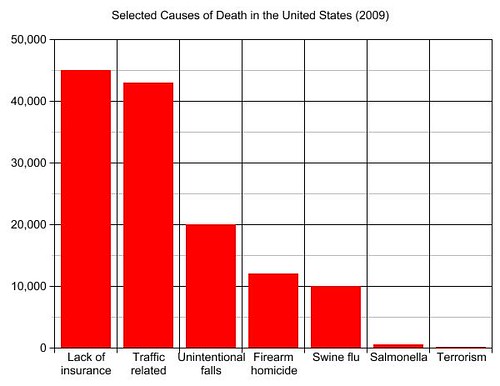
While Hoekstra runs around trying to profit from the attempted bombing over Detroit and score points with teabagger Republicans, it's important to put this incident into perspective. Via Blue Texan at FDL (see his chart below):

Terrorism Still Less Deadly in US Than Lack of Health Insurance, Salmonella
If you count the Ft. Hoot shooting as a terrorist attack, which even the likes of Pantload doesn’t, 16 people have died in the United States as a result of terrorism in 2009. The other three deaths include the Little Rock military recruiting office shooting (1), the Holocaust Museum shooting (1), and Dr. George Tiller’s assassination (1), the last two coming at the hands of right-wing extremists.

On the other hand, 45,000 Americans died because they didn’t have health insurance and 600 died from salmonella poisoning.
Clearly, lack of health insurance is more of a threat to Americans than a terrorist attack, yet Hoekstra voted NO on health care. He's clearly in no position to be shooting off his mouth and calling on the president to "lead in the fight to keep Americans safe" after that vote.

From FireDogLake, causing of death in US

Thursday, December 24, 2009

Merry Christmas!

Here's a Christmas card for all my blogging friends from man's best friend (no, not Joe Lieberman) - and me!

May all your Christmas wishes come true.

Wednesday, December 23, 2009

Senate Health Bill Provides Enormous Help To Poor

Everyone seems to be trashing the Senate's health reform bill. That's fine, dissent is good, but I don't think we should let it blind us to the positives, such as the enormous good the bill will do for the poor and middle class. (Via Jonathan Cohn at TNR.)
This bill would mean Medicaid coverage for an additional 15 million people a year, all of them living below or just above the poverty line. For a sense of scale, that's more than double the entire population now covered by the state Children's Health Insurance Program.

This bill would also subsidize coverage in the exchanges for (roughly) another 15 million people a year, the majority of whom would also qualify as low-income by any reasonable standard.
"Do the math," he says, and we'll see that this bill is "arguably, the single most progressive initiative in a generation."

And if you don't believe Cohn, he asks you to consider what his colleague Harold Pollack at the Huffington Post had to say [emphasis mine]:
Fully implemented, the bill would provide about $200 billion per year down the income scale in subsidies to poor, near-poor, and working Americans.

$200 billion is a big number. It exceeds the combined total of federal spending on Food Stamps and all nutrition assistance programs, the Earned Income Tax Credit, Head Start, TANF cash payments to single mothers and their children, the Department of Housing and Urban Development, and the National Institutes of Health.
That money won't be allocated to wars or tax cuts for the rich, it's going to help the poor and middle class.

Trash the bill if you want, but don't let yourself lose sight of the good it will do.


(Cross-posted at Blogging for MI.)

Monday, December 21, 2009

Bottled Water Tax: "The People Deserve To Get Something In Return"

LG John Cherry has an op-ed in the Detroit News today that talks about his plan to restore the Michigan Promise Scholarship with a water bottle tax. Go read it, but here's the best part (emphasis mine):
Right now, bottlers across the state remove water from our wells essentially for free, and we lack the necessary funding to safeguard this precious resource. In other words, we're losing one resource -- our talented work force -- while giving away another resource, our water, for free.

You don't need a Ph.D. in mathematics to solve this terrible equation. It's time for the bottlers to pay their water bill, just like you and I do. We can use the proceeds from that water bill to fund the education that our young people need to compete, as well as protecting the water resources that Michigan desperately needs.

By conservative estimates, a charge of 10 cents per bottle, paid by bottling companies that operate in Michigan, would raise $118 million per year. The cost of the Michigan Promise Scholarship, on the other hand, is about $100 million per year. Not only would this modest charge on each bottle of water that leaves Michigan raise enough funds to pay for the entire Michigan Promise program, we'd still have $18 million a year to spend on wetlands regulation and other conservation initiatives. [...]

This is the people's water, and the people deserve to get something in return.
Ironically, employers like to point out they need an educated workforce to be successful and profitable, and Nestle, the parent company of Ice Mountain, is no exception.
Like every Michigan employer, we rely on an educated workforce.
Yet Nestle is complaining that Cherry's proposal penalizes Michigan employers, risks jobs, and that bottlers may resort to supplying products from outside the state in order to remain competitive on the price consumers pay for bottled water products.

A Nestle Water Company spokesman also claimed that the tax would nearly double the price consumers paid for a case of water.
"Let's look at the math," said Flaherty. "Most bottled water is purchased in cases of 24 bottles of .5 liter size, for about or less than $4.00 per case -- putting the price per bottle at about 16 cents. A 10-cent per bottle tax on Michigan manufactured products nearly doubles the price for consumers, and would be unsustainable in the highly competitive beverage marketplace.

"Consumers are very savvy, and rarely could be convinced to pay nearly double for Michigan-produced bottle water when lesser-priced options exist," said Flaherty. "I challenge you to ask consumers if they'd pay $6.50 for a case when they can pay less than $4 for the same product made elsewhere."
True, consumers are savvy, but we also care about educating our children. I have a suggestion for Nestle. You pay the 10 cent tax per bottle on the water you currently get for free without passing it on to consumers and in return you'll get an educated workforce, an improved "corporate neighbor" image and the gratitude of citizens who just might go out of their way to buy your product. I'd say that's a win-win for everyone involved. After all, your company admitted that bottled water profits were down in part because of public criticism. Why would you want to anger us even more?

Wednesday, December 16, 2009

Don't Give Up On Health Care Now

I am extremely disillusioned with the shape the healthcare bill has taken, but I'm not willing to say it shouldn't pass and/or we should start over. I'll let Kevin Drum speak for me. He makes a compelling argument for seeing this bill through.
With the public option now out of the healthcare bill, is it still worth passing? Regular readers will be unsurprised that I think the answer is pretty firmly yes—and that liberals who now want to pick up their toys and hand reform its sixth defeat in the past century need to wake up and smell the decaf. Politics sucks. It always has. But the bill in front of us—messy, incomplete, and replete with bribes to every interest group imaginable—is still well worth passing.
Six defeats. Think about that. More from Kevin:
When big legislative efforts go down in flames, they almost never spring back onto the calendar anytime soon — and that's especially true when big healthcare bills fail. It didn't happen in 1936, it didn't happen in 1949, it didn't happen in 1974, and it didn't happen in 1995. What makes anyone think it will happen in 2010?
Drum also makes the point that if healthcare reform dies this year, it dies for a good long time, and Republicans know it. And even though it's not the bill we wanted, it's a good start. Via Ezra Klein:
"This is a good bill," Sen. Sherrod Brown said on Countdown last night. "Not a great bill, but a good bill." That's about right. But the other piece to remember is that more than it's a good bill, it's a good start. With $900 billion in subsidies already in place, it's easier to add another hundred billion later, if we need it, than it would be to pass $1 trillion in subsidies in 2011. With the exchanges built and private insurers unable to hold down costs, it's easier to argue for adding a strong public option to the market than it was before we'd tried regulation and a new competitive structure. With 95 percent of the country covered, it's easier to go the final 5 percent. And with a health-care reform bill actually passed, it's easier to convince legislators that passing such bills is possible.
Here's some other things we'll be getting:
  • Insurers have to take all comers. They can't turn you down for a preexisting condition or cut you off after you get sick.

  • Community rating. Within a few broad classes, everyone gets charged the same amount for insurance.

  • Individual mandate. I know a lot of liberals hate this, but how is it different from a tax? And its purpose is sound: it keeps the insurance pool broad and insurance rates down.

  • A significant expansion of Medicaid.

  • Subsidies for low and middle income workers that keeps premium costs under 10% of income.

  • Limits on ER charges to low-income uninsured emergency patients.

  • Caps on out-of-pocket expenses.

  • A broad range of cost-containment measures.

  • A dedicated revenue stream to support all this.
  • Drum is right. This is still a huge achievement, one that will benefit tens of millions of people in very concrete ways and will do it without expanding our long-term deficit. And he also points out "this is more than Bill Clinton ever did, more than Teddy Kennedy did, more than LBJ did, more than Truman did, and more than FDR did."

    Don't throw in the towel now.

    Thursday, December 10, 2009

    Poll: Let The Wealthy Pay Higher Taxes

    A new Bloomberg poll shows Americans want the government to do something about the economy.
    Americans want their government to create jobs through spending on public works, investments in alternative energy or skills training for the jobless.

    They also want the deficit to come down. And most are ready to hand the bill to the wealthy.

    A Bloomberg National Poll conducted Dec. 3-7 shows two- thirds of Americans favor taxing the rich to reduce the deficit.
    Raising taxes on the rich was popular across party lines too: About half of Republicans back the idea and it is more popular among Democrats and Independents.

    Steve Benen summarized the polls results best:
    In other words, here's a poll showing widespread support for the Democratic economic agenda.
    That's because mainstream America is rational, unlike those teabagger Republicans whose only answer for every problem is cut taxes, cut taxes...


    (Cross-posted at Blogging for MI.)

    Tuesday, December 08, 2009

    Who's More Popular Than Traditional Republicans?

    Teabagger Republicans. According to the latest Rasmussen poll, Republicans have fallen to third place in terms of popularity.
    In a three-way Generic Ballot test, the latest Rasmussen Reports national telephone survey finds Democrats attracting 36% of the vote. The Tea Party candidate picks up 23%, and Republicans finish third at 18%. Another 22% are undecided.
    So are Republicans worried? Nope. Greg Sargent asked for the GOP's leadership view of the poll and this was one senior GOP aide's reply:
    This proves one of the major points that Democrats have tried hard to deny: the Tea Party movement is not some fringe group of ultra-conservatives, it is most popular among independents, many of whom believed President Obama’s campaign promises about doing things differently in Washington, and feel burned by the fact that he has governed in a relentlessly partisan fashion.
    Partisan? Did he really say partisan? Three words: Health care reform. Obama reached out to Republicans and they said NO.

    I think GOP leadership has to spin this in a favorable light. After all, several Glenn Beck inspired Tea Party candidates are causing problems for a number of GOP lawmakers, including John McCain. They're caught between a rock and a hard place. They can't afford to ignore the teabaggers, and they can't afford to embrace them at the risk of losing their moderate members.

    And I don't take too seriously the GOP spokesperson's comment that "the Tea Party movement is not some fringe group." Again, really? What else would you call a group that invited Sarah Palin and Michelle Bachman to speak at their national convention next year. And don't forget about Joe the Plumber.

    I'm sorry, but I have a hard time believing that any independents with a smidgen of commonsense will embrace the teabaggers, the same group that shows up at rallies with guns and posters comparing health care reform to pictures of dead bodies at the Dachau concentration camp. These people are not mainstream Americans, they're extremists.

    And when a fake party "that doesn't have organized candidates or organized fundraising is more highly thought of than one of the two traditionally dominant political parties," that's a sign that Republicans are in big trouble, no matter how much they spin this poll.

    Thursday, December 03, 2009

    All I Want For Xmas Is...

    (Via Fox News Detroit)

    A man in Riverview has an unusual Christmas display on his lawn and the neighbors aren't too happy about it. His signs support national health insurance, but the mom next door is upset because her kids are asking questions. "I just don't think Christmas is the time to make a political statement," she said.

    Fox asks what you think. I say that young man probably speaks for millions of people who would love to wake up to health insurance under their tree on December 25th.

    Wednesday, November 25, 2009

    Holiday Shopping Tips for Progressives

    Happy Thanksgiving everyone! I wanted to pass along a few shopping tips before heading out to spend the holiday with family and friends.

    If you're picking up a bottle of wine for your host or guests, consider buying Wine Spectator’s 2009 Wine of the Year: Columbia Crest’s Cabernet Sauvignon Columbia Valley Reserve 2005. According to FDL, members of the United Farm Workers helped pick the grapes. If you don't like red wine, check out these other labels that use UFW members (as well as other products like strawberries, dates, and almonds).

    Moving beyond Thanksgiving to Black Friday, you can show your support for union workers by clicking here and checking out the box in the left upper corner to find union made products and services.

    Or maybe you want to avoid naughty companies that force their employees to labor long hours under dangerous working conditions for poverty wages? Then Working in These Times advises you to read the "Shop With a Conscience Consumer Guide" from Sweat Free Communities, as well as this Sweatshop Hall of Shame 2010 report that highlights some of the big apparel and textile companies that use sweatshops in their global production. (Ikea, Abercrombie and Fitch, Wal-Mart, Hanes, L.L. Bean, and Kohl's among others.)

    And from Michael Whitney at FDL comes this reminder about shipping your packages:
    UPS is almost entirely union employees (Teamsters), with impressive wages, benefits and treatment for workers. FedEx, on the other hand, doesn’t even consider their employees to be employees, with meager pay, no benefits, no vacation days, and no respect. Check out this handy chart to see the stark difference between how UPS and FedEx treat their employees.
    Finally, before heading out the door, you might want to check out Gizmodo, because no matter where it's made and who makes it, some "deals" really aren't deals at all!

    (I'm so thankful my family likes gift certificates and cash. It makes life much simpler.)

    Monday, November 23, 2009

    Sen. Carl Levin is The Real Deal

    The Republican Party is staking its future on people like Sarah Palin for commonsense solutions to our nation's problems. Meanwhile, Democrats don't have to look any further than Sen. Carl Levin. This is his commonsense approach to paying for the war in Afghanistan.
    Higher-income Americans should be taxed to pay for more troops sent to Afghanistan and NATO should provide half of the new soldiers, said Carl Levin, chairman of the Senate Armed Services Committee.

    An “additional income tax to the upper brackets, folks earning more than $200,000 or $250,000” a year, could fund more troops...

    White House Budget Director Peter Orszag has estimated that each additional soldier in Afghanistan could cost $1 million, for a total that could reach $40 billion if 40,000 more troops are added.

    That cost, Levin said, should be paid by wealthier taxpayers. “They have done incredibly well, and I think that it’s important that we pay for it if we possibly can” instead of increasing the federal debt load, the senator said.
    "Incredibly well" is an understatement. The Bush tax cuts cost almost $2.5 trillion over the decade after they were first enacted and 52.5 percent of the benefits are going to the richest 5 percent of taxpayers. And, of course, we can't forget the war profiteers cronies who made a killing off Iraq, i.e., Blackwater, Halliburton, KBR, etc.

    Had the Bush administration showed some commonsense and opposed tax cuts to pay for increased defense spending, he wouldn't have squandered Clinton's surplus and left office with a record budget deficit of more than $1 trillion.

    Traditionally during wartime, taxes have been raised to pay the costs of war, but Bush and the GOP had some grandiose idea that Iraq's oil would pay for the war. So, they drummed up a lie to get things started and proceeded to cut taxes for their rich cronies, leaving our country in economic shambles.

    So kudos to Sen. Levin and his commonsense approach to paying for the Afghanistan War. Besides, if rich Republicans have to dig into their trust funds to pay for war, it's a pretty sure bet they won't be so quick to support it.

    (Cross-posted at Blogging for MI.)